

You’ve just found a tricky bug. It’s not a complete showstopper, but it could definitely frustrate some users. Now what? Do you log it and move on? Do you tell the developer who wrote the feature? Do you flag it for the project manager? Who ultimately decides if it’s important enough to fix before the release?
The answer to all these questions is: “It depends on the stakeholder.”
In the world of software development, it’s easy to get tunnel vision and think of testing as a simple, two-step process: we find bugs, and developers fix them. But the reality is that the quality of a product is something that a wide variety of people care about, all for different reasons. These people are your test stakeholders. They are the individuals and groups who have a direct or indirect interest in the quality of the product you’re building.
Understanding who these stakeholders are, what they care about, and how to communicate with them is one of the most important non-testing skills a developer or tester can have. It transforms your role from a simple bug-finder into a vital communication hub for product quality. This guide will introduce you to the typical cast of characters and help you understand their unique perspectives on testing.
What is a Test Stakeholder, Anyway?
The simplest definition is that a test stakeholder is anyone who is impacted by the quality of the software or has an influence on the testing process. Think of it like a movie production. The director, the actors, the scriptwriter, the producer who funded the film, and the audience who buys the tickets are all stakeholders. They have different roles and different priorities, but they all have a vested interest in the final movie being a success.
Similarly, in a software project, you have a diverse group of people who are counting on the testing process to give them the information they need to do their jobs and achieve their goals. A crucial first step in any test strategy is to perform a stakeholder analysis—a fancy term for figuring out who your audience is. The list below is a great starting point, but remember that every project is unique. You need to identify the specific people and groups relevant to your context.
Let’s meet the key players.
The Core Team: The People in the Trenches
These are the stakeholders you work with day in and day out. They are closest to the code, the features, and the tests.
Developers, Development Leads, and Development Managers
As a tester, the development team is your closest partner. Their interest in testing goes far beyond just being the recipients of your bug reports.
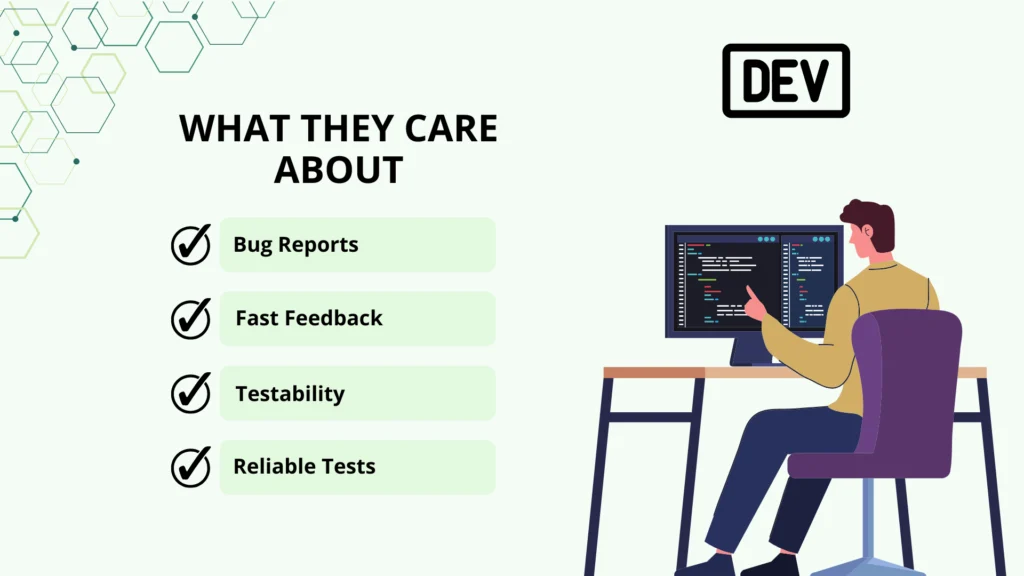
- Their Role: Their primary job is, of course, implementing the system under test. But their role as a stakeholder in quality is much broader. They are responsible for acting on test results (i.e., fixing bugs), but they are also deeply involved in unit testing and are increasingly contributing to the entire testing process through integration and end-to-end tests.
- What They Care About:
- Clear, Reproducible Bug Reports: Time spent trying to reproduce a vague bug report is time not spent building new features or fixing other issues. They need clear steps, logs, and screenshots.
- Fast Feedback: The sooner they learn about a bug, the easier and cheaper it is to fix. A bug found minutes after a code commit is much better than one found weeks later.
- Testability: They have a vested interest in writing code that is easy to test. Complex, untestable code is a nightmare for everyone.
- Reliable Tests: When a test fails, they need to trust that it’s because of a real bug, not a flaky or poorly written test. False alarms erode confidence and waste time.
- How to Engage Them: Treat developers as your allies in quality, not your adversaries. Foster a collaborative environment. Sit down together to reproduce a difficult bug. Involve them when you’re planning your test strategy for a new feature—they often have the best insights into a component’s potential weak spots. The goal is a partnership, not just a handoff.
Testers, Test Leads, and Test Managers
This is us! It might seem strange to list ourselves as stakeholders, but we absolutely are. We have a unique and central interest in the testing process.
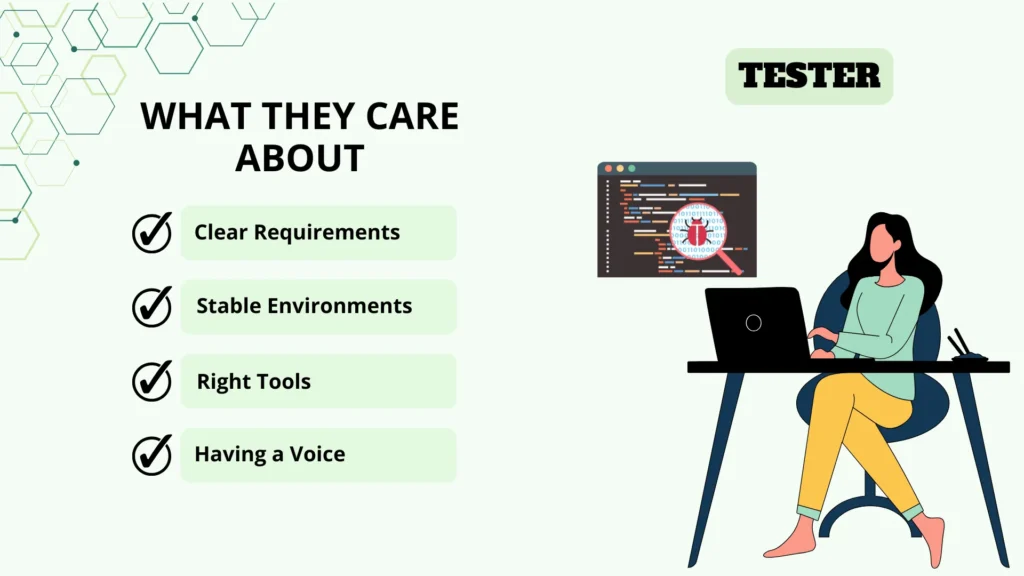
- Our Role: We are the specialists responsible for quality assurance. We prepare testware, which is a broad term for all the artifacts we create: developing test plans, conducting requirements analysis to ensure they are testable, performing test design and test execution, managing defect tracking and reporting, building and maintaining test automation, and handling test progress reporting.
- What We Care About:
- Clear Requirements: We can’t test what we don’t understand. Vague or constantly changing requirements are a primary source of frustration and ineffective testing.
- Stable Environments: An unstable or misconfigured test environment can bring all testing to a grinding halt and is one of the most common testing bottlenecks.
- The Right Tools: Having the right tools for test management, automation, and performance testing makes our work more efficient and effective.
- Having a Voice: We care about our findings being taken seriously and having our risk assessments considered in release decisions.
- How to Engage Ourselves: Our responsibility is to be the champions of quality. This means providing clear, objective, and timely information to all the other stakeholders. We need to translate our technical findings into language that each stakeholder can understand and act upon.
The Visionaries and Decision-Makers
This group is focused on the bigger picture: the project’s goals, budget, and timeline. They rely on the test team to help them manage risk and make strategic decisions.
Project Managers, Product Owners, and Business Users
These stakeholders are responsible for ensuring the team is building the right product and that it delivers value to the business.
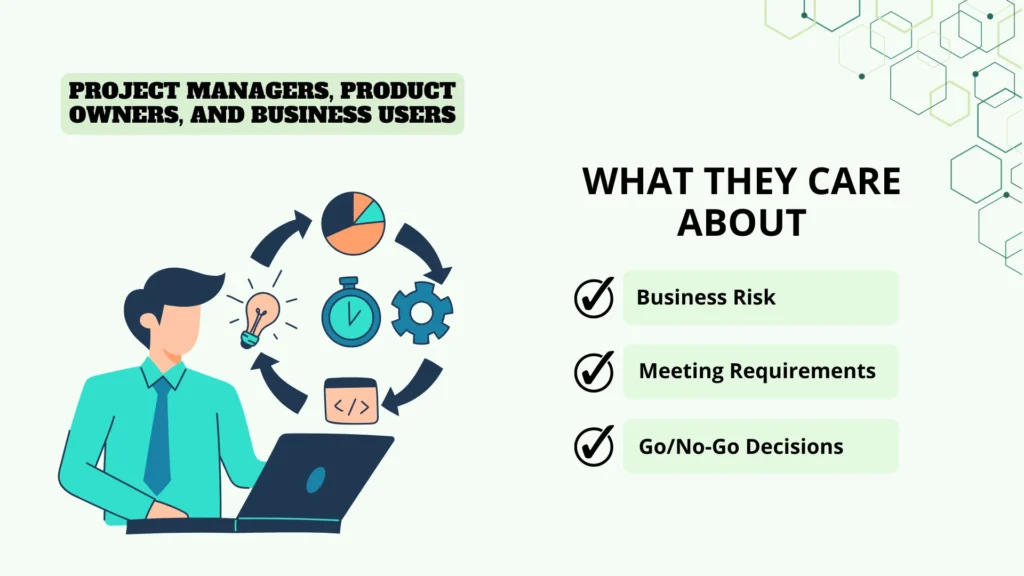
- Their Role: They are often the source of truth for the project’s vision. They specify requirements, define the requested level of quality, and recommend required coverage based on perceived risks. For example, they might tell you that the checkout process is a high-risk area that needs 100% test coverage, while the “About Us” page is a low risk. They also review work products, participate in User Acceptance Testing (UAT), and ultimately make decisions based on test results.
- What They Care About:
- Business Risk: Their main question is, “What is the risk to the business if we release the software in its current state?” They need to balance quality with deadlines and budget.
- Meeting Requirements: Does the product do what it’s supposed to do from a business perspective?
- Go/No-Go Decisions: They rely on your test completion report to make the final call on whether to release the software.
- How to Engage Them: Speak their language. Avoid technical jargon. Instead of saying “35 out of 1,200 automated tests failed,” say “The new inventory management module is showing a high number of errors, and we assess the risk of deploying it as high.” Use dashboards and summaries that clearly communicate risk levels for key features. Involve them early in test planning to get their input on high-risk areas.
The Guardians of Production
Once the software is released, it’s no longer just a development project; it’s a live service. This is where the Operations team comes in.
The Operations Team (Ops, SRE, DevOps)
These are the people who have to support, maintain, and keep the application running in the production environment. They are the ones whose pagers go off at 3 AM if something breaks.
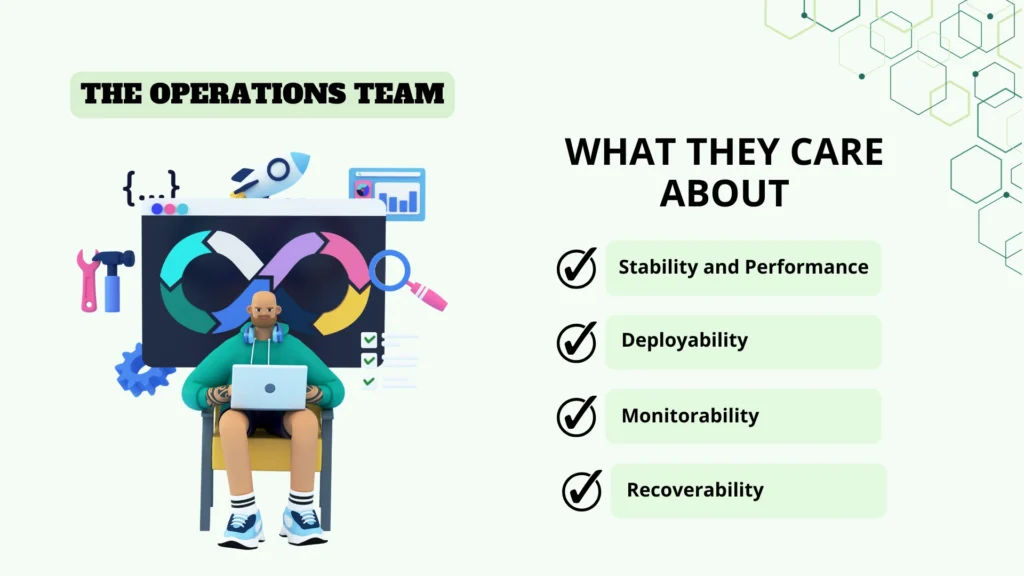
- Their Role: They are primarily engaged in operational acceptance testing to ensure the system is ready for the real world. They focus on aspects that are crucial for a stable production environment and are key contributors to defining non-functional requirements.
- What They Care About:
- Stability and Performance: Will the system crash under heavy load? Does it have memory leaks?
- Deployability: How easy is it to deploy a new version? More importantly, how easy is it to roll back a bad deployment?
- Monitorability: Can they tell if the system is healthy? Does it produce meaningful logs and metrics that can be fed into monitoring tools?
- Recoverability: If the system fails, can it be restored from a backup quickly and reliably?
- How to Engage Them: Involve them early and often. Don’t wait until the day before release to show them the application. Share your performance and load testing plans with them. Give them access to your test environments so they can practice deployments. Ask for their input on what makes a service “production-ready.” A good relationship with the Ops team is one of the best ways to ensure a smooth and drama-free release.
The Ultimate Judges
At the end of the day, all of the stakeholders above are working in service of this final, most important group.
Customers and Users
These are the people the software is built for. It’s important to distinguish between the two.
- Their Role: Customers are the ones who purchase the product (e.g., the company paying for the enterprise software). Users are the ones who directly utilize it day-to-day (e.g., the employees of that company). Both are essential for defining requirements, and they are the ultimate validators of quality. They should be involved in User Acceptance Testing (UAT) to confirm that the product truly meets their needs.
- What They Care About: They have zero interest in your internal processes. They don’t care about your test coverage or your CI/CD pipeline. Their concerns are simple and direct:
- Does this software solve my problem?
- Is it easy and intuitive to use?
- Is it fast, reliable, and secure?
- Is it worth my time and/or money?
- How to Engage Them: Direct user feedback is gold. User Acceptance Testing (UAT) is a formal way to get this feedback, where real users are asked to perform their normal tasks in a pre-production environment. Beta programs, user interviews, and feedback forms are other excellent channels. The insights you gain from watching a real user struggle with a feature that seemed perfectly logical to the development team are invaluable. This feedback is the ultimate reality check for your entire team.
Bringing It All Together
Understanding these different perspectives is the first step. The next is to use that understanding to communicate effectively. This is where a simple stakeholder analysis comes in. For each project, take a moment to:
- Identify: List the specific names of the people or teams who fill these stakeholder roles for your project.
- Analyze: For each one, jot down what you believe their main interests and concerns are regarding quality. How do they prefer to receive information—a formal email, a Slack message, a weekly meeting?
- Plan: Based on your analysis, create a simple communication plan. This clarifies who gets what information and when, ensuring that everyone stays informed and aligned.
Testing is fundamentally a collaborative effort. When you understand who your stakeholders are and what they care about, you can provide the right information to the right people at the right time. You stop being just a person who runs tests and become a central figure who empowers the entire team to build a better product.