
Ever felt that pre-release panic? That sinking feeling when a critical bug pops up just hours before launch? We’ve all been there. It often stems from a lack of a clear game plan. This is where test planning comes in—not as a boring, bureaucratic exercise, but as your strategic map to building quality software with confidence.
For developers and testers, test planning isn’t someone else’s job; it’s a collaborative process that empowers us to work smarter, not harder. It’s about transforming our testing from a reactive, chaotic scramble into a proactive, focused, and effective quality-building activity.
This guide will walk you through the essential activities of test planning. We’ll break down how to understand your project’s context, tackle risks head-on, define a winning test strategy, and get everyone on the same page. Think of this as your handbook for turning test planning into one of the most valuable tools in your development lifecycle.
What is Test Planning, Really?
At its core, test planning is the activity of figuring out what you need to do and what resources you’ll need to achieve your testing goals. It’s the “thinking” before the “doing.” According to the established principles of software testing, it involves identifying the activities and resources required to meet the objectives laid out in the overall test policy.
This isn’t just about creating a single, static document at the beginning of a project. Test planning is a dynamic and continuous activity. Its scope can be broad or narrow:
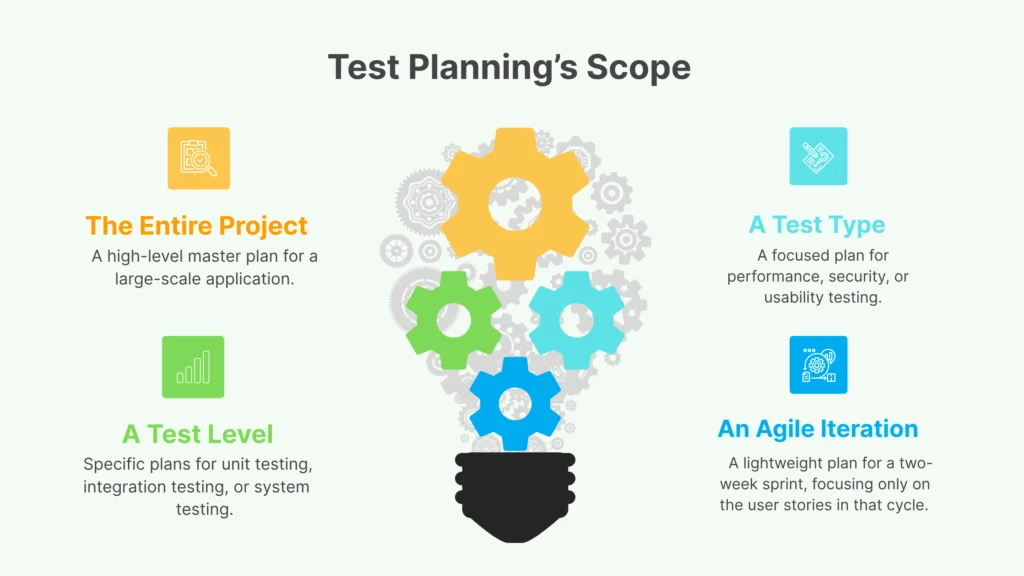
- The Entire Project: A high-level master plan for a large-scale application.
- A Test Level: Specific plans for unit testing, integration testing, or system testing.
- A Test Type: A focused plan for performance, security, or usability testing.
- An Agile Iteration: A lightweight plan for a two-week sprint, focusing only on the user stories in that cycle.
The key is to start early. Ideally, test planning should begin as soon as a project is conceived, sometimes even before detailed requirements are finalized. Why so early? Because early planning allows you to influence the design for testability, anticipate challenges, and secure the necessary resources before it’s too late.
As the project evolves, so will your plan. It’s an iterative process that embraces change and feedback, ensuring your testing efforts always remain relevant and aligned with the project’s current state.
=> Related Content: Test Strategy vs. Test Planning in Agile Development
Getting Started: Understanding the Lay of the Land
Before you can plan a journey, you need to know where you are and where you’re going. The first step in test planning is to understand the context and get organized. This involves looking both inward at your project and outward at your organization, and then getting everyone to agree on the path forward.
Understand the Context
You don’t test in a vacuum. Your work is influenced by a bigger picture. Understanding this context is critical.
- Organizational Context: Every company has a way of doing things. This is often captured in a test policy (a high-level document outlining the organization’s philosophy on testing) and an organizational test strategy (which describes the standardized test levels and approaches the company uses). Do you work in a regulated industry like finance or healthcare that demands rigorous documentation? Or are you in a fast-moving startup where speed is prioritized? Knowing this helps you tailor your plan to fit the company culture and its quality standards.
- Scope of the Test: You must clearly define the boundaries. What are you testing, and just as importantly, what are you not testing? Is the scope a single API endpoint, a new user registration feature, an entire mobile app, or a database migration? A well-defined scope prevents “scope creep” and ensures your team’s efforts are focused on the right areas.
- The Test Item: Get specific about the work product you’re testing. Is it a set of microservices? A React component library? A backend batch processing job? Knowing the specifics of the test item—its architecture, its dependencies, and its technology stack—directly informs the kind of testing you’ll need to do. For example, testing a front-end component is very different from testing a data pipeline.
Organize and Get Buy-In
Once you understand the context, it’s time to organize your planning activities. This isn’t a solo mission. Test planning is a team sport. You need to involve and get approval from key stakeholders—the people who have a vested interest in the project’s success. This typically includes the product owner, the project manager, developers, and other testers.
Getting buy-in involves:
- Outlining the Planning Activities: What steps will you take to create the test plan? (Hint: They’re the ones in this article!)
- Creating a Schedule: When will each planning activity be done? When will the final plan be ready?
- Seeking Approval: Present your plan for planning to the stakeholders. This isn’t about asking for permission; it’s about building consensus and alignment. When everyone agrees on the process upfront, it makes it much easier to get the final test plan approved later. Think of it as agreeing on the rules of the game before you start playing. 🤝
Facing the Unknown: Taming Product Risks
Every software project has risks. A product risk is a potential problem with the software that could negatively impact users or stakeholders. Instead of ignoring these risks and hoping for the best, great test planning meets them head-on. The goal of risk analysis in testing is to focus your limited time and resources on the areas that matter most.
Identify and Analyze Risks
The first step is to get the team together for a brainstorming session. Ask the simple but powerful question: “What could go wrong with this product?” Think from the perspective of different users and stakeholders.
Examples of product risks include:
- Functional Risks: A critical feature, like the “Add to Cart” button, might not work correctly.
- Performance Risks: The application might become unacceptably slow during peak usage.
- Security Risks: Sensitive user data could be exposed.
- Usability Risks: The user interface might be so confusing that users can’t complete their tasks.
- Data Risks: The system might corrupt user data during processing or storage.
Once you have a list of potential risks, you need to analyze them. For each risk, assess two key factors:
- Likelihood: How likely is this risk to occur? (e.g., High, Medium, Low)
- Impact: If it does occur, how bad will the consequences be? (e.g., High, Medium, Low)
A risk with high likelihood and high impact (e.g., a security flaw that is easy to exploit and exposes all user data) is your top priority. A risk with low likelihood and low impact (e.g., a minor typo on a rarely visited “About Us” page) is a much lower priority. This analysis gives you a clear, prioritized list of what to worry about.
Choose Your Risk Treatment Approach
After analyzing the risks, you decide how to handle them. These risk treatment approaches are the actions you’ll take to address the identified risks. They become a core part of your test strategy.
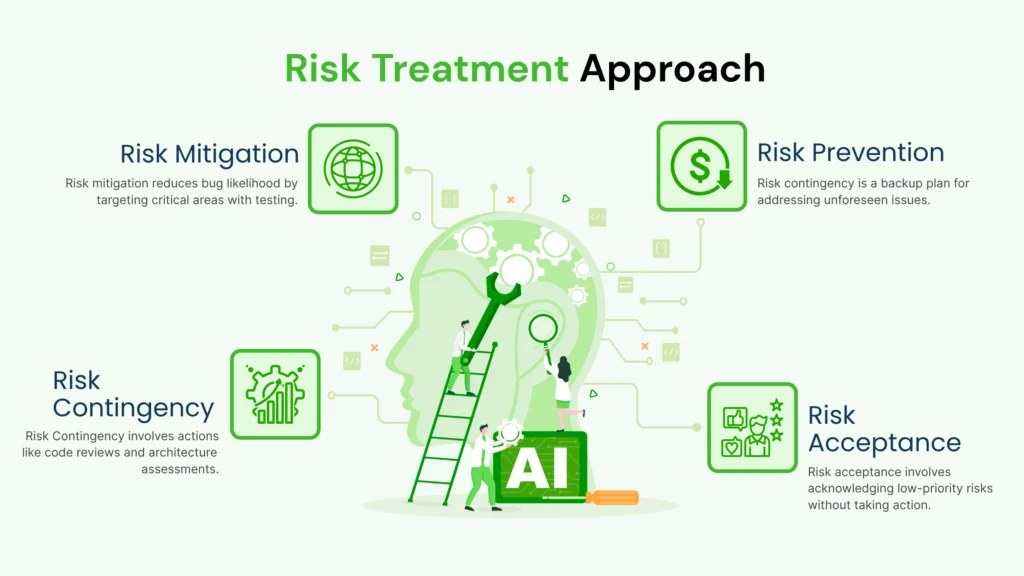
- Risk Mitigation: This is the most common approach for testing. You can’t eliminate the possibility of a bug, but you can reduce its likelihood of reaching the user by designing tests specifically to find it. If you identify “slow performance under load” as a high-impact risk, your mitigating action is to conduct rigorous performance testing. Your test plan will then allocate time and resources for this activity.
- Risk Prevention: These are actions taken to prevent a risk from materializing in the first place. This often happens outside of dynamic testing. Examples include conducting architectural reviews to prevent performance bottlenecks, using static code analysis tools to catch common coding errors, or holding mandatory peer code reviews.
- Risk Contingency (Corrective Action): This is your “Plan B.” What will you do if the risk becomes a reality despite your best efforts? A contingency plan could be having a feature flag to instantly disable a faulty new feature in production or having a well-rehearsed rollback procedure.
- Risk Acceptance: Sometimes, the cost of addressing a risk outweighs the potential impact. For very low-priority risks, the team might consciously decide to “accept” it and do nothing. This is a valid strategy, as long as it’s a deliberate decision made by the stakeholders.
By systematically identifying, analyzing, and planning treatments for risks, you ensure that your testing effort is laser-focused on protecting the product where it’s most vulnerable.
Building Your Strategy: The Test Approach and Resources
With a clear understanding of your context and risks, you can now define how you’re going to test. This is your test approach. It’s the practical, hands-on strategy for your specific testing scope. It’s also where you figure out what you’ll need to execute that strategy.
Define the Test Approach
Your test approach is guided by several factors: the organizational test strategy, any regulatory standards, project constraints (like budget and deadlines), and, most importantly, your chosen risk treatment approaches.
The approach you define should be a mix of different techniques and methodologies tailored to your needs. Here are some common elements of a test approach:
- Analytical Approaches: These are driven by a specific factor.
- Risk-Based Testing: You prioritize and focus your testing effort based on the risk analysis you just completed. High-risk features get the most in-depth testing.
- Requirements-Based Testing: You systematically design test cases to cover every requirement or user story acceptance criteria.
- Dynamic Approaches: These are less scripted and rely on the tester’s skill.
- Exploratory Testing: Experienced testers are given the freedom to “explore” the application, using their knowledge and intuition to uncover bugs that scripted tests might miss. This is often done in time-boxed sessions.
- Process-Oriented Approaches: These follow a standard process.
- Automation-First: The team commits to automating as much of the testing as possible, especially regression tests, to run within a CI/CD pipeline.
- Traditional Waterfall: Testing is a distinct phase that happens only after all development is complete (less common today but still used in some contexts).
Your final test approach will likely be a hybrid. For example, you might use a risk-based approach to decide what to test, a requirements-based approach to create your core set of test cases, and then supplement it with exploratory testing sessions.Risk-Based Testing
Estimate and Allocate Resources
A strategy is useless without the resources to execute it. This is where you get down to the brass tacks and estimate what you’ll need. Be realistic and comprehensive.
- People (Test Staff): Who will perform the testing? How many people do you need? What skills are required? Do you need a performance testing specialist or someone with deep knowledge of the business domain? This includes both dedicated testers and developers who will be writing unit and integration tests.
- Tools (Test Tools): What software will you use? This could include test management tools (like Jira or TestRail), automation frameworks (like Selenium, Cypress, or Playwright), API testing tools (like Postman), performance testing tools (like JMeter or k6), and security scanning tools.
- Environments (Test Environments): Where will the testing take place? You need stable, reliable environments that are as close to production as possible. This includes specifying hardware, software, network configurations, and any third-party integrations. A common bottleneck is not having enough well-configured test environments.
- Data (Test Data): What data is needed to conduct your tests? You might need a set of standard user accounts, large datasets for performance testing, or specific data to trigger edge-case scenarios. Managing test data (creating it, protecting its privacy, and resetting it) is a critical and often underestimated task.
Estimation is famously difficult, but it’s a necessary part of planning. Use a combination of expert judgment, data from past projects, and team consensus to arrive at a realistic estimate of the time and effort required. In Agile, this might be done through story pointing for testing tasks. The key is transparency—be clear about your assumptions and the level of uncertainty in your estimates.
The Final Huddle: Establishing the Test Plan ✅
You’ve done the hard work of analyzing, strategizing, and estimating. The final activity is to bring it all together into a coherent test plan and get everyone to agree on it. This plan is the formal record of your decisions and the primary communication tool for all things testing.
The format of the test plan can vary. It could be a formal, multi-page document for a large project, a detailed page on a team wiki (like Confluence) for an Agile team, or even a set of well-defined tickets in a project management tool. The format is less important than the clarity and completeness of its content.
At a minimum, your test plan should summarize:
- The Scope and Test Items
- The Risk Analysis and Treatment Approaches.
- The defined Test Approach.
- The required Resources (people, tools, environments, data).
- A Schedule of testing activities.
- Entry and Exit Criteria (what must be true to start and consider testing complete?).
- Test Deliverables (what will you produce, e.g., test cases, automation scripts, bug reports, a final summary report?).
The most critical part of this step is ensuring the test plan is accepted by all stakeholders. This is the final alignment check. Circulate the plan and hold a review meeting. This is the time for stakeholders to ask questions, raise concerns, and debate priorities.
Disagreements are normal and healthy! It’s better to settle them now than to have misunderstandings later. The goal is to negotiate and compromise until you have a plan that everyone understands, supports, and is committed to helping execute.
Conclusion: Planning for Quality
Test planning is far more than just paperwork. It’s a strategic, collaborative, and continuous process that brings order to the potential chaos of software development. It forces us to think critically about what quality means for our product, to focus our efforts on the areas of highest risk, and to communicate our intentions clearly to the entire team.
By embracing these planning activities—understanding your context, managing risks, defining a smart approach, and aligning with your team—you empower yourself. Developers can write more testable code with a clearer picture of how it will be validated. Testers can execute their work with purpose and precision. Together, you can move away from frantic, last-minute bug hunting and toward a confident, steady march toward a high-quality release. A well-crafted plan is your best defense against the unexpected and your clearest path to success.