
In Agile projects, where teams are constantly building and releasing new features, a more dynamic approach is needed to keep up instead of traditional testing. That’s where exploratory testing shines. It helps teams find unexpected bugs and ensure quality in a fast testing process
This article will explain what exploratory testing is in an Agile context, why it’s a perfect fit in the Agile universe, and how to conduct it effectively.
1. What is Exploratory Testing in Agile?
What is exploratory testing, in short?
Exploratory testing is an iterative, unscripted approach where testers learn, design, and execute tests at the same time. Instead of following a detailed, pre-written script, the tester actively learns about the application while testing it. They act like a detective, continuously exploring the software to gain knowledge and apply their experience to uncover hidden problems.
All you need to know about Exploratory Testing is in our guide: What is Exploratory Testing? A complete overview for beginners.
How the Agile Environment operates

Now, let’s look at how the Agile world operates. In the Agile environment, teams work in short, iterative cycles called sprints, emphasizing usable products at the end of each cycle with constantly changing requirements. Traditional scripted testing alone may not provide the speed or adaptability needed to respond to constant change.
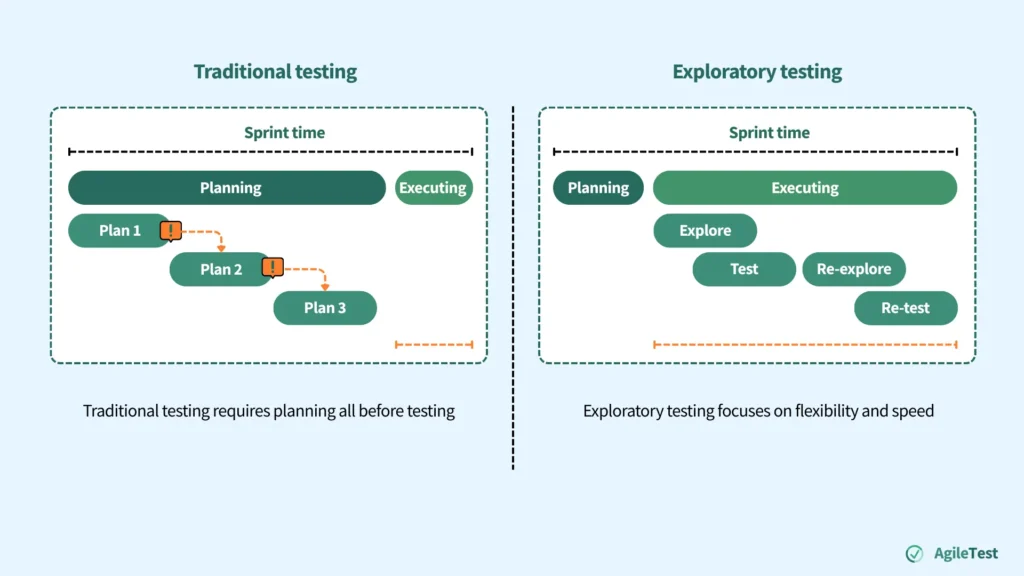
Imagine that you only have 2 weeks to first test the profile page. Under the traditional testing approach, you will spend about 1-2 days to complete the test plan, then another 1-2 days to analyze the requirements and finish the test cases with detailed test steps. If any changes take place, you then redo these activities again. It’s the turning point that you need to change your test approach; otherwise, you will be overburdened with repetitive preparation work. This is where exploratory testing becomes valuable.
Read our related article: Testing in Traditional vs Agile Worlds.
2. Why Exploratory Testing Works in Agile
High speed and flexibility
In the same example, with exploratory testing, you only need to clarify the objectives from the beginning of the week. It only takes you 1-2 days; you could spend the rest of the two weeks discovering more about the features and running your tests. This allows you to quickly discover critical bugs and provide feedback to developers within your given time.
Even when changes occur, you will just need to double-check if any of your objectives have been modified or not. Then, you can flexibly continue to conduct your tests without having to set up everything from scratch again. Therefore, exploratory testing is a perfect match for the Agile mindset because of its focus on flexibility and speed.
Accumulate knowledge and build up a foundation
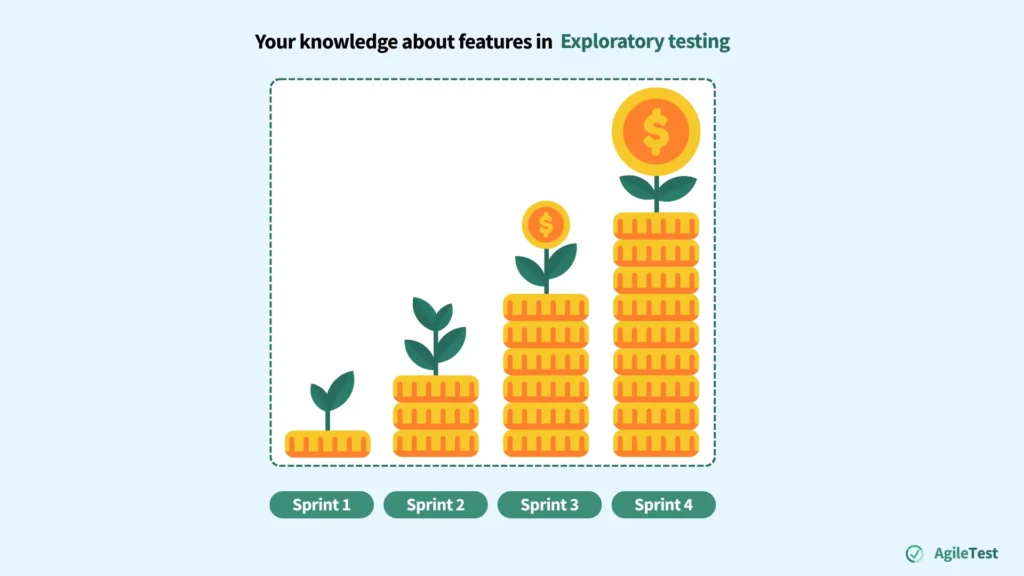
Exploratory testing is a continuous learning and adaptation, which aligns with core Agile principles. The exploratory testing approach frees testers from the pressure of fully understanding the features before designing tests. Testers can gain knowledge about the new feature little by little and execute tests based on their accumulated knowledge foundation.
In addition, by dividing the feature into smaller areas and exploring each in cycles, testers can gain a deeper understanding while testing, rather than learning everything first and only then writing and executing tests. In this way, you can build up your comprehensive knowledge base about the features via a “theory & practice” approach.
Complement for scripted and automated tests
Initially, when you are new to the feature, exploratory testing helps you understand it and divide each of your sprints into different areas for testing. Only when your core understanding is solid can you make use of your test documents through each cycle to design a suitable, focused test case with scripted testing. This allows the team to focus on covering all the expected behaviors and critical functionality efficiently.
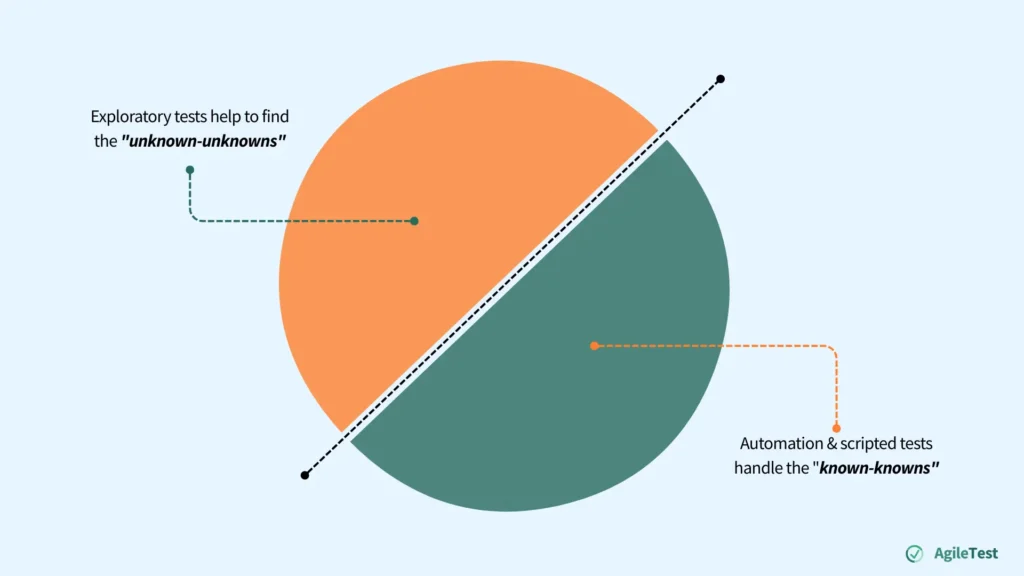
Even with a strong suite of automated and scripted tests, exploratory testing should continue throughout the development cycle. While automation handles the “known-knowns“, a tester’s intuition is needed to find the “unknown-unknowns“. By continuously exploring the application, testers can uncover unexpected bugs, usability issues, and edge cases that a pre-written script would never find, ensuring the product remains robust and high-quality.
Wonder when you should apply Exploratory testing? Read our article now: Ad-Hoc vs. Exploratory Testing: What are the differences?.
3. How to Conduct Exploratory Testing in Agile
In general, exploratory testing will have the same flow as the fundamental testing process. However, there will be some further requirements you need to prepare for this testing type.
Step 1: Set priorities
First, you need to prioritize and spot a feature to focus on in the current sprint. It can come from your experience and knowledge. But don’t be pressured into picking up the right one at first. Remember that exploratory testing is a continuous learning process. You can adjust your priorities in the following sprints. The purpose is only to narrow your focus to a specific section to explore, rather than randomly clicking as an ad-hoc approach.
Step 2: Define the Test Charter
Then, you should define a test charter. It is a short, focused guide that describes what you want to accomplish in a single testing session. It is often concise, with a few bullet points. The charter is meant to be a guide, not a detailed script.
A test charter is distinct from a test objective and a test plan. A test objective is a broad goal, such as “verify the checkout process handles multiple discount codes correctly”. On the other hand, a test plan is a formal document that outlines the entire testing strategy for a project, including schedules, roles, and resources. The test charter sits in between these two: it is more detailed and scope-focused than an objective but more flexible than a plan. It defines a time-boxed session, a specific scope for exploration, but also gives the tester freedom to investigate while staying aligned with the overall testing goals.
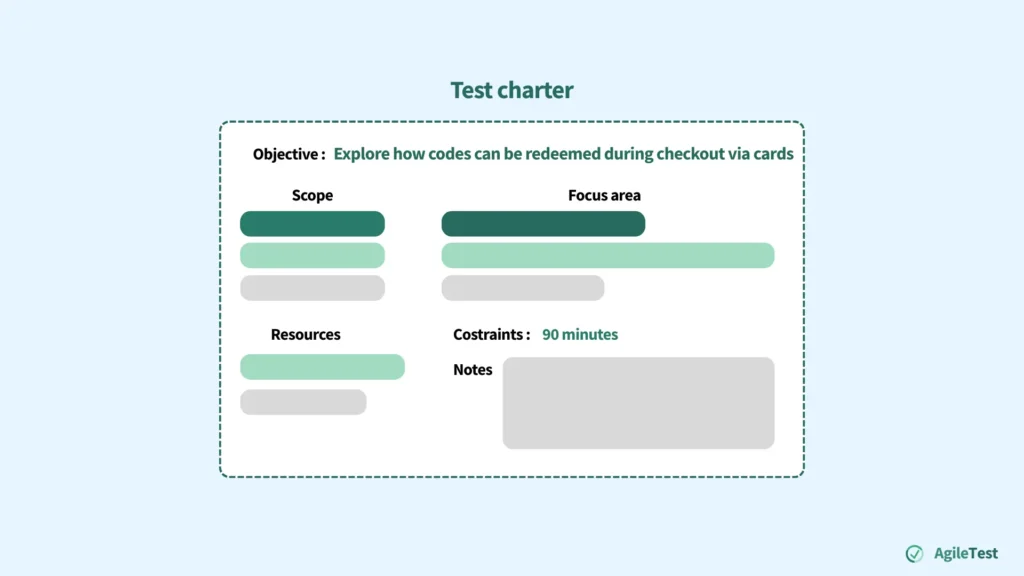
To write a good test charter, you should first clearly define “what” you want to accomplish in each session. Next, set a specific scope you will explore of the feature. You should also add any constraints, such as a time limit or specific tools available. Finally, highlight focus areas such as high-risk, complex, or those that have had past defects. For example, a good test charter for a checkout feature might define the goal as “Explore how codes can be redeemed during checkout via cards in 90 minutes”.
Step 3: Set a Time-Box
You now come to the next step to determine the time to spend on every test session. Exploratory testing works best in short, focused sessions, typically 60–120 minutes. Time-boxing helps maintain concentration and ensures that you make progress without getting lost in endless clicks or checks. For simpler features, you can adjust the time-box to 30–60 minutes, while for more critical issues, it may be extended to 90–120 minutes. Usually, you can consider it as a constraint factor and complete this step as soon as you define your test charter.
Step 4: Prepare Test Data and Environment
After that, you come to the next stage of setting up your testing data. You may not need sample data and detailed test steps, but you are required to generate possible test cases from your understanding and experience. By guiding your test actions from one logical step to the next, these test cases will help you create a “chain of thoughts” during the test process, making it more valuable than just randomly clicking.
In addition, you need to set up a test environment, including the availability of hardware and software. The setup requirements may vary according to the scope in the test charter. It aims to make sure that no infrastructure blockers will happen during your test sessions.
Step 5: Execute the Testing
Now, it’s time to run your exploratory test. Like the fundamental process, you need to mark the status for each test case you have completed and record evidence for further testing purposes. This helps build a record for further analysis, allows you to refine future test cases, and ensures that any issues identified are properly logged for review and resolution.
Discover what to do during the execution stage with our article: The Fundamental Test Process: A Comprehensive Guide.
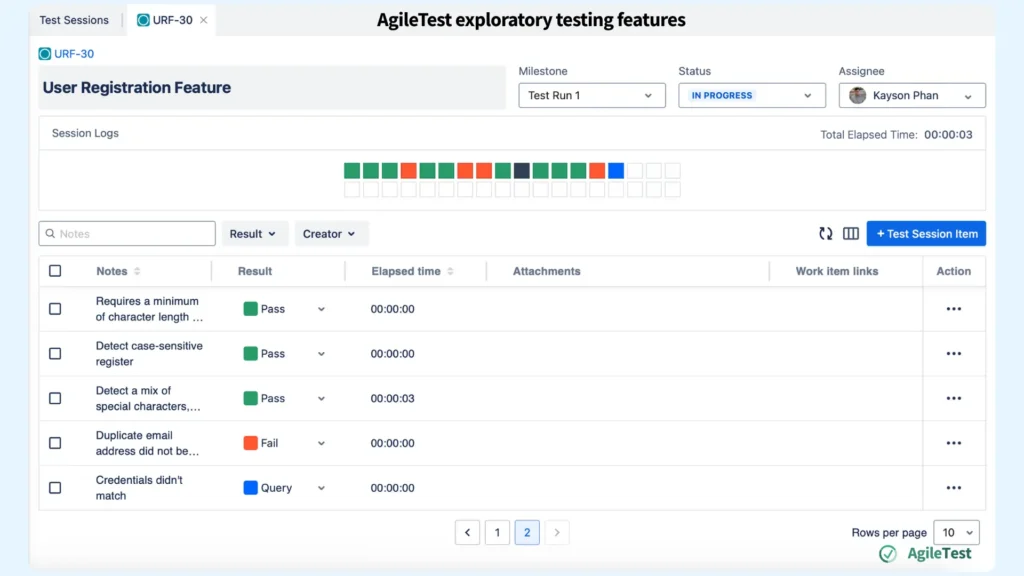
Step 6: Analyze and Share
Finally, you need to reflect on your results of exploratory testing. After each sprint, you can share your findings with the team and stakeholders during sprint reviews and retrospectives. This ensures that everyone has a clear picture of the application’s quality and helps the entire team make smarter decisions for the next cycle. Remember that exploratory testing doesn’t end after one attempt; it just means that you have finished exploring the current area, and are moving to another with more practical knowledge gained from the previous run.
Explore more key Scrum events with our article: Understand Scrum Meaning: An Introduction to Scrum.
4. What Should Be Considered
While a powerful tool, exploratory testing does come with a few challenges that need to be considered.
Tester experience
Exploratory testing relies heavily on the tester’s experience. You need to think like an end-user to adapt their testing approach as they learn more about the system. Experienced testers are better equipped to make rapid decisions about what to test next and are more likely to uncover subtle issues that automated scripts or scripted tests might miss.
For teams new to exploratory testing, it’s important to gradually build up experience. Initially, they should focus on simpler features or work closely with more experienced colleagues to develop their intuition about the system. Over time, testers will get better at adapting their testing approach based on the knowledge they accumulate.
Balancing with Scripted and Automated Testing
Exploratory testing doesn’t replace scripted or automated testing; rather, it complements them. Automated tests are great for repetitive, well-defined tasks and ensuring basic functionality, while exploratory testing uncovers the issues that scripted tests might miss, like usability flaws, performance problems, or edge cases.
To achieve the best results, exploratory testing should be done separately, but at the same time as automated testing. Use exploratory testing to delve into complex areas or new features that require deeper understanding, while relying on automated tests to quickly validate well-defined functionality. It’s crucial to strike a balance between the two methods to cover both the known and unknown aspects.
Final Thoughts
Exploratory testing is an essential practice in Agile development. It’s a flexible, intelligent way to ensure quality that keeps pace with a project’s speed. By focusing on continuous learning, time-boxed sessions, and collaboration, your team can use this method to uncover hidden bugs and improve the overall quality of your product. It’s the perfect mixture of freedom and discipline, making it the ideal weapon for finding bugs in a world that’s always changing.