
In the ever-evolving landscape of software development, the way we build things has a profound impact on how we ensure they work correctly. For decades, the industry followed rigid, sequential blueprints. Today, many teams have embraced a more fluid, adaptive rhythm. As developers and testers, we are often caught in the middle, needing to adapt our quality practices to fit the overarching development philosophy of our organization.
Understanding the “why” behind different testing approaches is crucial. It’s not just about following a process; it’s about aligning our efforts to deliver the most value, whether we’re in a highly structured environment or a fast-paced, iterative one. This guide is for you—the developer writing unit tests, the QA engineer designing an end-to-end strategy, and the test lead guiding the team. We’ll break down the fundamental differences between testing in traditional (like Waterfall) and Agile models, not as a theoretical exercise, but as a practical comparison of the day-to-day activities you live and breathe.
Think of it this way: a traditional model is like building a skyscraper. You need a detailed, finalized architectural blueprint before you even break ground. Every phase—foundation, framing, electrical, plumbing—must be completed in sequence. You can’t test the plumbing on the 50th floor until the first 49 floors are built.
An Agile model, on the other hand, is like a master chef cooking a multi-course meal. They work on different dishes concurrently, constantly tasting, adjusting seasonings, and getting feedback. A single course might be perfected and ready to serve while others are still in preparation. The quality is built-in, not inspected at the end.
Both approaches can create masterpieces, but the process, tools, and mindset required are worlds apart. Let’s dive into what that means for testing.
Head-to-Head: A Practical Comparison of Testing Activities
To truly grasp the differences, let’s compare the core testing activities side-by-side, from initial planning to final reporting.
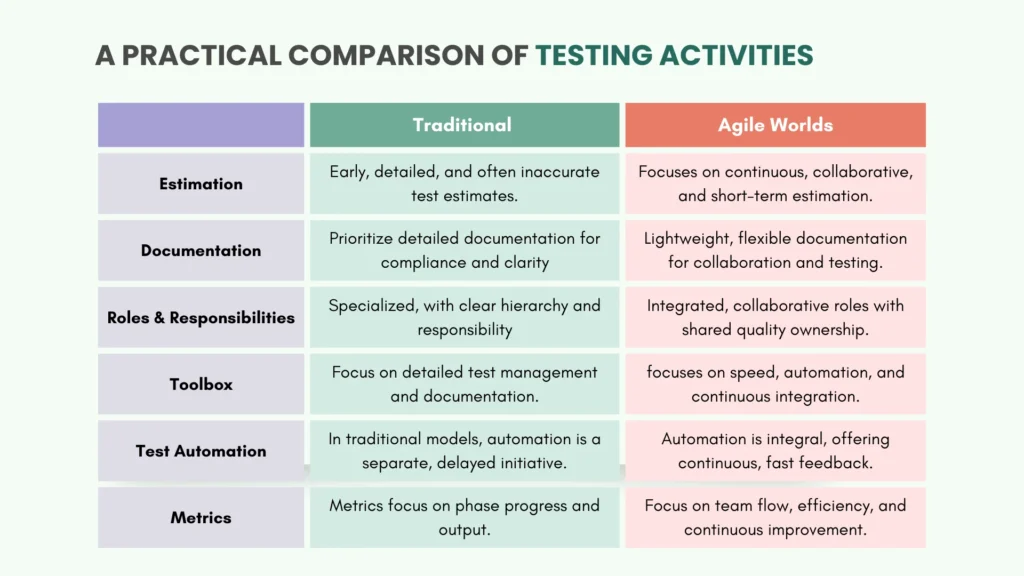
1. Estimation: The Art of Predicting the Future
In the Traditional World: Early, Detailed, and Set in Stone
In a Waterfall model, predictability is king. Before a single line of code is written, the test manager is tasked with creating a comprehensive, detailed estimate for the entire project’s testing effort.
- How it works: This involves breaking down the project into distinct test levels (e.g., System Integration Testing, User Acceptance Testing). The manager estimates the time, resources, and budget required for each phase based on voluminous requirements documents. This detailed estimate becomes a cornerstone of the overall project plan.
- What it feels like for you: As a tester, you might be asked to estimate how long it will take to write and execute 500 test cases for a feature you’ve only read about in a specification document. The pressure is on to get it right upfront, as this estimate will be used for budgeting and resource allocation for months to come. The benefit is a clear, long-term plan, but the challenge is that these early estimates are often inaccurate, as requirements inevitably change.
In the Agile Universe: Iterative, Collaborative, and Adaptive
Agile turns estimation on its head. Instead of one big prediction at the start, estimation is a continuous, team-based activity done in small, manageable chunks.
- How it works: During sprint planning, the entire team (developers, testers, and product owner) collaborates to estimate the effort for each user story in the upcoming iteration. Techniques like Planning Poker, using story points instead of hours, are common. The focus isn’t on long-term perfection but on getting a “good enough” estimate for the next couple of weeks.
- What it feels like for you: You are an active participant in estimation. Your input as a tester on the complexity of a story is just as valuable as the developer’s. This iterative approach is far more accurate for the short term and highly adaptable. If a story turns out to be more complex than anticipated, the team can adjust in the next sprint. The trade-off is less long-term predictability for the entire project.
2. Documentation: The Blueprint for Quality
In the Traditional World: Comprehensive and Formal
Traditional models run on a detailed paper trail. Documentation is not just a guide; it’s a formal contract and a record for governance and compliance.
- Key Artifacts: Expect to be creating or working with a Master Test Plan, detailed Level Test Plans, exhaustive step-by-step Test Cases with specific expected results, a rigid Test Schedule, and formal Test Summary Reports that require stakeholder sign-off.
- What it feels like for you: A significant portion of your time is dedicated to writing and maintaining these documents. While it can feel bureaucratic, this level of detail ensures clarity, provides a solid basis for legal and regulatory compliance, and is helpful for onboarding new team members.
In the Agile Universe: Lightweight and Living
Agile values “working software over comprehensive documentation.” The goal is to facilitate conversation and collaboration, not to create a massive library of documents.
- Key Artifacts: The focus shifts to lightweight, dynamic artifacts. Acceptance Criteria (written in formats like Gherkin’s Given-When-Then) on a user story become the test case. The Definition of Done (DoD) becomes the contract for quality within a sprint. For more complex scenarios, you might use lightweight exploratory test charters instead of detailed scripts.
- What it feels like for you: You spend less time writing and more time testing and talking. The automated tests and the code itself become the primary forms of documentation. This frees you up to be more creative and responsive, but it can be a challenge if your organization has strict audit requirements.
3. Roles & Responsibilities: Who Owns Quality?
In the Traditional World: Hierarchical and Specialized
Roles in a traditional setup are clearly defined and specialized, with a clear chain of command.
- The Team Structure: You have a Test Manager who oversees the entire testing effort, makes key decisions, and manages the team. Test Leads might manage specific test levels, and Testers are responsible for execution. Quality is seen as the primary responsibility of this dedicated test team.
- What it feels like for you: You have a well-defined role and career path. It’s clear who to go to for decisions. However, this can sometimes create an “us vs. them” mentality between the development and testing teams, with quality being “thrown over the wall.”
In the Agile Universe: Integrated and Collaborative
Agile promotes a “whole-team approach” to quality. Quality is everyone’s job.
- The Team Structure: The formal Test Manager role often disappears, replaced by a QA Coach or Facilitator who empowers the team with best practices. Roles are more fluid and integrated. Developers are expected to write robust unit and integration tests, while testers focus on exploratory testing, automation, and being the “quality conscience” of the team.
- What it feels like for you: You are a partner in development, not a gatekeeper at the end. You work side-by-side with developers every day. This fosters immense collaboration and shared ownership, but it can also lead to ambiguity if roles aren’t clearly understood by the team.
4. The Toolbox: Instruments of the Trade
In the Traditional World: The Test Management Suite
The tools in a traditional project are geared towards managing distinct phases and comprehensive documentation.
- Central Tools: You’ll likely live in a dedicated test management tool (like Jira and AgileTest). These tools are excellent for requirements traceability, detailed test case management, planning execution cycles, and formal defect tracking.
- What it feels like for you: Your workflow is centered around this tool. It’s your single source of truth for what needs to be tested, what has been tested, and what failed.
In the Agile Universe: The CI/CD and Automation Pipeline
Agile tools are all about speed, feedback, and integration with the development process.
- Central Tools: The CI/CD pipeline (using tools like Jenkins, GitLab CI, or CircleCI) is the heart of the Agile testing process. Automation frameworks (like Selenium, Cypress, or Playwright) and collaboration platforms (like Jira or Azure DevOps) are central. Test management is often a lightweight plugin within these platforms rather than a separate, monolithic application.
- What it feels like for you: You work much closer to the code and the build process. Your primary goal is to get automated feedback from the pipeline as quickly as possible. Your tools are designed to support continuous testing, not phase-based testing.
5. Test Automation: The Engine of Speed
In the Traditional World: A Strategic, Separate Project
Automation is valued in traditional models, but it’s often treated as a separate, strategic initiative.
- How it works: An automation effort might be planned after the manual test cases have been written and stabilized. It’s often focused on creating a large regression suite that is run periodically, perhaps before a major release.
- What it feels like for you: You might be on a dedicated automation team, or you might hand off test cases to them. The feedback from automation is slower and less frequent compared to Agile.
In the Agile Universe: An Integral, Inception-to-Delivery Practice
In Agile, automation is not an afterthought; it is a foundational practice.
- How it works: Automation is built-in from the very beginning of a project. The Test Pyramid model is a guiding principle, emphasizing a large base of fast unit tests, a smaller layer of integration tests, and a very small number of slow end-to-end UI tests. These tests are run continuously in the CI/CD pipeline with every code commit.
- What it feels like for you: As a tester, you are heavily involved in the automation strategy, and you might be writing automation scripts yourself. As a developer, you are responsible for writing automated tests for your code. The goal of automation is to provide near-instant feedback to the team.
6. Metrics: Measuring What Matters
In the Traditional World: Measuring the Phase Output
Metrics in a Waterfall project focus on the health and progress of the distinct testing phase.
- Key Metrics: You will be tracking things like Test Execution Progress (number of tests passed/failed/blocked), Defect Density (bugs per line of code), Defect Removal Efficiency, and Requirements Coverage. These metrics are compiled into formal reports to show the status of the testing phase.
- What it feels like for you: Your success is often measured by how many tests you run and how many bugs you find. The focus is on the output of your specific team.
In the Agile Universe: Measuring the Team’s Flow
Agile teams use traditional test metrics, but they add another layer of metrics that measure the health and efficiency of the entire team’s development process.
- Key Metrics: In addition to defect counts, you’ll be looking at Team Velocity (how many story points the team completes per sprint), Cycle Time (how long it takes for a story to go from “in progress” to “done”), and Burndown/Burnup Charts that show progress within a sprint.
- What it feels like for you: Your success is tied to the success of the team. The metrics are used to facilitate conversations during retrospectives to help the team improve its flow and predictability, not to judge individual performance.
Conclusion: Choose Your Adventure
Neither model is inherently superior; they are simply different tools for different jobs. Traditional, phase-gated testing provides a high degree of control, predictability, and documentation, making it suitable for high-risk, safety-critical projects. Agile’s continuous testing model provides speed, adaptability, and rapid feedback, making it ideal for projects where requirements are evolving and time-to-market is critical.
As a developer or tester, your power lies in understanding these differences. By grasping the principles behind the process you’re working in, you can align your activities, choose the right tools, and communicate more effectively. Whether you are crafting a detailed Test Plan or collaborating on Acceptance Criteria, you are the ultimate champion for quality. Understanding the rules of the game—no matter which game you’re playing—is the first step to winning.