
In the world of software development, you wouldn’t use a screwdriver to hammer a nail. You use the right tool for the job. The same principle applies to software testing. “Testing” isn’t a single, monolithic activity; it’s a diverse collection of techniques and approaches, each designed to answer a different question about your product’s quality.
Because the goals of each test type are different, the way we manage them must also be different. Managing a performance test is a world away from managing the testing of a user registration form. An effective test management strategy recognizes this diversity and adopts an integrated approach, tailoring its focus, resources, and success criteria to the unique demands of each test type.
For developers and testers on the front lines, understanding these different management perspectives is key. It helps you understand the “why” behind your tasks, communicate your results more effectively, and see how your specific piece of the quality puzzle fits into the bigger picture. This guide will break down the distinct management activities for four key testing categories: functional, non-functional, black-box, and white-box testing.
The Foundational Split: Seeing from the Outside vs. the Inside
Before we dive into the four main types, it’s helpful to understand a fundamental distinction that underpins almost all testing: the difference between a black-box and a white-box perspective.
- Black-Box Testing: Imagine being handed a mysterious, sealed black box with some buttons and a screen. Your job is to test it without ever opening it up. You press buttons (inputs) and observe the screen (outputs). You don’t know or care about the wires, circuits, or code inside. This is the essence of black-box testing. It’s an external, user-focused approach that validates functionality from the outside in.
- White-Box Testing: Now imagine you’re given the same box, but this time it’s made of clear glass (or a “white box”). You can see every wire, every connection, every line of code. Your job is to test it by making sure every internal pathway and logical decision works as designed. This is white-box testing. It’s an internal, code-focused approach that validates the application’s structure from the inside out.
Functional and non-functional testing describe what you are testing, while black-box and white-box testing describe how you are viewing the system while you test. Let’s see how this plays out in practice.
Managing Functional Testing: “Does It Do What It’s Supposed to Do?” ✅
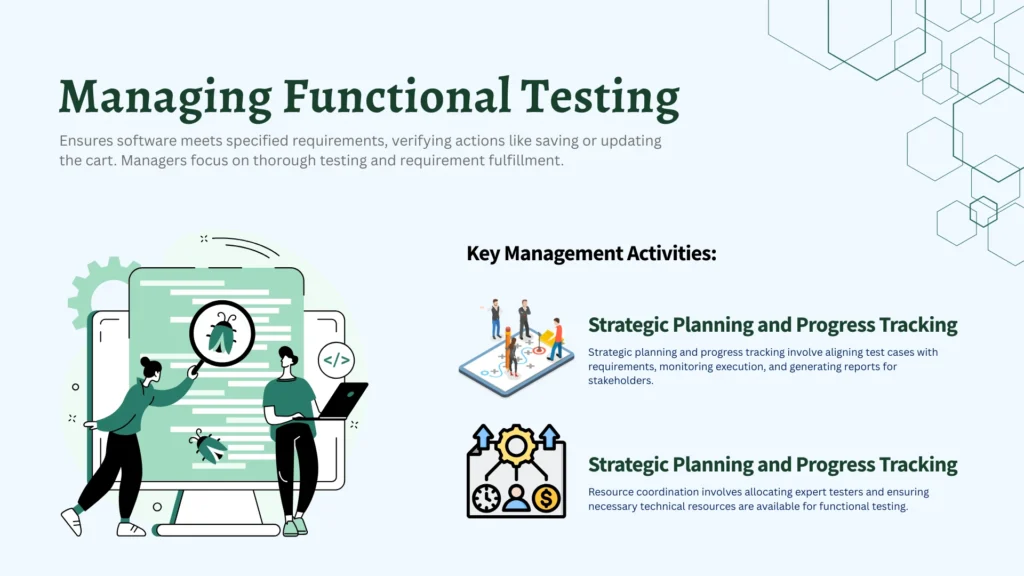
Functional testing is the bedrock of quality assurance. Its purpose is to verify that the software behaves according to its specified requirements. When a user clicks “Save,” does it save? When they add an item to the cart, does the cart update? For managers, the focus here is crystal clear: ensuring that all functionalities are thoroughly tested and meet the defined requirements.
Key Management Activities:
Strategic Planning and Progress Tracking
The management of functional testing begins with crafting a detailed test strategy that aligns with functional requirements and project objectives. This isn’t just about creating a list of test cases. It’s about traceability. A test manager will work with the team to ensure every user story, use case, or requirement has corresponding tests designed to validate it.
Progress tracking is the other side of this coin. It’s about answering the question, “How much of the required functionality have we confirmed is working?” This involves using test management tools to:
- Link test cases directly to requirements.
- Monitor execution status in real-time (e.g., 70% of login-related tests have passed).
- Generate reports that show requirements coverage, giving stakeholders a clear view of which features are ready and which still have outstanding issues.
Resource Coordination
Functional testing often requires a broad understanding of the application’s business logic. Management here involves allocating human and technical resources efficiently to cover all functional aspects of the system. This means assigning testers to areas where they have the most domain expertise. For example, a tester with a background in finance is the best person to validate a complex reporting feature.
It also means ensuring the team has the necessary technical resources. A functional test of a checkout process might require a stable, fully integrated test environment with access to a payment gateway sandbox, an inventory service, and a shipping calculator. The manager’s job is to ensure these resources are available and properly configured.
Managing Non-Functional Testing: “Does It Do It Well?” 🚀🔒
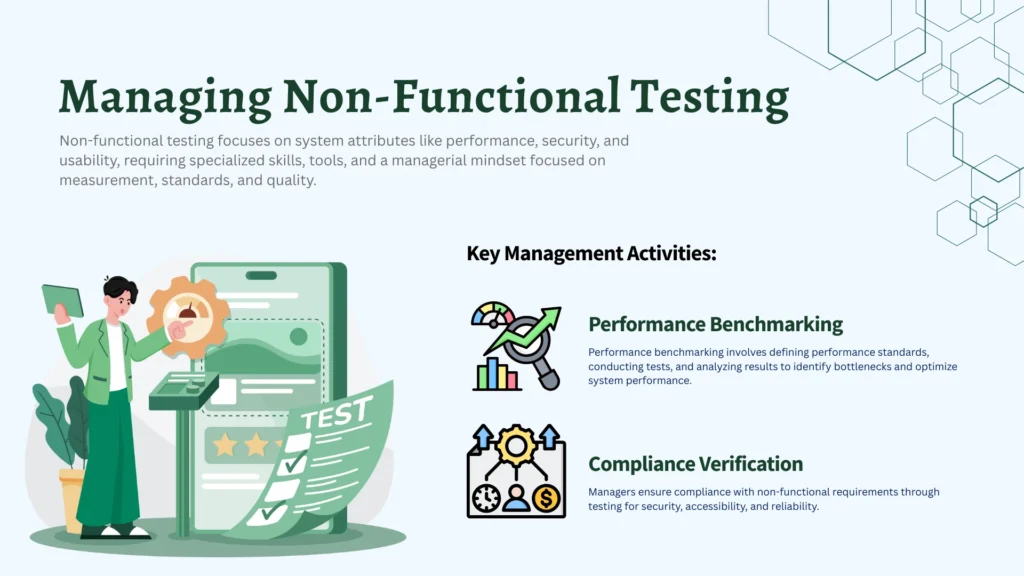
If functional testing is about what the system does, non-functional testing is about how the system is. The management of this type of testing revolves around verifying system attributes like performance, security, usability, and reliability. These “-ilities” are often what separate a usable product from a great one. This type of testing requires specialized skills, tools, and a different managerial mindset focused on measurement and standards.
Key Management Activities:
Performance Benchmarking
You can’t improve what you don’t measure. A key management task is establishing performance benchmarks before testing even begins. This involves working with stakeholders to define what “good performance” means. For example: “API response times must be under 200ms at 1,000 requests per minute.”
With benchmarks in place, the manager then oversees the testing activities that assess the system against these criteria. This includes:
- Scheduling load, stress, and soak tests.
- Coordinating the setup of performance testing tools (like JMeter or k6).
- Analyzing the complex results (which are often graphs and statistical models) to identify performance bottlenecks and memory leaks.
Compliance Verification
Many non-functional requirements are tied to industry or legal standards. Here, the manager is responsible for overseeing tests that ensure the system meets non-functional standards. This is a process of compliance and verification.
Examples of management activities include:
- Security: Identifying relevant security standards (like the OWASP Top 10) and coordinating penetration tests or vulnerability scans.
- Usability/Accessibility: Ensuring the application is tested against accessibility guidelines (like WCAG) so it can be used by people with disabilities.
- Reliability: Designing and overseeing tests that measure things like Mean Time Between Failures (MTBF) to ensure the system is stable over long periods.
Managing Black-Box Testing: The User’s Point of View 🧑💻
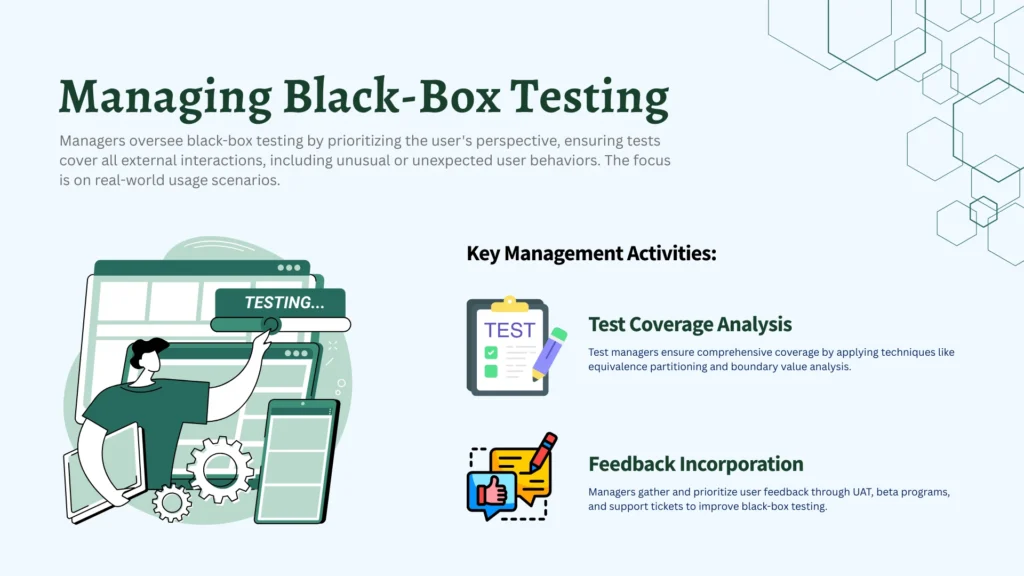
As we discussed, black-box testing is about validating the system from the outside. The management focus here is to champion the user’s perspective, ensuring that tests are user-focused and that all possible external interactions are covered. The manager constantly asks, “Have we tested this the way a real user would, including all the strange and unexpected things they might do?”
Key Management Activities:
Test Coverage Analysis
In black-box testing, “coverage” has nothing to do with code. It’s about covering user scenarios and business requirements. A test manager’s job is to ensure the team is thinking beyond the “happy path.” This involves encouraging the use of black-box design techniques like:
- Equivalence Partitioning: Grouping inputs into classes to test one representative from each (e.g., testing one valid age, one too low, one too high).
- Boundary Value Analysis: Focusing tests on the “edges” where errors often occur (e.g., if a field accepts 1-100 characters, test 0, 1, 100, and 101).
- Decision Table Testing: Mapping out complex business rules to ensure all combinations are tested.
The goal of this analysis is to cast a wide net that covers the full spectrum of user interactions.
Feedback Incorporation
Because black-box testing is so user-centric, getting feedback from real users is invaluable. A key management task is managing the process of gathering feedback from stakeholders to refine black-box testing approaches. This can involve organizing User Acceptance Testing (UAT) sessions, running beta programs, or analyzing feedback from support tickets.
Once this feedback comes in, the manager is responsible for ensuring it gets triaged and that the resulting defects are prioritized and fixed. This creates a powerful feedback loop where real-world usage directly informs and improves the quality assurance process.
Managing White-Box Testing: The Developer’s Point of View 🔬
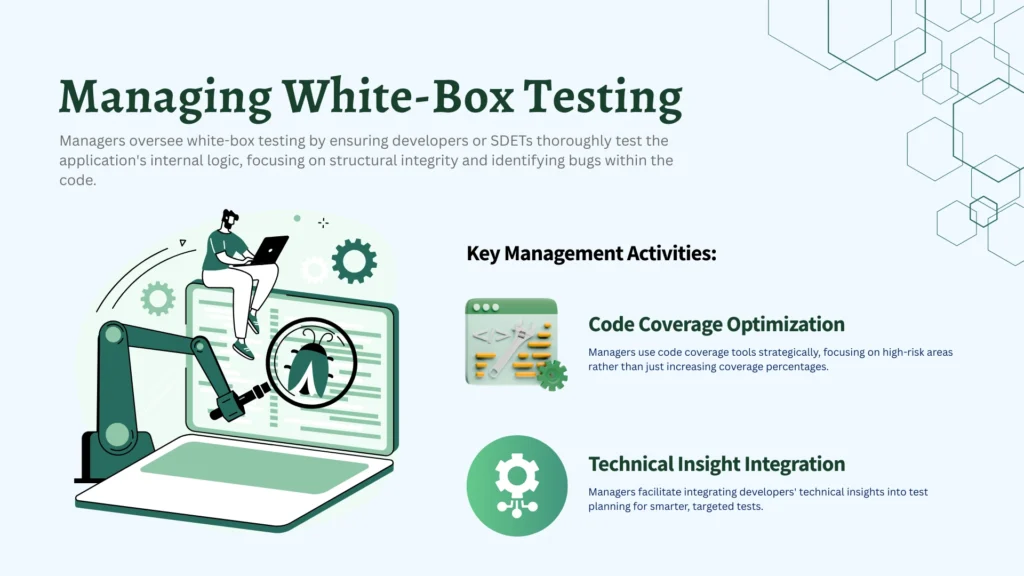
White-box testing is a deep dive into the application’s internal structure. It is almost always performed by developers or specialized software development engineers in test (SDETs). Its management, therefore, emphasizes understanding the code structure and ensuring that tests thoroughly cover the internal logic. The focus is on structural integrity and finding bugs at their source.
Key Management Activities:
Code Coverage Optimization
White-box testing relies heavily on metrics produced by code coverage tools. These tools show exactly which lines of code, branches (if/else statements), and functions are executed by the test suite. However, the goal is not just to chase a high percentage. The manager’s role is to oversee the intelligent use of these tools.
This involves identifying gaps in white-box testing and directing resources to address these areas. A development lead acting as a test manager might see a report and say, “Our overall coverage is 85%, but the critical error-handling logic in our payment processing module is at 10%. That’s a huge risk. Let’s focus our efforts there.” This is strategic optimization, not just number chasing.
Technical Insight Integration
The people who write the code have the deepest understanding of its complexities and risks. A crucial management activity is managing the incorporation of technical insights into the test planning process. It’s about creating a culture where developers are empowered to say, “I just refactored a core algorithm, and while my unit tests pass, we should probably run extra integration tests on these three downstream services because they could be affected in subtle ways.”
The manager’s job is to create channels for this kind of information to flow and to ensure that these valuable, code-aware insights are used to design smarter, more targeted tests.
Conclusion: The Integrated Symphony of Testing
These different management styles do not operate in isolation. They work together as part of an integrated approach to quality. Consider a simple new feature like a “Login with Google” button.
- Functional Management would ensure tests are planned to verify a successful login, a failed login, and what happens when the user cancels, all tracked against the project’s requirements.
- Non-Functional Management would oversee performance tests to ensure the login completes within a 1.5-second benchmark and security tests to verify that the authentication token is handled securely.
- Black-Box Management would ensure that testing covers different browsers and that scenarios like a slow network connection during the login process are considered.
- White-Box Management would have a developer lead check code coverage reports to confirm that the internal logic for the API callback, including all its error-handling branches, is thoroughly covered by unit tests.
Effective test management isn’t about picking one approach; it’s about skillfully conducting this symphony of different techniques. By understanding the unique goals and management activities of each test type, developers and testers can better align their efforts, communicate their value, and contribute to a truly comprehensive and robust quality strategy.