Have you ever been in a situation where deadlines are pressing, everyone is busy, but no one is sure what to do next? This is where Scrum saves the day. It’s a simple framework that helps you organize complex work into manageable pieces, allowing your team to focus on what matters and deliver results.
This article will guide you through the basics of Scrum. We’ll explore its main goals and core characteristics. We will also learn about the different roles, key terms, and events that make up the Scrum process. For more practical knowledge on how to apply Scrum, you can wait for our part two.
1. What is Scrum?

What Scrum is
Scrum is a simple framework for teams to work together. Instead of a long, single process, Scrum breaks down complex work into small and manageable pieces that fit into fixed time-boxed cycles called sprints. Typically, a sprint lasts about two weeks, though these sprints can range from one week to a maximum of one month, depending on the team’s needs.
Imagine you are building a new website. With Scrum, you do not try to build the entire site at once. Instead, you might work on the login page first. You finish it in 2 weeks, get feedback, and then start on the next page. This step-by-step approach ensures that each part is usable, tested, and improved before moving on to the next.
What Scrum is not
Scrum is not Agile
It is also important to know what Scrum is not to avoid confusion. Scrum is not Agile. Agile is a mindset defined by values and principles, such as adapting to change, delivering value quickly, and improving through feedback. Scrum is one of the frameworks that helps teams achieve Agile values.
For example, instead of waiting months to deliver the full website, you would deliver smaller, usable parts such as a login page or shopping cart quickly, then improve them based on feedback. This is an Agile mindset. Scrum is one way to do this in practice: it organizes the work into 2 sprints, where each sprint team commits to delivering a usable feature (login page & shopping cart) and the team adapts continuously based on what they learn.
In general, Agile is a mindset, while Scrum is one of many structured frameworks you may choose to put that mindset into action.
Read our related blog about Agile vs Waterfall approach here: Agile Testing vs Waterfall Testing.
Scrum is not micromanagement
While Scrum breaks down large work into smaller pieces, it does not mean to turn top-down management into micromanagement. The purpose is to give the team more control, not less. Rather than dictating every detail, Scrum empowers the team itself to organize and decide how the work should be completed.
2. Characteristics of Scrum
Then, after knowing about Scrum, you may wonder what characteristics make Scrum unique. Scrum has 3 main characteristics:

Iterative & Incremental:
Scrum is usually in the form of short, repeated cycles. After completing each cycle, you create a new one based on the last one you have finished. Think of it like building a house one room at a time. The first room is a simple box. Next week, you will add a window. The week after, you add a door. This allows you to improve the product continuously. Thanks to this approach, you can have more time for refinements rather than waiting until the end.
Time-boxed Cycles:
Everything in Scrum has a time limit, including the work cycles. Those cycles are called Sprints. They last for a fixed period. This creates a sense of urgency and helps your team stay focused on delivering value within a limited timeframe. When the time is up, you must stop, even if the work is not fully complete. As a result, Scrum prevents endless work cycles and encourages teams to focus on prioritizing essential tasks, leading to higher productivity, clearer outcomes, and better alignment with project goals
Outcome-Driven:
Scrum is an outcome-driven approach. This means that Scrum is not just about completing tasks; it is about delivering tangible value. Each sprint is a focused effort to produce a finished, working product. Traditional methods might measure success by completing a long list of tasks or milestones. Meanwhile, with Scrum, the goal is always a usable product that customers can test and provide feedback on. This focus on outcomes helps the team stay aligned with what truly matters to the customer, ensuring that every effort contributes to the final, valuable result.
3. Scrum vs Kanban
So, when should you use Scrum? Let’s compare it to Kanban to see the differences and determine in which case you should apply this framework.
How it looks
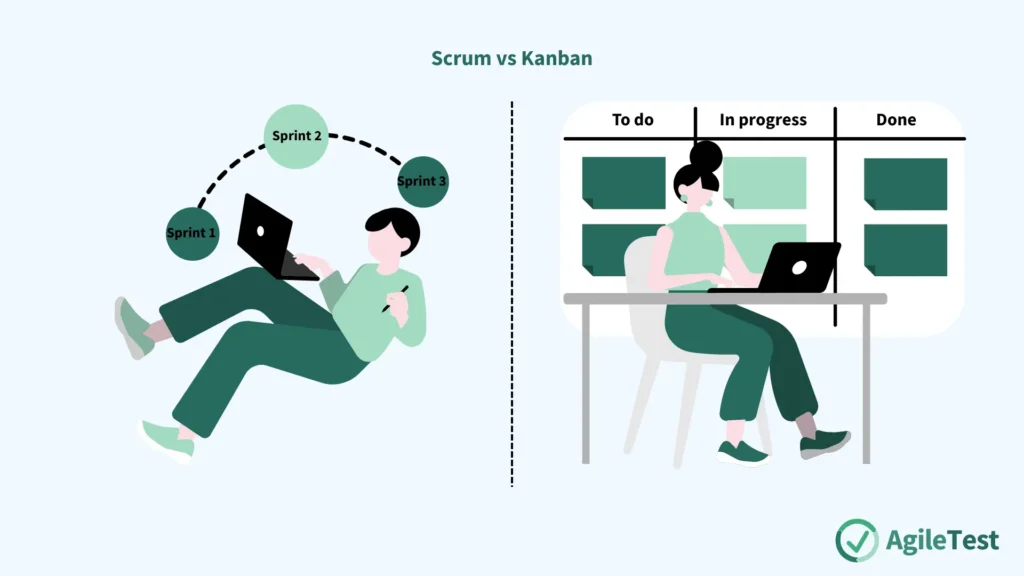
Scrum is a very structured way for a team to work. It has specific roles for people, clear documents for tracking work, and scheduled events to continuously close the feedback loop internally.
Kanban, on the other hand, is a visual approach that uses a Kanban board to illustrate workflow, with columns like “To Do“, “In Progress“, etc, and “Done“. This board is the main tool for tracking and visualizing how their work proceeds.
How it operates
Scrum uses an iterative and incremental approach. Work is planned and completed in fixed-length sprints. The team commits to a set of tasks at the beginning of each sprint and works together to complete them. The focus is on teamwork and delivering a working product increment. This would be the best fit for complex and long-term tasks that require continuous feedback, adaptation, and improvement based on lessons learned during each cycle.
Kanban, in contrast, uses a continuous flow model. There are no sprints or fixed cycles. Team members simply pull new tasks from the “To Do” column as they complete their current work. The main goal is to keep work flowing smoothly. It should be best used for simple and repetitive tasks where priorities can change frequently, and the emphasis is on maintaining efficiency and minimizing delays rather than planning in fixed cycles.
How it is measured
In Scrum, progress is measured by the successful delivery of working product increments at the end of each sprint. Teams often track their velocity (the amount of work completed per sprint) to help predict how much they can accomplish in the future.
In Kanban, success is measured by the efficiency of the workflow. Key metrics include cycle time (how long it takes for one task to go from start to finish) and throughput (the number of tasks completed over a period of time).
How it adapts to changes
Scrum is less dynamic when it comes to changes. Since work is organized into fixed-length sprints, the scope of a sprint is generally set once it begins. This stability allows the team to focus on completing the planned tasks without interruption.
Kanban, on the other hand, adapts continuously. Priorities can shift at any time, and new tasks can be added to the board as they arise. This makes Kanban highly flexible, ideal for environments where work priorities change frequently.
How it works with the timeline
Scrum‘s sprints create a predictable delivery schedule. Since each sprint has a fixed duration, the team and stakeholders always know when to expect a new working product.
Kanban has no fixed timeline. Work is continuous, and the time it takes to complete a task depends on how long it takes to move through the workflow. This can make it less predictable than Scrum for projects that require regular, scheduled deliveries.
Pick the right choice
When it comes to choosing between Scrum and Kanban, the right choice depends on your project’s needs. Kanban is the ideal framework for teams that handle ongoing, unpredictable work, where priorities change frequently and a continuous flow of tasks is more important than fixed delivery dates. It works best for tasks that are repetitive or reactive, such as customer support or maintenance, where flexibility and efficiency are key. With Kanban, work moves smoothly from one task to another, optimizing throughput and minimizing delays.
Contrastingly, Scrum is best for projects that require a clear structure and predictable progress. Its sprints allow teams to focus on specific goals within fixed periods, ensuring regular delivery of usable increments. Scrum’s structured approach fosters collaboration, alignment, and continuous feedback, making it the ideal choice for complex projects where teams need to collaboratively cooperate and proactively adjust with feedback at regular milestones.
4. Scrum Artifacts
Before going deep into a Scrum workflow, you will need to get familiar with some Scrum artifacts. An artifact is a key document that a Scrum Team uses to manage its work.

Product Backlog:
The Product Backlog is a prioritized list of everything that needs to be “done” for the project. It includes features, bug fixes, technical tasks, and new requirements. One project only has one product backlog. Noticeably, this document is not flat. As the team learns more, whether through feedback, testing, or market changes, the product backlog is regularly refined and adjusted to reflect the most current needs. In this way, you ensure that the team is always working on the highest priority items, enabling continuous value delivery and making the backlog a critical tool for guiding the project through its sprints.
Sprint Backlog:
The Sprint Backlog is a subset of the Product Backlog. It consists of the items the team commits to working on during a single sprint, chosen based on their priority and the team’s capacity. Once selected, it becomes a static list during the sprint, in which no new tasks are added, and no scope changes are made. However, you can have multiple sprint backlogs for the whole project, but only use one for each sprint. This helps maintain focus and ensures that the team delivers a complete, usable product increment by the end of each cycle. By restricting changes during the Sprint, the team can concentrate on the tasks at hand and commit to delivering the agreed-upon work within a limited timeline.
The Increment:
The Increment is the finished, usable product at the end of each sprint. Each Increment must be usable, meaning it is completed and functions properly to add value to the current product. Note that the increment is not just the outcome of a single sprint; it accumulates over time, with each sprint adding new functionality, features, or improvements. This ensures that by the end of each sprint, the product is continuously evolving and can be evaluated for feedback, ensuring it aligns with user needs and business goals.
5. Scrum Events
Now, you may question when these artifacts should be used. In fact, Scrum uses specific meetings to keep the team on track and discuss items in those artifacts. Some common Scrum events may include:
Sprint Planning:
The Sprint Planning meeting takes place at the start of each Sprint. The Scrum Team comes together to select the highest-priority items from the Product Backlog and organize them into the current Sprint Backlog or arrange them for future sprints. This collaborative meeting ensures the team is aligned on their shared goals, sets clear expectations, and clarifies any uncertainties about the work.
Daily Scrum:
Daily Scrum (sometimes referred to as a Daily Stand-up meeting) is a short, 15-minute meeting that happens every day. The team quickly recaps what they did yesterday, what they will do today, and any problems in their way. It keeps everyone aligned and focused on the Sprint backlog.
Sprint Review:
The Sprint Review happens at the end of each Sprint, where the team demonstrates the Increment to stakeholders. In this meeting, the Scrum Team showcases what has been accomplished according to the Sprint Backlog, discusses the progress made, and gets feedback from the stakeholders. During this meeting, the team and stakeholders discuss the next steps, adjust priorities, and refine the Product Backlog as necessary. Thanks to this session, the project is ensured to be on the right track and aligns with stakeholder needs.
Sprint Retrospective:
The Sprint Retrospective also takes place at the end of each Sprint, usually after the Sprint Review. It is a reflective meeting where the team evaluates their process and discusses what went well during the Sprint, as well as areas that could be improved. The goal of the Retrospective is to identify strengths to continue building on and challenges that need to be addressed in the upcoming Sprint. By making small, incremental improvements based on feedback and reflection, the team ensures that they’re always getting better after each sprint.
6. Scrum Roles
Finally, after acknowledging key Scrum artifacts and events, we come to the Scrum role section. A Scrum team has three main roles. Each role has a specific scope of work.
The Product Owner:
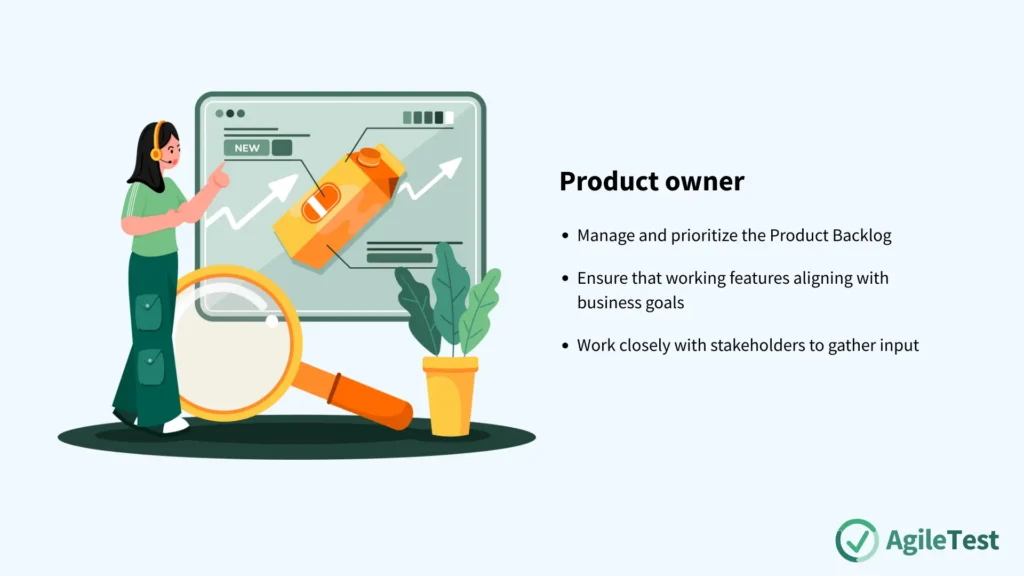
The Product Owner is responsible for managing and prioritizing the Product Backlog. They are the “what” person. They act as the voice of the customer and ensure that the team is working on features that align with business goals. The Product Owner also works closely with stakeholders to gather input and prioritize what features the team should focus on.
The Scrum Master:
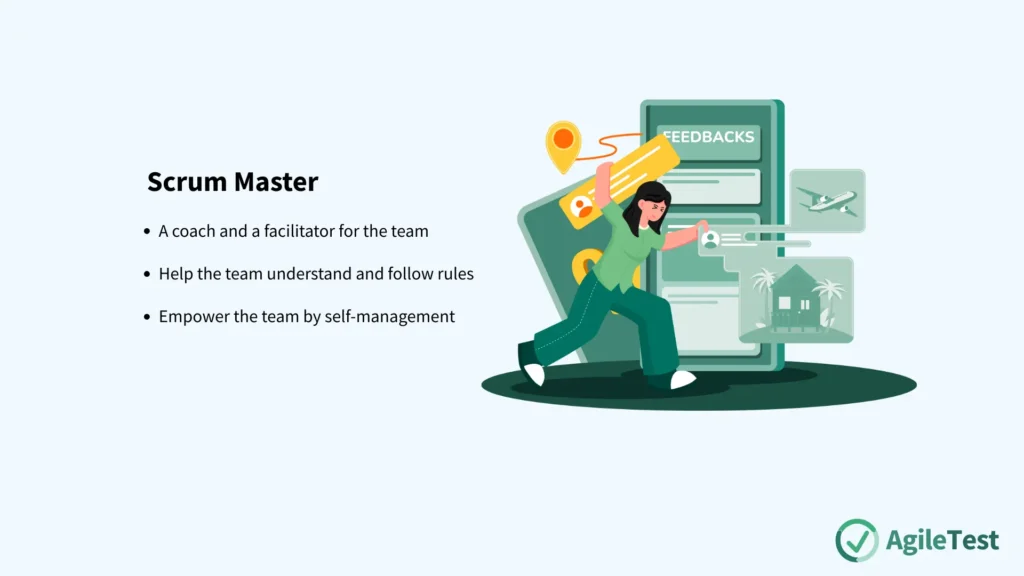
The Scrum Master is a coach and a facilitator for the team. They are the “how” person. They help the team understand and follow the Scrum rules. Rather than managing the team directly, the Scrum Master works to empower the team by ensuring that Scrum is implemented effectively and by helping the team manage itself. The Scrum Master also works to remove obstacles that get in the way of the team’s work and facilitate a collaborative environment.
The Development Team:
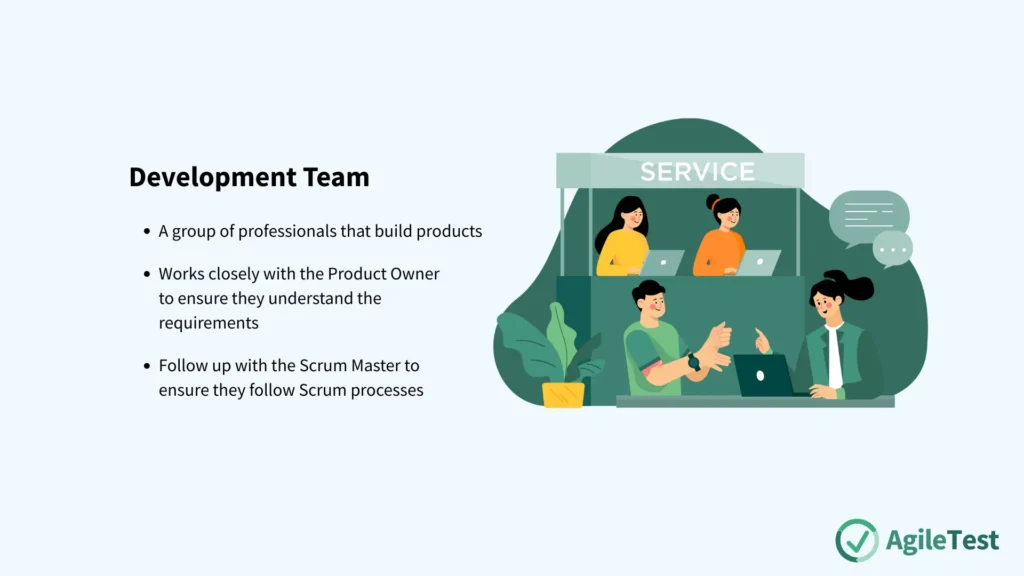
The Development Team is a group of professionals who are responsible for building the product. They are self-organizing, meaning they decide how to approach and complete the work within each Sprint. The Development Team works closely with the Product Owner to ensure they understand the requirements, and with the Scrum Master to ensure they follow Scrum processes. Their focus is on delivering high-quality increments that add value to the product, ensuring that the product is continuously improved throughout the project.
Final Thoughts
Congratulations! You’ve successfully navigated the core concepts of Scrum. You now have a solid understanding of its key characteristics, goals, and the roles, events, and artifacts that make it work.
By embracing this framework, your team can move from a state of chaos to one of clarity and purpose. Instead of spending time endlessly planning, you can focus on what really matters: consistently delivering a high-quality, working product to your customers.
Scrum is more than just a set of rules—it’s a flexible mindset that empowers teams to succeed. Now that you’ve got the theory down, are you ready to learn how to apply it? Be sure to come back for our next article, where we’ll dive into the practical knowledge you’ll need to use Scrum effectively and get your team started on the path to success.