
In Agile worlds, teams are required to deliver valuable results in each sprint. Relying on a single, lengthy test phase can cause bottlenecks and make this goal unachievable.
To fix this, we need a balanced approach. The Agile Testing Quadrants provide a powerful framework that not only helps teams prioritize what they should focus on each sprint but also ensures enough test types are conducted. This article will break down the Agile Testing Quadrants, explain why they are essential for delivering high-quality software, detail each of the four areas, and show you how to apply them to achieve true quality in every sprint.
1. What Are Agile Testing Quadrants?
The Agile Testing Quadrants (ATQ) are a powerful framework designed to organize testing activities in Agile software development. It helps teams see what to test, why, and for whom.
- What techniques should be used?
- Why do those tests need to be conducted?
- Who is in charge of those tests?
- ….
The framework is structured along two main axes that define the types of feedback and the focus of the test.
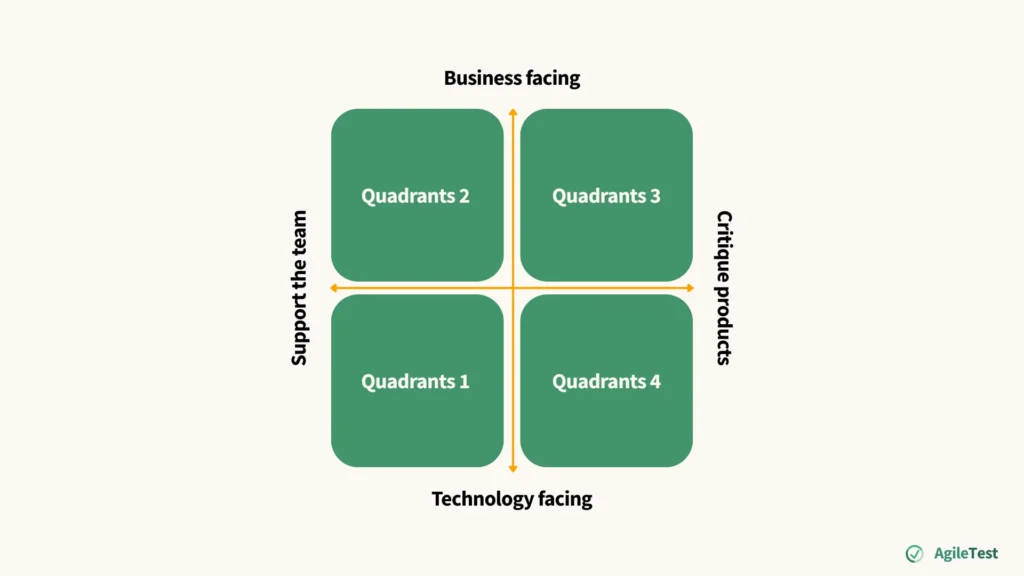
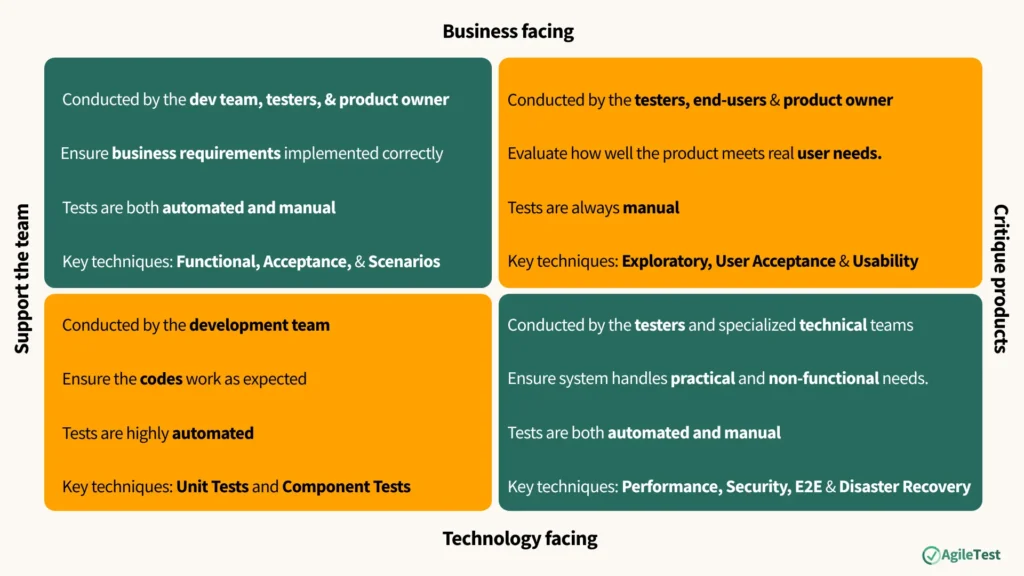
It compares two goals: tests that Support the Team (helping developers build the product correctly) with tests that Critique the Product (checking if the product meets business needs and works well for the customer).
It also compares two focuses: tests that are Technology-Facing (focused on internal code quality and architecture) with tests that are Business-Facing (focused on external features, requirements, and user value).
“Agile software development moves fast. To keep up, your testing strategy needs to be just as agile — and that’s where the Agile Testing Quadrants come in. Whether you’re a QA engineer, developer, or product owner, understanding these quadrants can help you balance test coverage, enhance collaboration, and deliver higher quality software.”
Zubair Khan, 2025
These quadrants map testing activities across two complementary goals and two distinct focuses. This ensures testing stays continuous throughout the development cycle rather than becoming an afterthought.
2. The Four Quadrants Explained
The quadrants are generally numbered from 1 to 4 and are best understood by their goal and their focus.
Quadrant 1: Technology-Facing Tests & Supporting the Team (The Code Validators)
The Q1 quadrant follows the goal Support the team and focus on Technology facing. It should be conducted by the development team. These tests act as the code validators to ensure the individual pieces of code work as expected. For example, if you have built a login page with code, you will conduct tests to see whether entering a valid username/password returns a success message and an invalid one triggers an error.
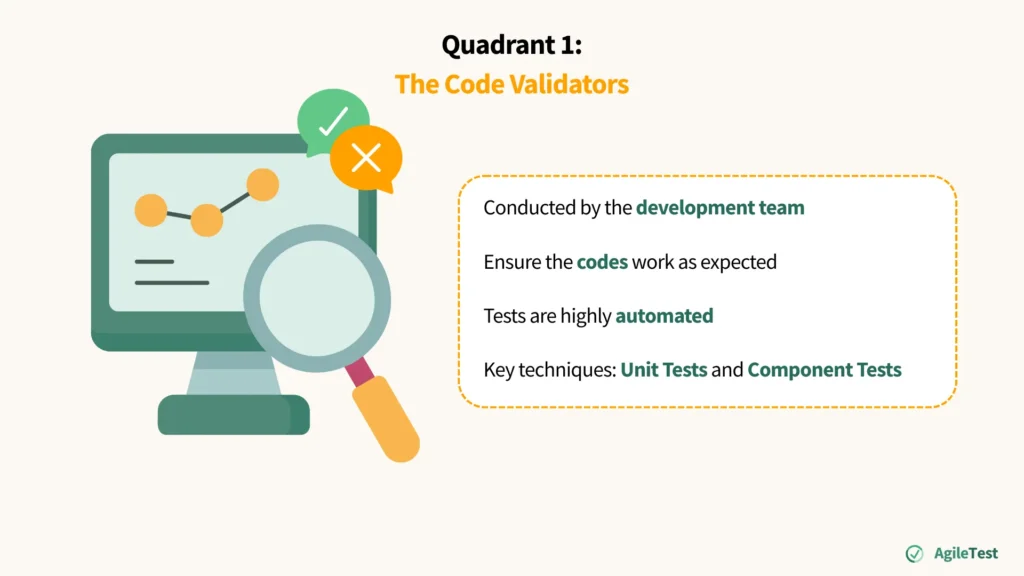
These tests are highly automated and execute quickly, allowing developers to run them frequently to get immediate feedback during the development cycle. They serve as the crucial safety net that reacts quickly to defects and alerts developers to errors. Without these tests, developers face a high risk when changing or refactoring code, because they might accidentally break existing functionality.
These tests should be conducted first after you finish the coding. This quadrant usually covers the architecture, functions, and components. The key techniques are Unit Tests (testing small blocks of code) and Component Tests (testing components one by one before integrating them back together).
Explore unit testing with our article: Improve Code Quality with JUnit: Unit Testing Basics.
Quadrant 2: Business-Facing Tests & Supporting the Team (The Requirement Checkers)
The Q2 quadrant aims at the goal Support the Team with a Business-Facing focus. These tests are conducted by the development team and QA/testers, often collaboratively with the product owner. These tests play a role as the requirement checkers to ensure that the business requirements agreed upon by the team are implemented correctly. They confirm that the team is building the feature as intended and stay on track with the product vision. For instance, you may check if your login page allows users to sign up with different portals (Email, Google, etc.)
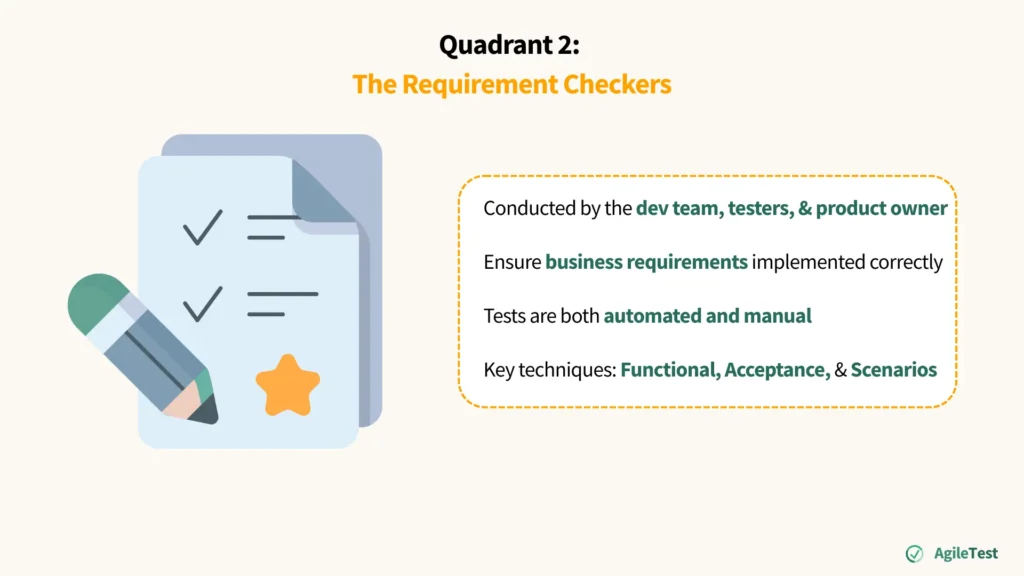
Q2 tests are often conducted side-by-side or immediately after the Q1 tests to confirm the team is building the right things customers want. You can apply both automated and manual testing to verify these business requirements. Key techniques include Functional Tests (automated tests to verify each feature performs as expected), Acceptance Tests (often using BDD/Gherkin to translate business requirements into automated, repeatable tests), and Scenario Tests (validate specific user stories or workflows to match intended goals).
Quadrant 3: Business-Facing Tests & Critiquing the Product (The User Experience Check)
The Q3 quadrant emphasizes the goal Critique the Product with a Business-Facing focus. These tests are conducted mostly by testers, sometimes with end-users, on UAT sessions and with input from the product owner. These tests can be considered as a user experience check to evaluate how well the product meets real user needs. They focus on subjective qualities that automation cannot easily measure and provide critical feedback on how people perceive the products in real-world usage. For illustration, testers should evaluate your login page to see if your layout, theme, colors, etc., are user-friendly. This includes making it accessible for non-technical users.
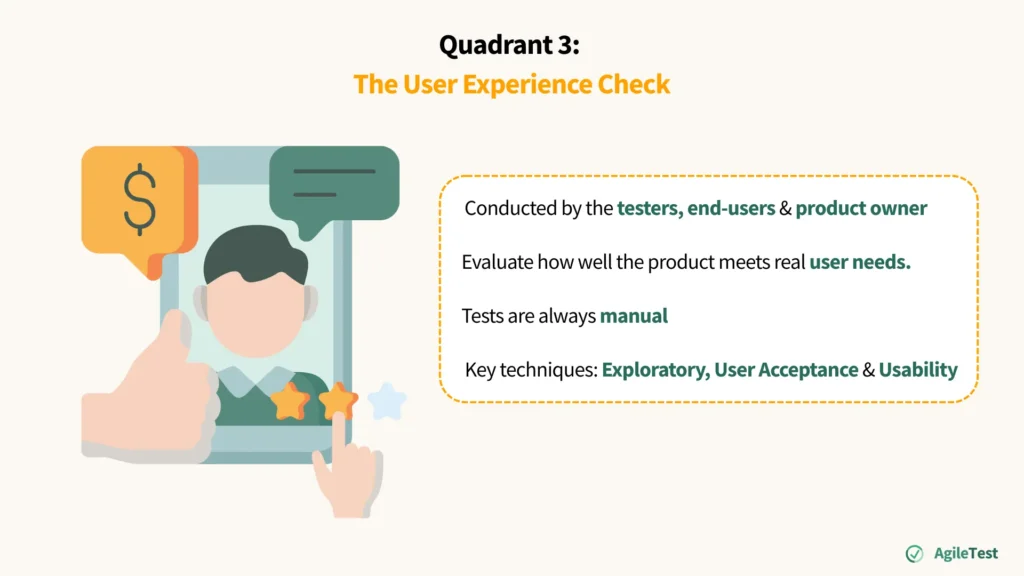
Q3 tests are almost always manual and rely on human judgment, usually after Q1 and Q2 (verifying code stability and business requirements). The scope is on usability, accessibility, user experience (UX), and overall fit for purpose. You can apply the Exploratory Testing technique to run unscripted sessions and uncover unexpected issues, which complement other automated tests. User Acceptance Testing and Usability Testing techniques should be applied when you need practical insights from end-users about your products for further improvements.
Try AgileTest to make use of the Exploratory testing feature, which helps you enhance your testing process.
Quadrant 4: Technology-Facing Tests & Critiquing the Product (The System Stressors)
The Q4 quadrant follows the goal Critique the Product with a Technology-Facing focus. These tests are conducted primarily by testers and specialized technical teams, such as performance engineers or security experts. They behave as the system stressors that evaluate the system from a deep technical perspective. These tests verify that the system can handle real-world demands and meet non-functional requirements, emphasizing reliability, scalability, and security. They evaluate the system as a whole and answer critical questions such as: “Can this system support 10,000 users simultaneously?”—ensuring long-term stability and resilience.
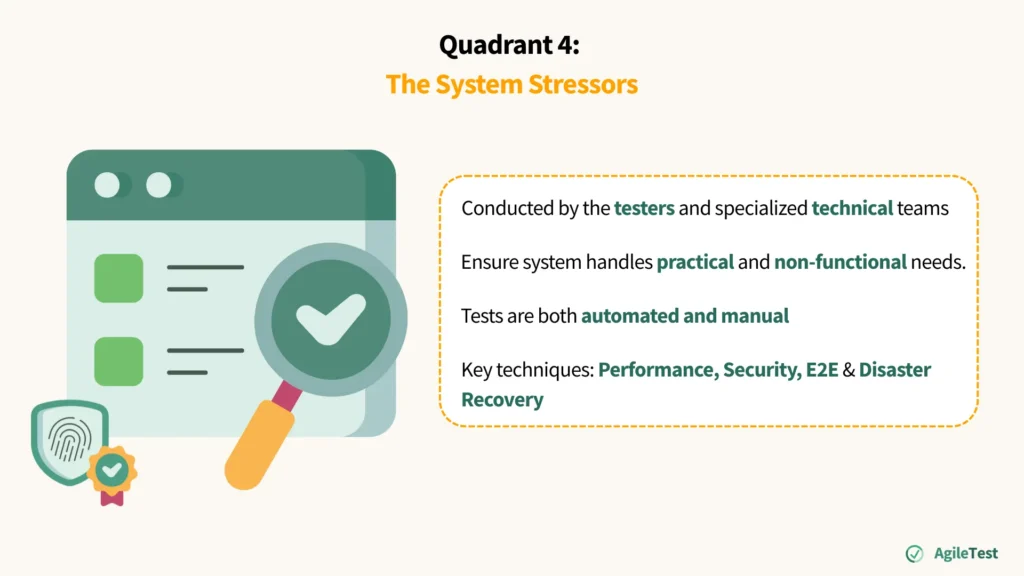
Q4 tests are both complex with automated and manual types, often require specialized tools or test environments, and are typically executed less frequently after all Q1, Q2, and Q3 tests have been completed. The focus areas include performance, security, scalability, reliability, and infrastructure robustness. You can apply the Performance Testing technique to evaluate a system’s speed, stability, responsiveness, and reliability. In case you want to find and fix vulnerabilities to avoid cyberattacks, data breaches, and unauthorized access, Security Testing is the right choice. The end-to-end Testing technique could be applied to validate the complete workflow of an application from start to finish. Disaster Recovery Testing comes in handy when you need to test the ability to restore data, applications, and operations.
3. Achieving Balance: The Key to Agile Quality
The greatest value of the quadrants is achieved not by mastering one area, but by mastering the balance between them.
A frequent misuse of the framework is an over-reliance on automated testing (Q1, Q2, and some Q4). Teams may have thousands of automated tests that all pass, yet the product still fails in the real world. That is because they neglect Quadrant 3, the manual, business-facing critique. No matter how good your automated suite is, you still need human eyes and brains to judge usability, flow, and user experience. The human element of testing is irreplaceable.
The opposite mistake is to ignore Q1 and Q4, which leads to technical debt. A team might rely only on manual Q2 and Q3 testing, meaning they have no automated safety net for their code. This makes the product fragile: every change a developer makes risks breaking other parts of the system without immediate detection. As the project grows, development slows to a crawl because the cost of change becomes too high.
To maintain balance, the quadrants must be built into every sprint. Developers focus on Q1 and Q2 tests while writing code. Testers lead the essential Q3 Exploratory and UAT sessions toward the end of the sprint, ensuring the product meets the demands. Simultaneously, Q4 tests run less often but are necessary to verify the system’s long-term health.
4. Benefits of Using Testing Quadrants
Adopting the Quadrants is not just about organizing tests; it’s about changing how your team approaches quality.
By applying different testing methods to each quadrant, the framework ensures the team examines more than just functionality. It covers both the internal health of the code (is the code clean and stable?) and the external user experience (is it easy to use?). For example, experienced testers can actively explore the app’s functionality, while non-technical users may struggle without clear instructions. This framework provides full test coverage and prevents the common problem of building a technically correct product that is difficult for customers to use.
The quadrants also provide a quick visualization tool for prioritization. Since the framework balances four different types of testing, the team can quickly see where they’re missing. For example, if your team has written a lot of code but is missing tests that check the internal code quality (Quadrant 1), they immediately know they have a high risk of introducing hidden problems.
This framework also makes sure quality isn’t just checked at the end; it’s built in by everyone. The framework clearly shows this by categorizing certain activities. For illustration, the tests designed to support the team (Quadrants 1 and 2) are focused on making sure the product is constructed correctly from the very start. This means developers must own a large part of that work, such as writing unit tests. This approach helps spread the responsibility for quality across the entire team, fostering quality ownership from the very first day of the project.
Final Thoughts
The Agile Testing Quadrants are more than just a model; they are a framework for shared quality responsibility. They pull testing out of a single department and embed it into the center of the development process. You can make use of this compass to navigate the competing needs of technical perfection and business value, and make sure your team delivers each software increment at the highest quality. Apply the four quadrants to turn testing from a hurdle into a strategic advantage, producing robust, high-value software every sprint.