
Hey everyone, let’s chat. I’ve been a QA Manager for a good while now, and if there’s one thing I’ve seen time and time again, it’s the evolution of how we handle defects. I remember my early days when the process felt like a game of hot potato. My team would find a bug, write a report, and toss it over a virtual wall to the development team. Then we’d wait. Sometimes it got fixed, sometimes it vanished into a backlog black hole, and sometimes it came back with a comment: “cannot reproduce.” It was inefficient, created friction, and honestly, it didn’t serve the product or our customers.
Over the years, I’ve learned a crucial lesson: effective defect management is not a QA-only activity. While the test organization, and by extension, my role, often owns the overarching process and the fancy tracking tools, the actual management of defects is a team sport. It requires a cross-functional huddle of minds from across the project. It’s a strategic conversation, not just an administrative task.
The old way of thinking positions QA as the “gatekeeper of quality.” I prefer to think of us as the “facilitators of the quality conversation.” Our job isn’t just to find what’s broken; it’s to provide the data and context so that the entire team can make intelligent, informed decisions together. Let’s dive into what this collaborative approach looks like and why it’s the only way to build truly great software.
Assembling the Quality Avengers: The Defect Management Committee
The cornerstone of modern, effective defect management is a cross-functional team, which I like to call the Defect Management Committee. This isn’t some stuffy, bureaucratic board. It’s a dynamic group of stakeholders who come together to guide a defect from discovery to resolution. Think of them as the project’s immune system, identifying issues and collectively deciding on the best way to heal the product.
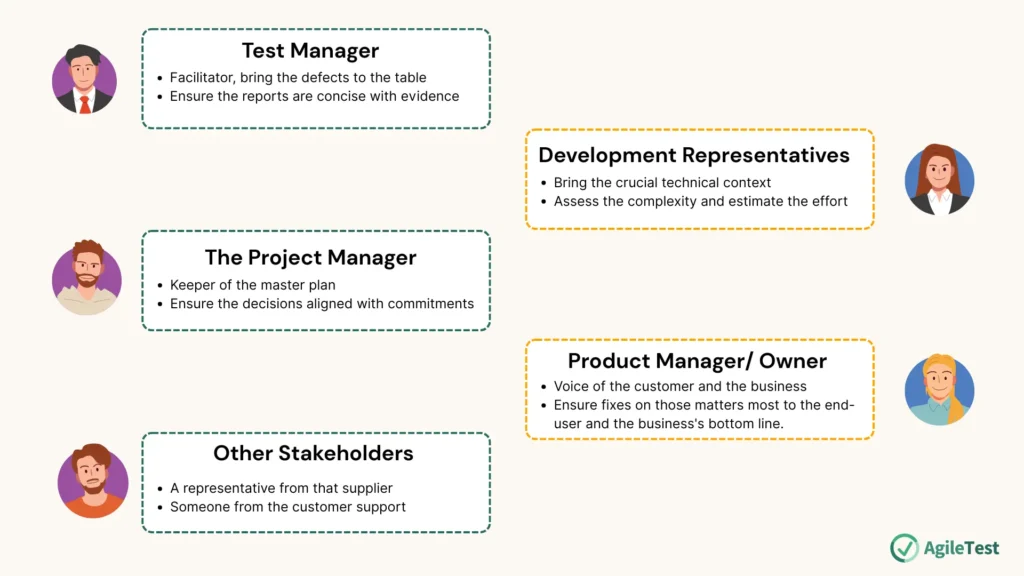
Who gets a seat at this table? It’s all about getting the right perspectives in the room.
- The Test Manager (That’s me!): I usually play the role of facilitator. My team and I bring the defects to the table. We’re responsible for ensuring the reports are clear, concise, and have all the necessary evidence—steps to reproduce, logs, screenshots, you name it. We represent the facts of the situation and provide objective information about the impact we’ve observed during testing.
- Development Representatives: This is non-negotiable. You need key people from the development team—often team leads or senior engineers who represent the different parts of the application (e.g., front-end, back-end, database). They bring the crucial technical context. They can quickly assess the complexity of a potential fix, speculate on the root cause, and, most importantly, estimate the effort involved. Without their voice, any decision is just a guess.
- The Project Manager: This person is the keeper of the master plan. They have the 50,000-foot view of the timeline, budget, and resource allocation. Their key question is, “How does fixing this defect affect our delivery schedule?” They ensure that the decisions we make about bug fixes are aligned with the overall project commitments.
- The Product Manager or Product Owner: This is the voice of the customer and the business. They are the ultimate arbiters of value. A bug might be technically severe, but if it only affects an obscure edge case that 0.01% of users will ever encounter, is it more important than a minor UI annoyance that 95% of users see every day? The Product Owner answers that question. They ensure we’re spending our valuable development time on the fixes that matter most to the end-user and the business’s bottom line.
- Other Stakeholders: Depending on the project, this group can expand. If we’re using a third-party component, a representative from that supplier might be needed. If the defect relates to a live issue, someone from the customer support team can provide invaluable context on how it’s impacting real people.
Having this diverse team is what transforms defect management from a simple bug-squashing exercise into a strategic decision-making process.
Read our guide about stakeholder matrix here: Who’s in Your Corner? A Developer’s Guide to the Stakeholder Matrix.
The Heart of the Matter: The Triage Meeting
So you have your committee. Now what? The main event is the triage meeting. This is where the magic happens. The goal of this meeting isn’t to fix the defects on the spot or to delve into deep technical debugging. The purpose is to look at new or un-actioned defects and make clear, decisive choices.
As each defect comes up for review, the committee works through a series of critical questions, and this is a conversation, not an interrogation.
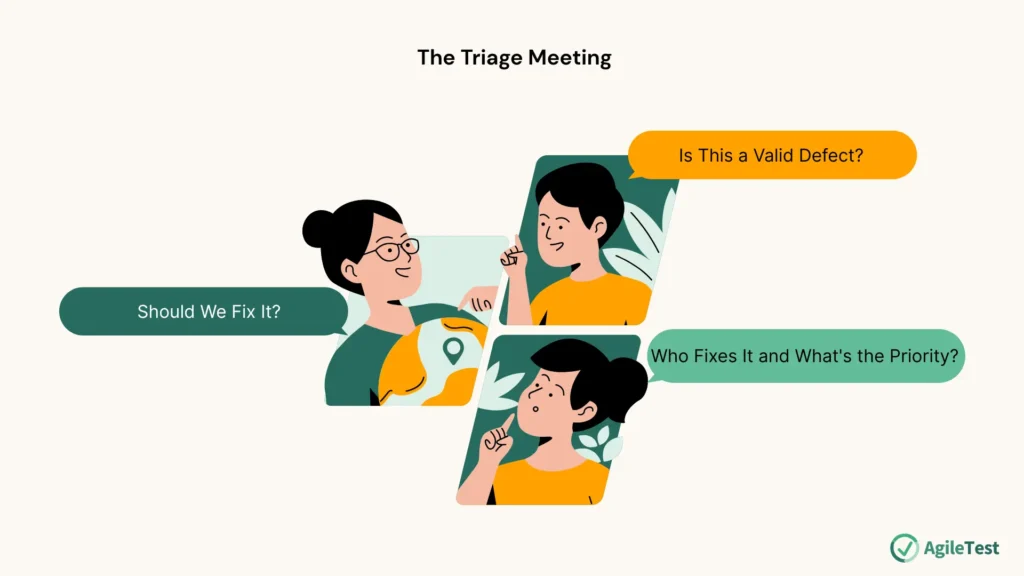
- Is This a Valid Defect? The first step is validation. As the QA representative, I’ll present the defect report. We discuss if it’s a genuine bug, a misunderstanding of the requirements, a duplicate of an existing issue, or perhaps an environmental problem specific to the test setup. This step alone saves countless hours by filtering out noise before it ever reaches a developer’s plate.
- Should We Fix It? This is the most important question and requires a careful balancing act. The committee has to weigh the benefits, risks, and costs of fixing the issue.
- Benefit: What good comes from fixing this? The Product Owner speaks to this. Will it improve user satisfaction, unblock a key workflow, or prevent potential revenue loss?
- Risk: What are the risks of not fixing it? This is a group discussion. It could be reputational damage, data corruption, or a security vulnerability. We also have to consider the risk of fixing it. Could the fix destabilize a core part of the application and introduce new, worse bugs? The development and QA teams provide this crucial perspective.
- Cost: What is the development and testing effort required? The development lead provides an estimate. A “simple” fix that takes two hours is a very different proposition from one that requires a week of refactoring.
- If So, Who Fixes It and What’s the Priority? If the decision is to fix the defect, two things must be established immediately. First, in projects with multiple development teams or external suppliers, clear ownership is assigned. This prevents the defect from getting lost in translation between teams. Second, and most critically, the team establishes the priority. This is a collective decision. The technical severity provided by QA is an input, but the final priority is determined by blending that with business impact (from the Product Owner), project timelines (from the Project Manager), and the cost to fix (from Development). This ensures we’re always working on the most important things first, not just the easiest or the loudest.
Based on this conversation, a defect is moved to its next state: assigned to a developer to be fixed, rejected with a clear explanation, or deferred to a future release if it’s deemed valid but not urgent enough for the current cycle.
Install AgileTest to manage your test cases and defects effectively.
The Role of Tools and People
It’s tempting to think that a powerful defect management tool like Jira or Azure DevOps can solve all these problems. And while a good tool is essential, it’s crucial to remember that a tool is a facilitator of a process, not a substitute for communication. I’ve seen projects with the most sophisticated tool setups fail because the people didn’t talk to each other.
Refer to our guide to select the test management tool here: Choosing the Right Test Management Tool.
A well-configured tool should mirror and support the collaborative process. This means:
- A Clear Workflow: The states in your tool (e.g., New, In Triage, Ready for Dev, In Progress, Ready for QA, Closed) should perfectly map to the decision-making process of your Defect Management Committee.
- High-Quality Data: The process starts with a good defect report from my team. We work hard to ensure every report is a solid foundation for the triage discussion.
- Visibility for All: The tool should act as the single source of truth. Dashboards and reports should be easily accessible so anyone, from a developer to an executive, can understand the health of the project at a glance.
Conversely, the committee should not be a substitute for using the tool effectively. Every decision made in the triage meeting must be meticulously documented in the defect ticket. The “why” behind a decision to reject or defer a defect is just as important as the assignment of one to be fixed. This creates a historical record that is invaluable for future reference and for identifying long-term trends.
Learn how to introduce new tools with our guide: The Right Tool for the Job: My Playbook for Introducing New Tools Without the Chaos
Scaling the Operation: The Dedicated Defect Manager
On smaller projects, I often wear the hat of the defect process owner, preparing for and following up on our triage meetings. However, the source text rightly points out that on very large, complex projects, this can become a full-time job. During the most intensive phases of testing, the sheer volume of incoming defects can be staggering.
In these scenarios, appointing a dedicated Defect Manager can be a game-changer. This person isn’t necessarily a deep technical expert or a tester. They are an expert facilitator and process manager. Their role is to make the entire defect management lifecycle run like a well-oiled machine.
They handle the critical prep work for triage, ensuring all new tickets are complete and ready for discussion. They facilitate the meeting itself, keeping the conversation on track and ensuring every defect gets a clear decision. And, perhaps most importantly, the follow-up is done: action items are chased down, ambiguities are clarified, and the decisions made by the committee are actually ensured to be implemented in the backlogs. They are the grease in the gears that allows the rest of the team to focus on their core responsibilities.
Make use of the AgileTest test case management to keep track of your tests with all linked issues in 1-page interface.
The Virtuous Cycle of Collaboration
When you shift from a siloed, “over-the-wall” approach to this cross-functional model, something amazing happens. It’s more than just efficient; it fundamentally changes the culture.
- Shared Ownership Emerges: Quality is no longer “QA’s job.” It becomes a collective responsibility. Developers become more invested in the outcomes of testing, and product owners gain a deeper appreciation for the technical challenges.
- Smarter, Faster Decisions: A focused 30- or 60-minute meeting replaces endless email chains and comment threads. People resolve ambiguity in real time. The group makes decisions with all the necessary context present.
- Stronger Relationships: The adversarial dynamic between QA and Development dissolves. When you’re sitting at the same table (even a virtual one) working toward a common goal, you build empathy and partnership. It becomes “us” solving a problem, not “you” fixing “my” bug.
- True Business Alignment: The team stops fixing bugs just because they exist. Instead, you focus your limited and valuable engineering resources on the issues that truly impact your customers and your business objectives.
Ultimately, managing defects is about managing risk and delivering value. By treating it as a strategic, cross-functional conversation, you move beyond simply tracking bugs. You start building a culture of quality, collaboration, and continuous improvement. And that is how you build products that people truly love.