
To deliver a quality product, you need to understand the different ways you can approach testing. At the highest level, every test falls into one of two categories: structured and planned, which we call scripted testing, or flexible and detective-like, which we call unscripted testing.
This article will break down these two essential approaches. We’ll look at how each one works, where it shines, and, most importantly, how you can combine them to find the most bugs and deliver the best software.
1. What is Scripted Testing?
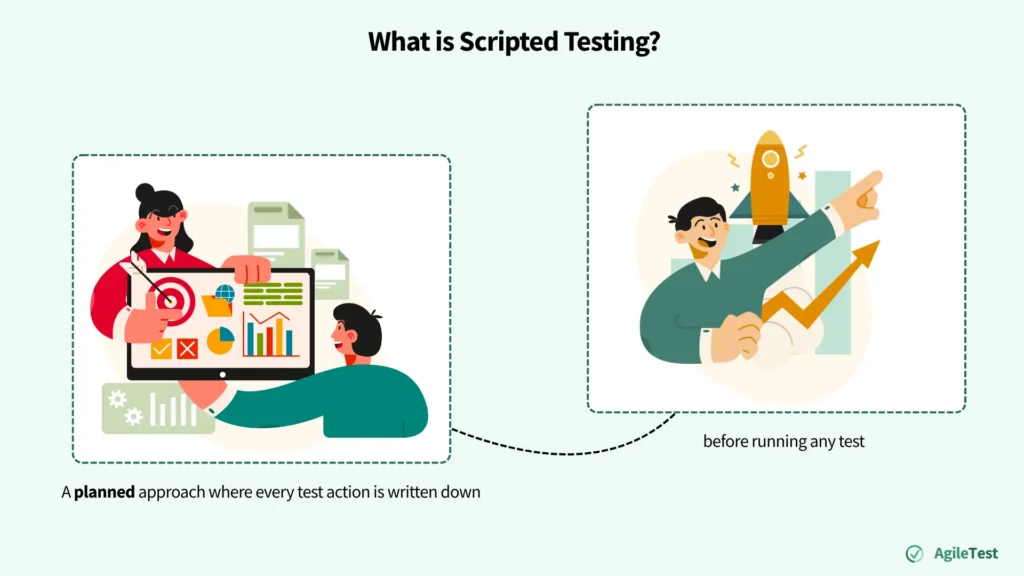
Scripted testing is a planned approach where every test action is written down before running any test. It starts with a detailed test plan that breaks down a feature into specific test cases. Each test case has exact, step-by-step test steps and a clear expected outcome. The tester simply follows the pre-written script and marks whether the actual result matches the expected one. This process is highly repeatable, meaning you can run the exact same test case again and again to ensure nothing has broken.
For example, when testing a login page, a scripted test case might include steps such as: enter a valid username, enter the corresponding password, and click the “Log in” button. The expected outcome is that the system grants access and redirects to the dashboard. Conversely, entering an invalid password should trigger an error message. By following these exact steps, testers can verify expected behaviors, ensuring that the login feature works as intended every time.
2. What is Unscripted Testing?
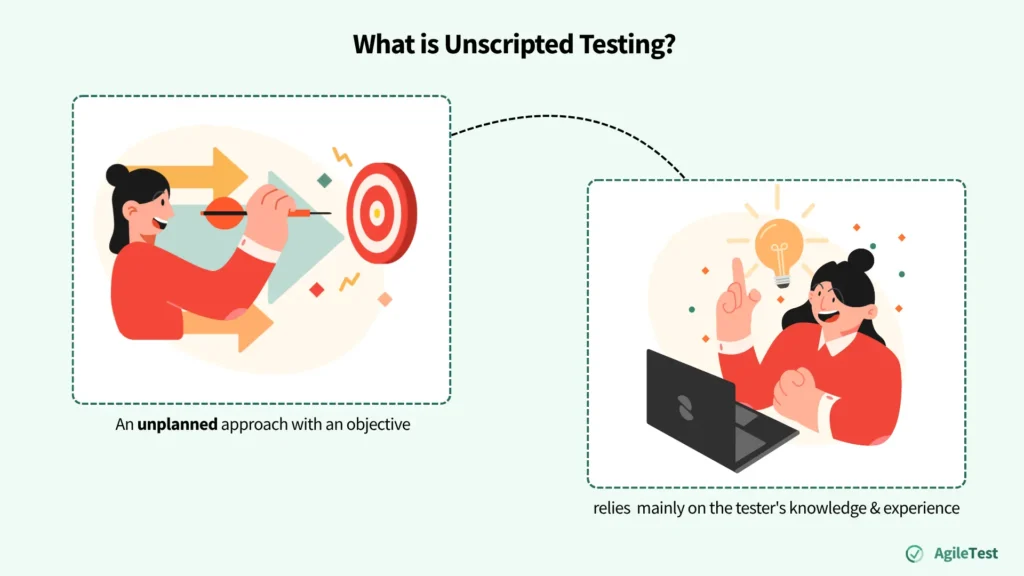
Unscripted testing, the opposite of scripted testing, is an unplanned approach. It relies on the tester’s knowledge, experience, creativity, and intuition. This method has no detailed steps written beforehand. Instead, testers continuously learn about the application and make decisions about what to test next based on what they explore. This approach is guided by a specific mission or goal, but the journey to achieve it is completely flexible. Some typical types of this approach are exploratory and ad-hoc tests.
Discover the key difference between ad-hoc and exploratory testing with our article: Ad-Hoc vs. Exploratory Testing: What are the differences?
With the same example, testers also aim to test the login feature, but they will conduct testing differently outside the sequential test steps. They might try to log in with an expired account or hit the “login” button multiple times quickly to see if any bugs occur.
3. Key Differences Between Scripted and Unscripted Testing
Now, let’s come to the main part to see how these two testing approaches differ from each other
Main goal
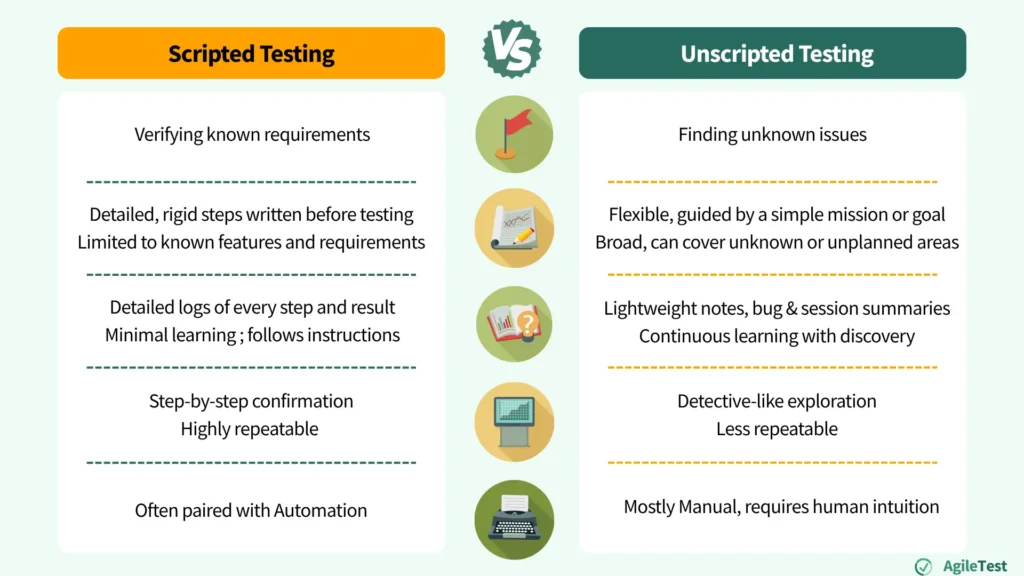
The most fundamental difference between scripted and unscripted testing lies in their primary goals. Scripted testing focuses on coverage, which verifies that all “known” requirements are met and that the core functionality of the software works exactly as intended. It validates what you expect to happen for the features according to your plan.
Unscripted testing, in contrast, emphasizes discovery. Its goal is to uncover “unknown” issues, such as hidden bugs that aren’t captured in formal requirements. Here, the testers explore the software from multiple angles to reveal flaws that might otherwise remain invisible with the normal testing process.
Planning
The level of planning is also what sets scripted and unscripted testing apart. When your goal is to verify every known feature, careful advance planning is essential to avoid missing any pre-defined scenarios. Scripted testing, therefore, requires a detailed plan upfront: every click, input, and expected result is documented before testing begins. Because it focuses on validating predefined behavior, the scope of testing is well-defined and limited, strictly following the test plan to ensure thorough coverage of known requirements.
Meanwhile, unscripted testing thrives on flexibility. Meanwhile, unscripted testing thrives on flexibility. While you have a clear objective to guide your testing process, you are free to explore the feature on your own. You can make real-time decisions about what to test next based on your observations and experience. As a result, the scope of testing is dynamic and unlimited, but you need to prioritize what areas truly matter to avoid going around the lowest-risk or already-known issues.
Documentation
The documentation requirements reflect the fundamental purpose of each testing method. In scripted testing, comprehensive documentation is critical. Every step, expected outcomes, and actual results must be recorded, not only to verify that each feature works as intended but also to enable repeatable testing, support automation, and satisfy compliance or audit requirements. These documents ensure that anyone, whether new testers or automated tools, can execute the test exactly as intended, reducing the risk of missed defects.
However, it’s important to note that these documents primarily serve verification purposes rather than helping testers understand the system. They capture what was done and what happened, but they contribute little to learning about feature behavior or uncovering unexpected issues. Essentially, the documentation guides your actions and validation, but does not deepen your insight into how the feature works or how users might interact with it.
In unscripted testing, documentation is intentionally less required, focused on capturing key findings rather than recording every action. Testers rely on their expertise to explore the system, taking notes, evidence, or brief summaries only where necessary to communicate defects, unusual behaviors, or insights. This approach maximizes speed, flexibility, and the discovery of unexpected issues, allowing testers to focus on uncovering unknown risks, usability challenges, and edge cases that scripted tests might miss.
This documentation helps testers simultaneously build knowledge about the features, especially those uncovered areas. It also tracks which areas have already been explored, guiding testers to decide what to investigate next during the testing process. By doing so, it creates a learning loop that makes unscripted testing more structured without limiting flexibility.
Approach
Scripted testing uses a step-by-step confirmation method. Testers write test cases, execute them and compare the results, then repeat the process to confirm that everything works as planned. They focus on the main question: “Are we building the product right?“.Because this process involves following clear instructions, it is highly repeatable, making it perfect for regression testing (running the same checks over and over to ensure old features haven’t broken).
Unscripted testing, on the other hand, uses a detective-like investigation. Testers determine a goal for each test session, then explore the feature to gain understanding and investigate the feature with knowledge and experience. They are guided by the question: “Are we building the right product?“. This approach is much less repeatable, as its success depends entirely on the tester’s skill, experience, and creativity to find flaws that no one planned for.
Tools
The final key difference lies in how technology supports each approach. Scripted testing is mostly paired with automation. Because every step is predefined and predictable, these tests can be executed repeatedly by automation tools. Automation ensures consistency, speeds up regression testing, and frees testers from repetitive tasks, allowing them to focus on higher-level test planning.
Conversely, unscripted testing, on the other hand, is inherently manual. It relies on human experience, intuition, and curiosity to uncover unexpected behaviors, usability issues, or edge-case defects that automation cannot anticipate. Testers have to notice small, strange problems, understand what’s happening now, and quickly change what they are doing, which is barely possible for the machine.
4. Should You Combine Both Approaches
While both ways of testing are useful, neither one is strong enough by itself. Scripted testing provides safety and documentation, but writing scripts for every case is time-consuming and requires extensive planning. Meanwhile, unscripted testing is fast and creative, uncovering hidden issues, but lacks formal proof to declare a feature complete.. For any complex feature, you need both the strict plan of the script and the experience of the tester. Using them separately causes wasted time; using them together means you could nearly catch all kinds of bugs.
5. When to use these approaches
The key to success is knowing when to use each method. You should always start with unscripted testing in the early stages of your testing process. Testers should spend a short, focused time exploring the system to learn how it works, find the biggest risks, and catch the obvious bugs right away. After this quick discovery phase, you move to scripted testing for the rest of the testing process. Any important problems or complex paths found during the exploration are written down as official, repeatable scripts. These new scripts are then automated so they can run all the time. To further enhance test coverage, you can continue applying unscripted tests alongside scripted ones. This balanced workflow uses the unscripted method for speed and new discoveries right away, and the scripted method for proof and long-term stability.
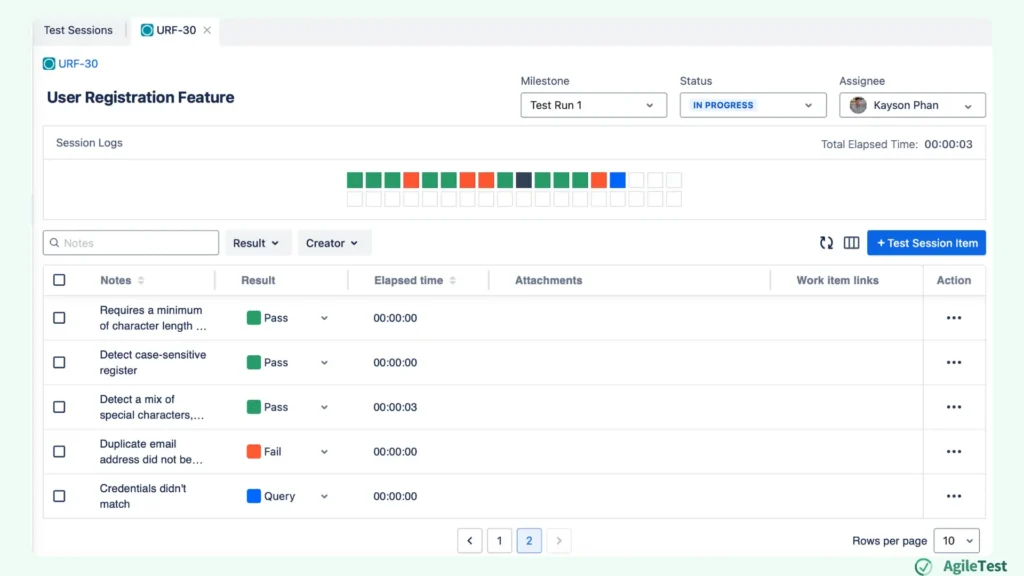
Install AgileTest to enhance and manage your test process effectively with various test types.
Conclusion
Both scripted and unscripted testing are vital for quality software; they are simply tools for different jobs. Scripted testing brings discipline, proof, and automation, making it the perfect choice for essential regression and compliance. Unscripted testing brings speed, intuition, and discovery, making it essential for uncovering the unexpected problems that users will actually face. Great testers understand that testing is not a single activity but a continuous blend of these two approaches. By consciously knowing when and how to apply each method, your team can achieve maximum quality and build better products.