Have you ever been in the middle of a project and wondered, “Why are we testing this way?” or “What are we actually trying to achieve with all these tests?” These are fundamental questions, and the answer to them should live in a single, powerful place: your Test Strategy.
A test strategy isn’t just a dusty, formal document that gets written once and then forgotten. It’s your project’s North Star for quality. It’s the high-level guide that explains the why and the how behind your testing efforts, aligning the entire team on a unified approach. It’s the difference between testing by habit and testing with intent.
For developers and testers, understanding and contributing to the test strategy is crucial. It ensures that the tests you write and run are valuable, efficient, and directly contribute to the project’s goals. This guide will walk you through the key factors you must consider to craft a winning test strategy that is tailored perfectly to your project’s unique context.
What is a Test Strategy, Really?
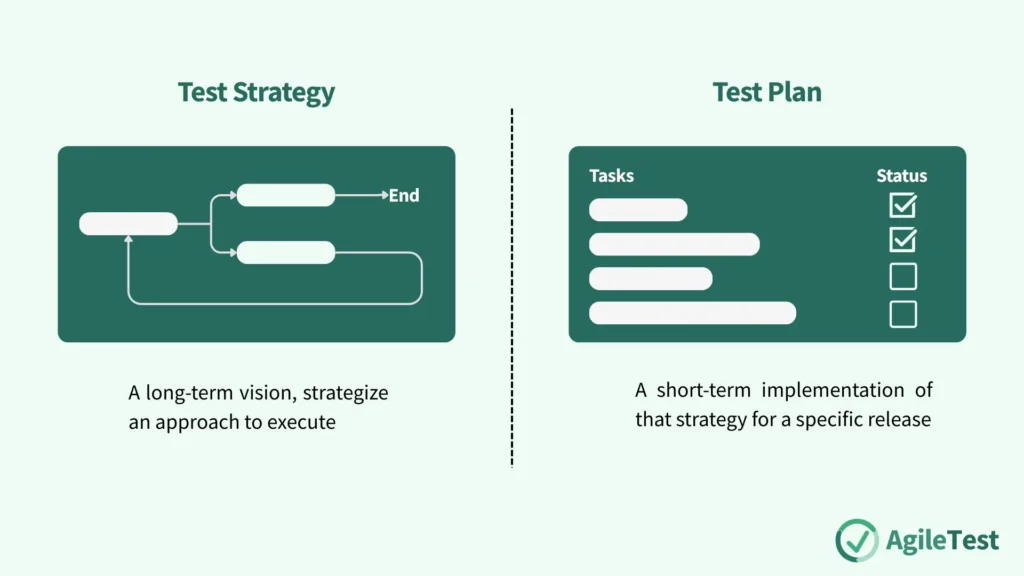
At its core, a test strategy outlines the high-level approach to testing for a specific project or product. It doesn’t list individual test cases or provide a detailed schedule. Instead, it answers big-picture questions like:
- What are our main quality goals?
- What types of testing will we perform (e.g., performance, security, usability)?
- What tools and environments will we use?
- How will we measure success and decide when we are “done”?
- What are the biggest risks, and how will our testing address them?
It’s important to distinguish this from a Test Plan. Think of it this way:
- The Test Strategy is the long-term vision. Example: “For this mobile banking app, our strategy is to focus heavily on security testing and automated regression, using a risk-based approach to prioritize our efforts.”
- The Test Plan is the short-term implementation of that strategy for a specific release. Example: “For the Q3 release, we will execute penetration tests on the new funds transfer feature and automate these 25 regression scenarios. Testing will begin on August 11th and end on August 22nd.”
Learn more about the differences between Test Strategy and Test Plan with this article: Test Strategy vs. Test Planning in Agile Development
To create an effective project test strategy, you must first understand the context you’re operating in, including the overarching organizational test strategy (your company’s general approach to quality) and the specific goals and constraints of your current project.
The Art of the Possible: 7 Factors That Shape Your Strategy
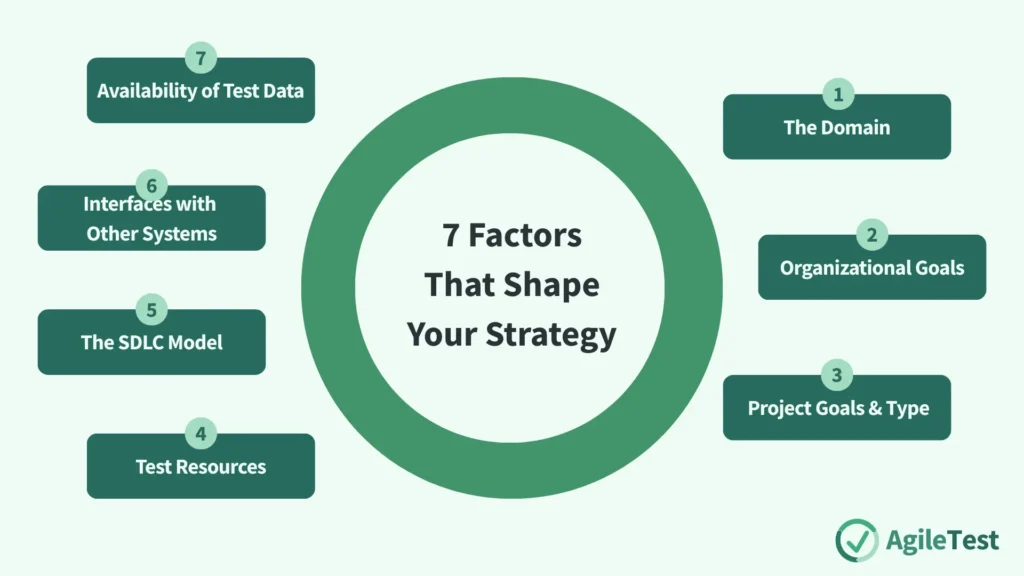
Crafting a test strategy is an act of analysis. You must examine your project from multiple angles to make conscious, informed decisions about your approach. The test manager typically leads this process, but the insights from the entire team are vital. Here are seven critical factors you must analyze to choose the right combination of test techniques, levels, and types.
1. What’s Our Playground? (The Domain)
The industry your product lives in fundamentally shapes your testing. The domain…may change the rigor of testing, the documentation required, as well as its level of detail. The definition of “quality” and the consequences of failure vary dramatically between different fields.
- As the source material points out, for pharmaceuticals and medicine, the test approach is dictated by risks to patient health. The strategy will emphasize meticulous documentation and intensive user acceptance testing (UAT) to ensure every functional requirement is met without fail.
- In contrast, for a web-based insurance application, the primary business risk might be a confusing interface that causes potential customers to leave. Here, the strategy might focus more on usability testing and A/B testing to optimize the user journey and increase the likelihood of new sales.
Ask your team: What are the unique rules and user expectations in our domain? Are we in a regulated industry that demands strict compliance, or a creative one that values innovation and speed?
2. What’s the Big Picture? (Organizational Goals)
Your project doesn’t exist in a vacuum. It’s part of a larger organization with its own strategic goals. These organizational goals and overarching quality characteristics can heavily influence your strategy.
For example, if the company has a high-level goal to increase the degree of test automation across all projects, your test strategy must reflect this. It would need to allocate time and resources for developing automation frameworks, writing scripts, and integrating them into the CI/CD pipeline. Similarly, if there’s a push to improve the maturity level of the testing process, your strategy might include introducing formal peer reviews of test cases or more detailed reporting.
Ask your team: Are there any company-wide engineering or quality initiatives that we need to support with our testing approach?
AgileTest has a Test Script feature that helps Testers write tests quickly, execute tests and generate reports effectively. Try it now!
3. What Are We Building and Why? (Project Goals & Type)
Zooming in from the organization, you have to consider the unique project goals and type of project. Every project has a unique balance of constraints, typically around budget, time, and quality.
- A project with tight budget and time constraints cannot afford to test everything exhaustively. The strategy must be ruthlessly efficient. This often requires the rigorous use of risk-based testing to prioritize efforts on the most critical parts of the application.
- The type of project also matters. If you are developing a generic, market-oriented product, your strategy might focus on broad compatibility and competitive features. But if you are building a product specifically for a customer, the strategy must prioritize tests that cover the pre-defined contractual acceptance criteria.
Ask your team: What are our project’s biggest constraints? Are we trying to be fast, cheap, or perfect? (Hint: you can only pick two). Are there any contractual obligations we must meet?
4. What’s in Our Toolkit? (Test Resources)
A brilliant strategy is useless if you don’t have the resources to execute it. You must consider any constraints regarding the availability of test resources. This includes:
- Staff and Skills: Do you have the right people? Experience-based testing requires testers with deep domain knowledge. A strategy focused on white-box testing requires developers skilled in writing unit tests.
- Tools and Licenses: Your ambition to automate everything should be under your software license management policy.
- Infrastructure and Devices: Testing mobile applications is a perfect example. Your strategy must be realistic about the typically limited number of different devices you can physically test on, which makes good device management essential.
Ask your team: What people, tools, and environments do we realistically have access to? How can we design a strategy that plays to our strengths and works around our limitations?
Explore AgileTest – Unified Management Tool for Jira.
5. How Are We Building It? (The SDLC Model)
Your test strategy must be synchronized with your development rhythm. The software development lifecycle model used for the project is a huge determining factor.
- A modern project using continuous integration (CI/CD) ships code multiple times a day. This reality requires more automated testing than a traditional approach. The strategy must be built around a fast, reliable, automated regression suite that can provide feedback in minutes, not days.
- A classic waterfall model, where development happens in long phases, allows for a different strategy, with more distinct, manual testing phases at the end of each stage.
Ask your team: How fast is our development cadence? How can our testing provide feedback at the speed the developers are working?
6. Are We Playing Nicely with Others? (Interfaces with Other Systems)
Few applications live on an island. Many are part of a complex system of systems, with intricate interfaces with other systems. When this is the case, aligning the testing with other teams or projects is a critical part of your strategy.
Your strategy must explicitly plan for system integration testing. This can be incredibly complex, so using risk-based testing helps to prioritize and scale these efforts. You would focus integration tests on the most critical or fragile connection points between the systems.
Ask your team: What are our key dependencies? How will we coordinate with other teams to test the connections between our systems?
7. What’s Our Fuel? (Availability of Test Data)
Tests are only as good as the data they run on. Your strategy must consider any constraints on the availability of test data. This is often a major, underestimated challenge.
- Do you need anonymized test data from production to test with realistic datasets? The process of scrubbing sensitive information can be a significant project in itself.
- Are you working in a field like AI testing, where creating specific, validated, and unbiased test data is incredibly difficult?
Your test strategy might need to include specific techniques like model-based testing, which can help auto-generate the data you need, or it might need to allocate a significant amount of time just for test data creation.
Ask your team: What data do we need to test effectively? Where will we get it, and what are the challenges in doing so?
Have a look at the challenges of Test Data and Key strategies to apply with this article: Efficient Test Data Management Strategies for Large-Scale Software Projects.
The Synthesis: Making the Final Decision
After analyzing all these factors, the final step is to synthesize them into a coherent strategy. This is where the test manager should determine which combination of test techniques, test levels and test types should be used to best satisfy the project’s unique blend of goals, constraints, and risks.
This isn’t a decision made in isolation. A good lead facilitates a discussion with the entire team, weighing the different factors and building consensus. The result is a documented strategy that everyone understands and agrees upon.
For example, after going through the analysis, your team might conclude:
- “Given that we are an Agile team building a mobile e-commerce app (domain) with a tight deadline (project goal) and a limited number of test devices (resources), our test strategy will be a risk-based approach. We will focus on automating our core regression suite to run in our CI/CD pipeline. We will supplement this with manual exploratory testing sessions focused on usability risks, conducted on our three most critical target devices. We will deprioritize full testing on older, low-usage devices.”
This is a clear, justified, and actionable strategy. For teams that need a lightweight structure for writing that document, this test strategy template shows how to organize risks, requirements, test approaches, environments, reporting, and staffing in one place.
Conclusion
A test strategy is your project’s essential guide to quality. It is a conscious, deliberate plan that is born from a thorough analysis of your project’s unique context. It’s not a one-time document but a living agreement that can evolve as the project context changes.
By taking the time to think strategically about these seven factors, you move beyond simply executing test cases. You become an architect of your project’s quality. You ensure that every hour spent testing is focused, efficient, and effective. You provide clarity for your team, justification for your stakeholders, and build a solid foundation for delivering a product with confidence and pride.