As developers and testers, we are the guardians of quality. We spend our days writing code, designing systems, and running tests with a singular goal in mind: to build and ship great software. But what does “great” truly mean? What does “high quality” look like in practice? Without a clear answer, our testing efforts can become a frustrating journey without a map—we’re busy, but are we making progress in the right direction?
This is where test objectives come in. They are the North Star for your testing process, the GPS that guides every decision you make. They transform vague notions of “quality” into a concrete, actionable plan that everyone on the team can understand and work towards.
This article will demystify the world of test objectives. We’ll explore what they are, how to define them using the powerful S.M.A.R.T. framework, and look at practical, real-world examples that you can apply to your projects today. By the end, you can write objectives that provide focus, drive collaboration, and ultimately help you and your team build better software for a better world.
What Are Test Objectives (And Where Do They Live)?
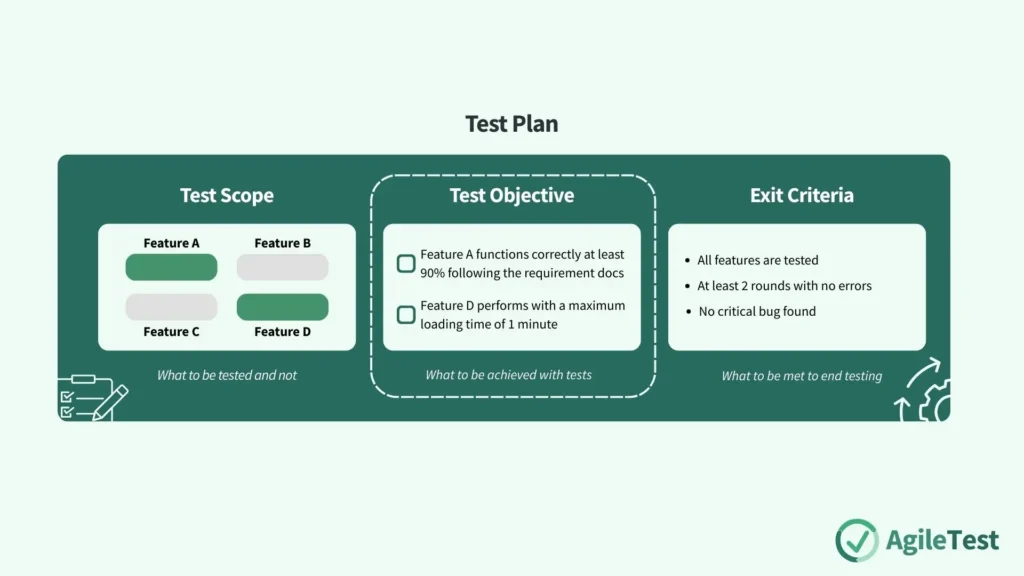
At its core, a test objective is a specific goal that a testing phase or activity aims to achieve. It’s a statement of purpose that answers the question, “Why are we running this test?” These objectives don’t exist in a vacuum; they are a critical component of the Test Plan.
Think of the test plan as the master blueprint for your entire quality assurance strategy. It’s a document that outlines the what, when, how, and why of your testing project. According to best practices, a solid test plan should always define three key things:
- Test Scope: What features and characteristics will be tested? What will not be tested?
- Test Objectives: What are the specific goals we aim to achieve with our testing?
- Exit Criteria: How do we know when we’re done? What conditions must be met to consider this phase of testing complete?
Read our guide to master Test Planning with this article: Mastering Test Planning: Your Guide from Chaos to Clarity
Test plans, and by extension their objectives, can operate at different altitudes depending on your project’s structure:
- Project (or Master) Test Plan: This is the high-level plan that covers an entire release or project. Its objectives are broad and aligned with the overall business goals.
- Level-Specific Test Plan: Sometimes you need to zoom in on a particular aspect of quality. You might have a dedicated Performance Test Plan with objectives focused on response times and resource usage. Or a Security Test Plan with goals related to vulnerability detection and data protection.
- Iteration Test Plan (Agile): In Agile and hybrid development, things move fast. An iteration or sprint-level test plan defines the objectives for a specific, short cycle of work, focusing on the new features and characteristics being delivered in that sprint.
Regardless of the level, the purpose is the same: to create a shared understanding among all stakeholders—from developers and testers to product owners and business analysts—of what success looks like.
The Antidote to Vague Goals: The S.M.A.R.T. Framework
The single biggest mistake teams make is writing vague objectives. Goals like “test the new user profile page” or “ensure the system is stable” are well-intentioned but ultimately useless. They provide no direction, offer no clear finish line, and make it impossible to know if you’ve succeeded.
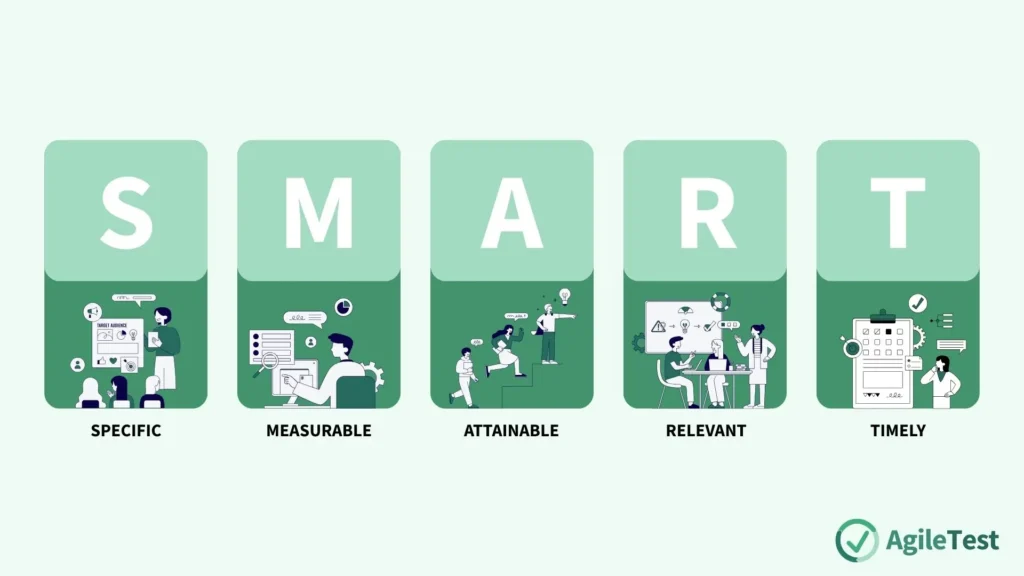
To fight this ambiguity, we can borrow a powerful methodology from the world of project management: S.M.A.R.T. goals. Crafting your test objectives to be S.M.A.R.T. ensures they are clear, actionable, and effective.
Let’s break down each letter.
S = Specific
A specific objective is clear and unambiguous. It leaves no room for interpretation. It focuses on a single, well-defined outcome.
- Vague: “Test the data migration.”
- Specific: “Verify that all customer records from the legacy database are migrated to the new system with 100% functional completeness and data correctness, ensuring no data loss or corruption.”
M = Measurable
If you can’t measure it, you can’t manage it. A measurable objective is quantifiable, meaning you can track your progress and know precisely when you’ve hit the target.
- Vague: “Improve API performance.”
- Measurable: “Reduce the average response time of the /api/v2/orders endpoint to under 150ms and the 95th percentile response time to under 300ms under a simulated load of 500 concurrent users.”
A = Achievable
An objective must be realistic. It should be feasible given the constraints of your project, including the available time, resources (people, hardware), budget, and team capabilities. This is where practical reality checks are essential. For example, you need to consider if the required test environments or tools will be available when you need them.
- Unachievable: “Automate 100% of all regression tests for our 10-year-old legacy application in the next two-week sprint with one junior tester.”
- Achievable: “Increase the automated regression test coverage for the payment module from 40% to 60% by the end of the quarter, focusing on P1 and P2 priority test cases.”
R = Relevant
Testing should always serve a larger purpose. A relevant objective is one that aligns with the overall project and business goals. It answers the question, “Does achieving this objective actually matter to our users or the business?”
- Less Relevant: “Verify that the copyright year in the website footer automatically updates to 2025.” (While it should be correct, it’s a low-risk, low-impact item).
- Highly Relevant: “Confirm that the new payment gateway integration complies with PCI DSS 4.0 standards to ensure secure transaction processing and avoid regulatory fines.”
T = Timely
Every objective needs a deadline. A timely goal has a defined timeframe for completion, which creates a sense of urgency and helps with planning and prioritization. In Agile, this is often tied to the end of a sprint or release cycle.
- Not Timely: “We can prove he security of all public-facing interfaces should be proven.”
- Timely: “Complete penetration testing on the new customer-facing API endpoints and deliver the vulnerability report to the development team by August 22, 2025, to allow for remediation before the Q3 release.”
Using the S.M.A.R.T. framework transforms testing from a loosely defined activity into a disciplined engineering practice.
Try AgileTest to generate test cases, schedule test plans and manage test records accordingly with your timeframe now.
Test Objectives in Action: Practical Examples
Let’s move from theory to practice. Here are some common types of test objectives, inspired by real-world scenarios, that you can adapt for your own projects.
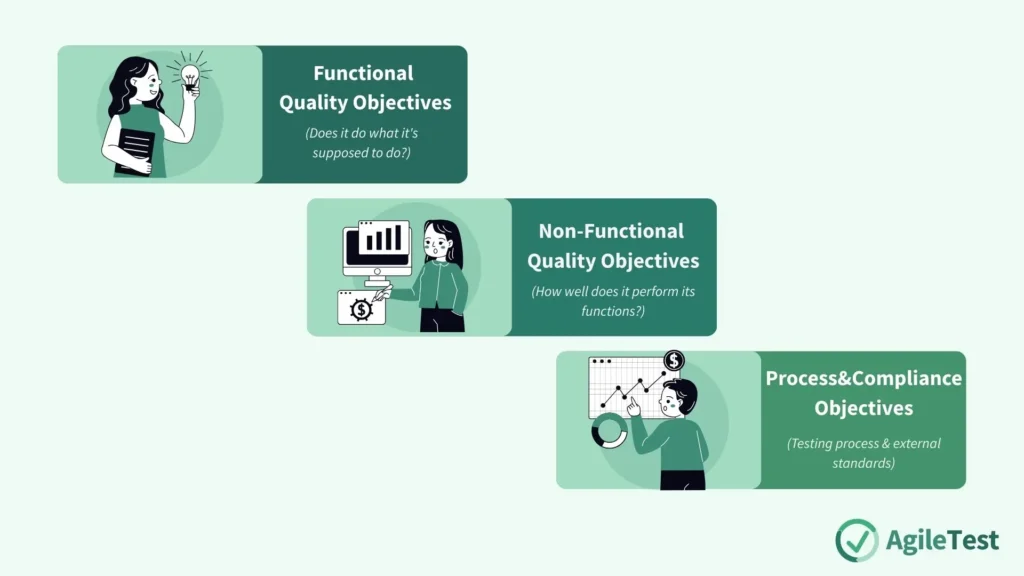
1. Functional Quality Objectives
These goals focus on the “what” of the software—does it do what it’s supposed to do?
- Functional Correctness & Completeness: “To verify that the new data migration tool correctly and completely transfers user profiles, order history, and product catalogs from the old e-commerce platform to the new one, validated against a checksum and a 5% manual spot-check, before the system goes live.”
- Successful Code Refactoring: “To prove that the refactoring of the authentication module has not introduced new defects by successfully executing the entire suite of automated regression tests (350 tests) for user login, password reset, and session management, with a 100% pass rate.” This objective helps manage technical debt while guaranteeing existing functionality remains intact.
2. Non-Functional Quality Objectives
These goals focus on the “how” of the software—how well does it perform its functions?
- Performance and Efficiency: “To ensure the application can support the expected Black Friday user load by achieving an average page load time of under 2 seconds and CPU utilization below 75% on all web servers during a 4-hour stress test simulating 10,000 concurrent users.”
- Security: “To prove the security of the application’s REST APIs by conducting penetration testing that demonstrates immunity to the OWASP Top 10 vulnerabilities, specifically SQL injection and Cross-Site Scripting (XSS), with zero critical or high-severity vulnerabilities found.”
- Data Integrity and Access Control: “To ensure the confidentiality of user data by verifying that non-administrative users can only access their own data, and any attempt to access another user’s data via API manipulation is rejected with a 403 Forbidden error.”
- Usability: “To confirm the usability of the new checkout process by having 10 representative users complete a purchase, with at least 80% of them successfully completing the task in under 90 seconds without assistance.”
3. Process and Compliance Objectives
These goals are about the testing process itself and meeting external standards.
- Meeting Exit Criteria: “To reach the defined exit criteria for the release, which includes a 98% pass rate for all planned tests, zero outstanding critical defects (blockers), and no more than five high-priority defects, within the project’s timeframe ending September 5th.”
- Enhancing Test Automation: “To increase the level of test automation for the core regression suite by 20% (from 50% to 70%) this quarter, reducing the time required for a full regression cycle from 8 hours of manual work to 1 hour of automated execution.”
- Complying with Regulations: “To verify and document that the system’s audit logging functionality complies with the data retention and integrity requirements of the Health Insurance Portability and Accountability Act (HIPAA) before deployment to our healthcare clients.”
Beyond the Numbers: The Human Element of Quality
While measurable objectives are critical, quality isn’t always something you can capture in a number. A feature can meet every technical requirement and pass every test, but still feel wrong to an end-user. This is where the human element comes in.
Beyond your S.M.A.R.T. objectives, always consider including a goal to get qualitative feedback. An objective could be: “To gain approval and sign-off on the new reporting dashboard from three key domain experts and the head of the sales department, confirming it meets their operational needs.” This acknowledges that some aspects of quality are subjective and best assessed by the people who will use the software every day. This blend of quantitative data and qualitative human assessment provides a holistic view of your product’s readiness.
AgileTest’s Report feature helps the team to track and trace issues with detailed reports. Apply it to improve your team QA process now.
Conclusion: Your Guide to Focused, Effective Testing
In the complex world of software development, clarity is king. Test objectives cut through the fog, providing a clear, shared, and unambiguous definition of success. By embracing the S.M.A.R.T. framework, you move beyond aimless testing and into the realm of precise, goal-driven quality engineering.
Think of your test objectives as a contract between you, your team, and your stakeholders. They align everyone on what matters most, ensure your hard work is focused on relevant risks, and give you a clear finish line to cross. They are your project’s North Star, guiding you steadily toward your ultimate destination: delivering robust, reliable, and truly high-quality software.