
In software development, the debate between Waterfall and Agile has evolved into a hybrid model, combining the best of both. For many organizations, the answer isn’t strictly Waterfall or purely Agile; it’s a strategic fusion of both. Welcome to the era of hybrid software development, a model born from necessity and tailored for effectiveness. This approach allows teams to leverage the structured safety nets of traditional models while embracing the speed and flexibility of Agile practices.
However, for developers and testers on the front lines, this “best of both worlds” scenario can often feel like navigating a complex maze. How do you reconcile a two-week sprint with a six-month release plan? How do you balance detailed, upfront test planning with the iterative nature of in-sprint testing? The challenges are real, but they are not insurmountable.
This guide is for you—the developer who writes the unit tests, the QA engineer who designs the integration plan, and the test lead trying to orchestrate it all. We will explore why hybrid models exist, dive deep into the unique testing challenges they present, and lay out a practical playbook for success.
Finally, we’ll introduce a tool, Agiletest, that is purpose-built to bring clarity and control to the complexities of the hybrid testing landscape.
The “Why” Behind the Hybrid Model: More Than Just a Compromise
Before we tackle the “how” of testing, it’s crucial to understand the “why.” Hybrid models aren’t just a sign of indecision; they are often a deliberate, strategic choice. The reasons typically fall into two main categories.
1. Hybrid as a Transition to Agile
For organizations steeped in decades of traditional, sequential processes like Waterfall, a sudden leap to pure Agile can be a culture shock. The required shifts in mindset, workflow, team structure, and stakeholder communication are profound. A “big bang” adoption of Agile often fails because the organizational immune system rejects the change.
A hybrid model acts as a vital bridge, providing a managed transition. It allows teams to dip their toes into Agile waters while retaining the familiar comfort of some structured processes.
- Phased Adoption: A team might start by introducing Agile practices within a single development phase. For instance, the core development and unit testing might happen in two-week sprints, complete with daily stand-ups and retrospectives. However, the upstream requirements gathering and downstream User Acceptance Testing (UAT) and release management might still follow a traditional, phased approach.
- Cultural Acclimation: This gradual exposure helps teams build muscle memory for Agile ceremonies. Developers and testers learn to collaborate more closely, and product owners learn to think in terms of user stories and backlogs. This controlled evolution prevents burnout and resistance, paving the way for a more complete Agile transformation in the future.
2. Hybrid as a “Fit-for-Purpose” Strategy
Sometimes, a hybrid model isn’t a temporary stopover—it’s the final destination. Certain projects or organizational contexts are inherently unsuited for a pure Agile approach, making a hybrid strategy the most logical and effective choice.
- High-Risk and Regulated Industries: In sectors like finance, aerospace, or medical devices, regulatory compliance and safety are non-negotiable. These industries often mandate extensive upfront documentation, formal verification and validation phases, and rigorous traceability from requirement to test case to release. A hybrid model allows teams to meet these stringent documentation and sign-off requirements (the traditional part) while still using Agile sprints for the actual coding and feature development to improve efficiency and responsiveness (the Agile part).
- Hardware Dependencies: Projects involving both software and hardware components are prime candidates for a hybrid approach. Hardware development cycles are typically longer and less flexible than software cycles. You can’t “sprint” the manufacturing of a physical prototype. In this scenario, the overall project plan might follow a sequential, milestone-driven path dictated by the hardware timeline. Within that framework, the software team can operate in Agile sprints, developing features that can be tested on simulators or previous hardware revisions.
- Large, Complex Enterprise Systems: Consider a massive enterprise resource planning (ERP) system. Core modules like finance or HR might be incredibly stable, with changes requiring a slow, deliberate, and risk-averse Waterfall approach. In contrast, a new customer-facing portal or a mobile application extension for the same system could be developed by a separate team using Scrum to rapidly innovate and gather user feedback. The overall program is hybrid, blending stability with agility.
The Testing Conundrum: Navigating the Hybrid Landscape
For testers and developers, the hybrid model introduces a unique set of challenges that don’t exist in pure-play environments. It’s a world of dual cadences, split focus, and potential communication gaps. Success hinges on mastering the art of context-switching and integration. Here are the key activities and challenges your team will need to manage.
1. Evaluating Team Readiness and Bridging the Methodological Gap
The first hurdle is ensuring everyone understands the rules of this new, combined game. A tester accustomed to receiving a 200-page functional specification document and having three months to write test cases can feel lost when asked to test a user story with minimal documentation within a two-day window. Conversely, an Agile-native developer may become frustrated by the “overhead” of a formal Test Plan and a gated quality review.
Your Goal: Proactively evaluate your team’s understanding and capability to seamlessly transition between traditional and Agile methodologies. This involves:
- Identifying Strengths and Weaknesses: Conduct workshops or assessments to see where the team excels and where they struggle. Does the team grasp BDD (Behavior-Driven Development) but fall short on formal risk analysis? Do they excel at exploratory testing but need help with creating a comprehensive Requirements Traceability Matrix (RTM)?
- Targeted Training: Don’t assume everyone will just “get it.” Provide training that specifically addresses the hybrid context. Explain how a user story in a sprint relates to a high-level business requirement in the overall project plan.
2. Combining Structured Processes with Agile Flexibility
This is the core tension of the hybrid model. How do you satisfy the need for structured, predictable quality gates while enabling the rapid, iterative progress of sprints?
Your Goal: Ensure the team is adept at combining these two seemingly contradictory approaches.
- Bi-modal Test Planning: Your test strategy must account for both. You will likely have a high-level Master Test Plan (a traditional artifact) that outlines the overall scope, phases (System Integration Testing, UAT), entry/exit criteria, and major milestones. Nested within this plan, you will have sprint-level test plans, which are more lightweight and focus on the scope of each iteration.
- Adaptable Artifacts: Your documentation must serve two masters. A test case might need to be detailed enough for a formal UAT sign-off while also being modular enough to be executed as part of a sprint’s regression suite.
3. Enhancing Collaboration and Communication
In a Waterfall model, handoffs between teams are formal and infrequent. In Agile, collaboration is constant and informal. In a hybrid model, you need both. A breakdown in communication can be disastrous, leading to untested integrations or redundant work.
Your Goal: Enhance collaboration between the test team, developers, and other stakeholders to manage testing within both sprints and traditional test phases.
- Testers as Linchpins: Testers are uniquely positioned to bridge communication gaps. They interact with business analysts on long-term requirements and with developers on daily sprint work. Encourage them to be proactive communicators.
- Coordinated Efforts (Scrum of Scrums for Testers): When multiple teams are working on different components of a larger system, coordination is key. A “Scrum of Scrums for Testers” or a “QA Guild/Chapter” is an excellent mechanism. This is a recurring meeting where test leads or representatives from different teams come together to discuss cross-team dependencies, share automation best practices, plan for upcoming integration testing, and identify systemic quality issues. This maintains a holistic focus on quality across the entire program.
4. Tracking and Reviewing Test Efforts in a Dual-Track World
How do you measure progress when work is happening in two different time scales? A burndown chart is great for a sprint, but it doesn’t show progress against the overall SIT phase. A traditional progress report might miss the value being delivered in each iteration.
Your Goal: Effectively track and review test efforts and cases within sprints and ensure they align with the broader, traditional test phases.
- In-Sprint Testing: This includes testing new user stories, performing regression on the sprint’s scope, and automating new test cases. The focus is on immediate feedback to the development team to ensure the sprint delivers a “potentially shippable increment.”
- Inter-Sprint/Phase-Gate Testing: This is the work that happens outside or between sprints. It includes end-to-end integration testing, performance testing, security audits, and formal UAT. These activities often require a stable environment built from the output of several sprints. Your tracking must be able to link the results of these larger test efforts back to the specific sprints and features that were included.
The Right Tool for a Hybrid World: Why Agiletest Excels
The challenges outlined above—managing dual cadences, bridging communication gaps, and tracking disparate efforts—are significantly amplified by using the wrong tools. Trying to force a purely Agile tool like a basic Kanban board to manage a formal UAT phase is a recipe for spreadsheet chaos. Similarly, a legacy test management tool can stifle the fast-paced collaboration needed for sprint testing.
This is precisely the problem Agiletest was designed to solve. It is not just another test management tool; it is a unified platform built from the ground up to support the realities of hybrid software development. It seamlessly integrates the structured world of traditional testing with the dynamic, iterative nature of Agile, providing a single source of truth for your entire quality process.
Here’s how Agiletest addresses the core challenges of the hybrid model:
Support for Traditional Test Management
For the structured part of your hybrid process, Agiletest provides a robust set of features that traditional QA teams expect and rely on.
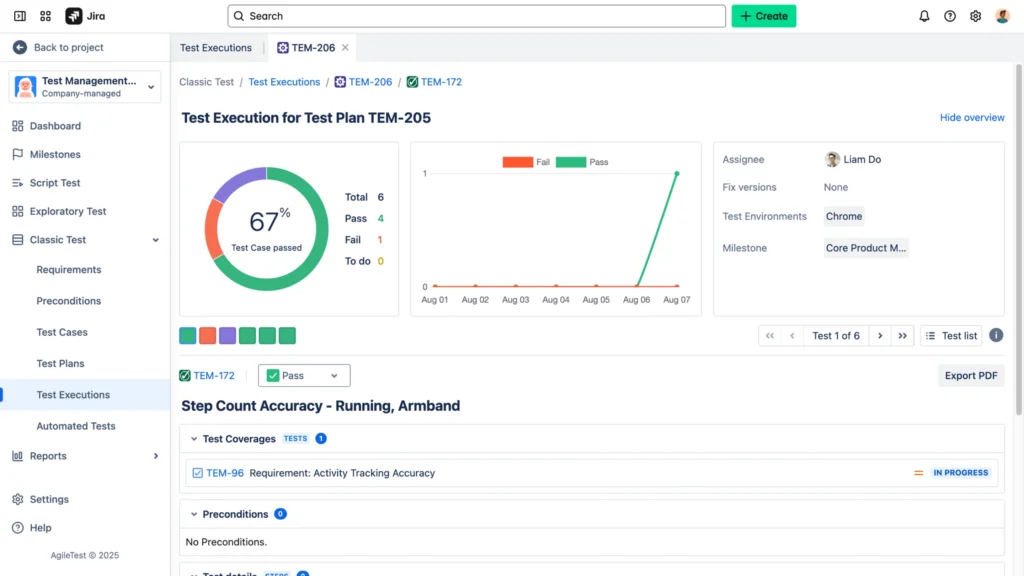
- Test Plans and Cycles: You can create comprehensive Master Test Plans that define the scope, strategy, and resources for your entire project. Within these plans, you can define distinct test cycles for different phases like System Testing, Regression, and UAT, complete with start and end dates and formal entry/exit criteria.
- Rich Test Case Design: Create detailed, step-by-step test cases with expected results, preconditions, and custom fields. Organize them in a hierarchical repository for easy reuse and maintenance across projects and releases.
Native Support for Agile Testing
For the Agile teams working in sprints, Agiletest provides the speed and flexibility they need without forcing them into a rigid, traditional workflow.
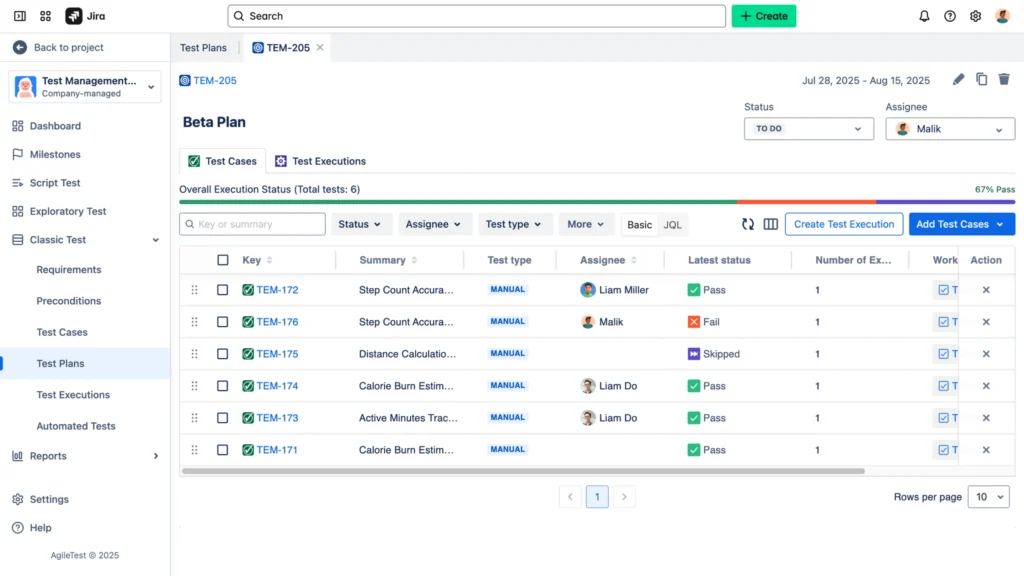
A Full Spectrum of Test Design (Scripted & Exploratory): Agiletest recognizes that a robust Agile quality strategy uses multiple approaches.
- Scripted Testing: For verifying core functionality and acceptance criteria, you can create clear, structured script tests.
- Exploratory Testing: To find the subtle bugs that scripted tests can miss, Agiletest provides robust tools for exploratory testing. Testers can launch session-based testing charters with a defined mission and timebox. As they freely investigate the application, the platform makes it easy to capture notes, annotate screenshots, and log defects on the fly. Every insight is automatically linked back to the exploratory session and the relevant user story, turning creative, experience-based testing into traceable, actionable data.
The Hybrid Magic: Unifying Both Worlds
The true power of Agiletest lies in how it connects these two paradigms.
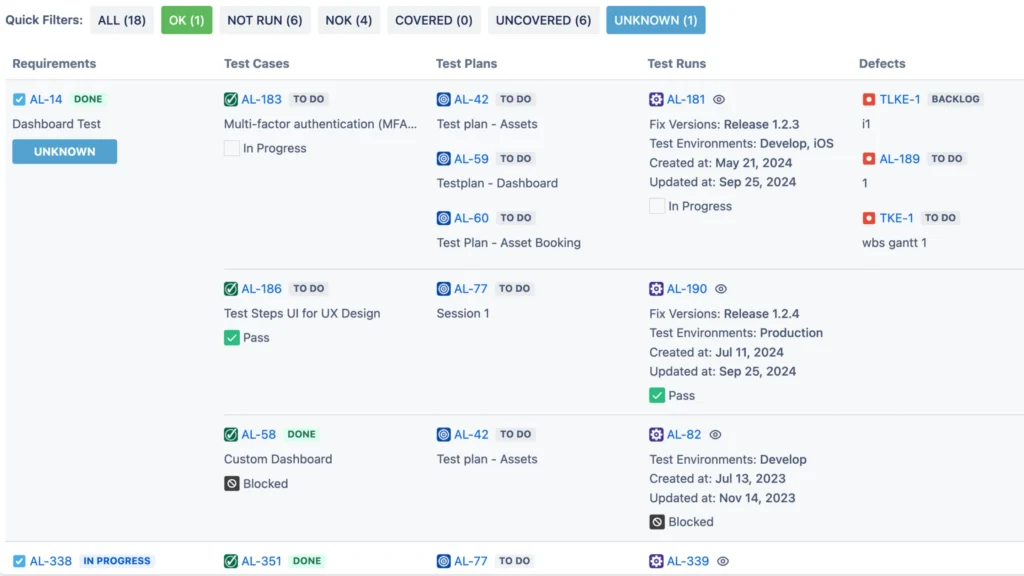
- Unified Reporting: Imagine a single dashboard where your project manager can see the burndown chart for the current sprint and the pass/fail percentage for the ongoing SIT cycle. Agiletest consolidates data from both Agile and traditional activities, eliminating information silos and providing a holistic view of quality.
- End-to-End Traceability: With Agiletest, you can trace a high-level business requirement from the Master Test Plan down to the user story in Sprint #5, to the specific BDD test case that validated it, to the automation run that executed it, and finally to the bug that was found and fixed. This seamless, end-to-end lineage is the holy grail for quality assurance in a complex hybrid environment.
- A Flexible Workspace: Your team doesn’t have to choose. A tester can spend the morning executing formal test cases for a UAT cycle and the afternoon participating in a backlog grooming session and writing exploratory test charters for the next sprint—all within the same intuitive platform.
Conclusion: Thriving, Not Just Surviving
Hybrid software development is not a temporary trend; it’s a mature, strategic approach for delivering value in a complex world. While it presents unique challenges for testing, these challenges are opportunities for QA and development teams to elevate their role and become central to project success.
Success in this environment rests on three pillars: People with a flexible, collaborative mindset; Processes that are adaptable and well-communicated; and a Platform that can unite disparate workflows. By embracing the strategies of the hybrid playbook and empowering your team with a purpose-built tool like Agiletest, you can move beyond simply surviving the complexities. You can master the maze