

First things first: Agile testing isn’t just doing the same testing faster. It’s a fundamental mindset shift.
The (Unofficial) Agile Testing Manifesto: Core Beliefs
Let’s take a look at the (unofficial) Agile testing manifesto:
- Quality is EVERYONE’S Job: Seriously. Developers, Testers, Product Owners, BAs, Designers – we’re all in this together. Silos are where good software goes to die. Collaborate early, collaborate often!
- Testing is Continuous, Not a Phase: Testing starts on Day 1 of the sprint (or even before!) and continues throughout the development lifecycle. Waiting until the end is like trying to proofread a novel five minutes before it goes to print – madness!
- Fast Feedback is KING: The shorter the time between writing code and knowing if it broke something, the better. This is where automation and CI/CD become our superpowers.
- Focus on Customer Value: We test to ensure the software delivers what the user needs, as defined in user stories and acceptance criteria. Working software over comprehensive (but useless) documentation!
- Embrace Change & Adapt: Requirements evolve. Priorities shift. Our testing strategy needs to be flexible and adaptable, not carved in stone tablets.
- Automate Strategically, Explore Manually: Automation handles the repetitive checks and regressions; human brains handle the clever, exploratory stuff automation can’t.
Got it? Good. Now for the juicy technical strategies!
Strategies That Sizzle: The How-To Guide
1. Shift Left Like You Mean It! (Test Early, Test Often)
This isn’t just a buzzword; it’s essential! Catching issues earlier saves time, money, and sanity.

- The Three Amigos Power Hour: Before any significant coding starts on a user story, get the Product Owner/BA, a Developer, and a Tester together. Discuss the requirements, define acceptance criteria, and brainstorm examples. This clarifies understanding before mistakes are made. Tools like Cucumber/SpecFlow using Gherkin (Given/When/Then) can capture these examples as living documentation and executable specifications (Behavior-Driven Development – BDD / Acceptance Test-Driven Development – ATDD).
- Test-Driven Development (TDD): Developers, embrace the Red-Green-Refactor cycle! Write a failing unit test first, then write just enough production code to make it pass, then refactor. This results in well-tested, modular code from the ground up. Testers can contribute by pairing or reviewing unit tests.
- API Testing First: Don’t wait for the pretty UI! Test the underlying APIs and services as soon as they are available (or even using mocks/stubs). Tools like Postman, Insomnia, or libraries like REST Assured (Java) or requests(Python) are your friends. Consider Contract Testing (e.g., using Pact) to ensure services communicate correctly without needing full end-to-end environments constantly.
- Static Analysis & Code Reviews: Integrate linters, security scanners, and code quality tools directly into the IDE and CI pipeline. Peer code reviews are invaluable for catching bugs and sharing knowledge.
→ Related content: BDD with Cucumber
2. Worship the Almighty Test Automation Pyramid (Not the Ice Cream Cone of Despair!)
Okay, maybe “worship” is strong, but respect the pyramid! It guides where to focus your automation efforts for maximum ROI and stability.
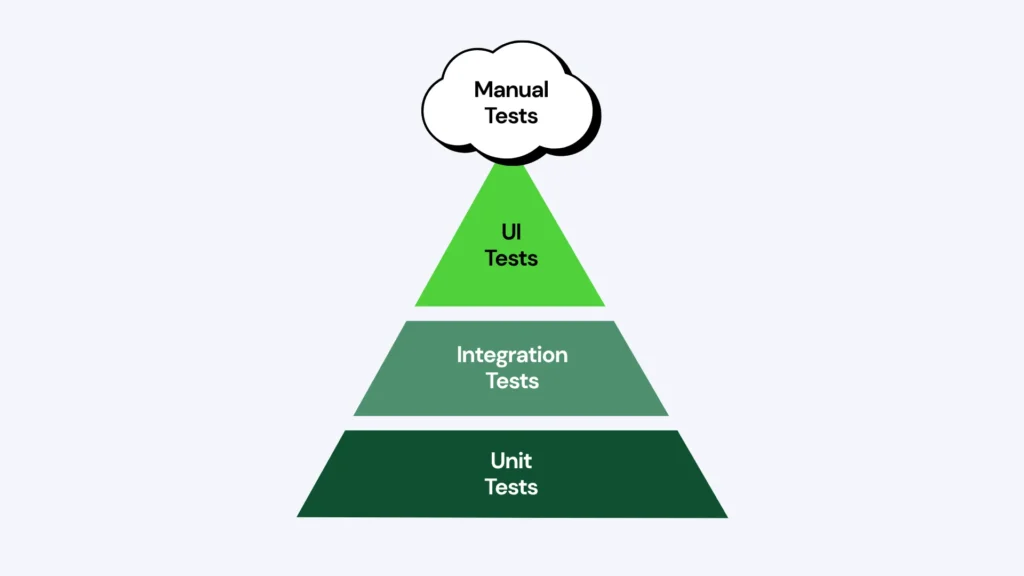
- Foundation: Unit Tests (Lots!): These are fast, isolated tests written by developers (TDD!), verifying small pieces of code (methods, functions, classes). They form the stable base. Aim for high coverage here.
- Middle Layer: Integration/API/Service Tests (Plenty!): These test the interaction between components, modules, or services. They check API contracts, data flows between layers, etc. Slower than unit tests, but faster and more reliable than UI tests. A crucial layer!
- Top Layer: UI/End-to-End Tests (Few!): These tests drive the application through the User Interface, mimicking user journeys. They are valuable for testing critical workflows but are inherently slower, more brittle (break easily with UI changes), and more expensive to write and maintain. Use them sparingly for key end-to-end scenarios. Avoid the “Ice Cream Cone” anti-pattern where most automation is at the slow, flaky UI level!
→ Related content: The Test Pyramid
3. Make Your Pipeline Your Quality Guardian (CI/CD Integration)
Your Continuous Integration / Continuous Delivery (CI/CD) pipeline is your best friend for fast feedback.
- Automate All The Things (Sensibly!): Unit tests, integration tests, API tests, and even a small, stable set of UI regression tests should run automatically on every code commit or build.
- Fast Failures: Structure your pipeline so the fastest tests (unit, static analysis) run first. If they fail, the build fails immediately – no need to wait for slower tests.
- Quality Gates: Configure your pipeline to automatically prevent merging or deploying code if critical tests fail or code coverage drops below a certain threshold.
- Visible Results: Ensure test results are clearly visible to the entire team via dashboards (integrated into your ALM tool like Jira/Azure DevOps, or CI server like Jenkins/GitLab CI/GitHub Actions).
4. Unleash Your Inner Sherlock Holmes: Exploratory Testing FTW!
Automation is fantastic, but it only finds bugs it’s programmed to look for. Humans are needed to find the unexpected!
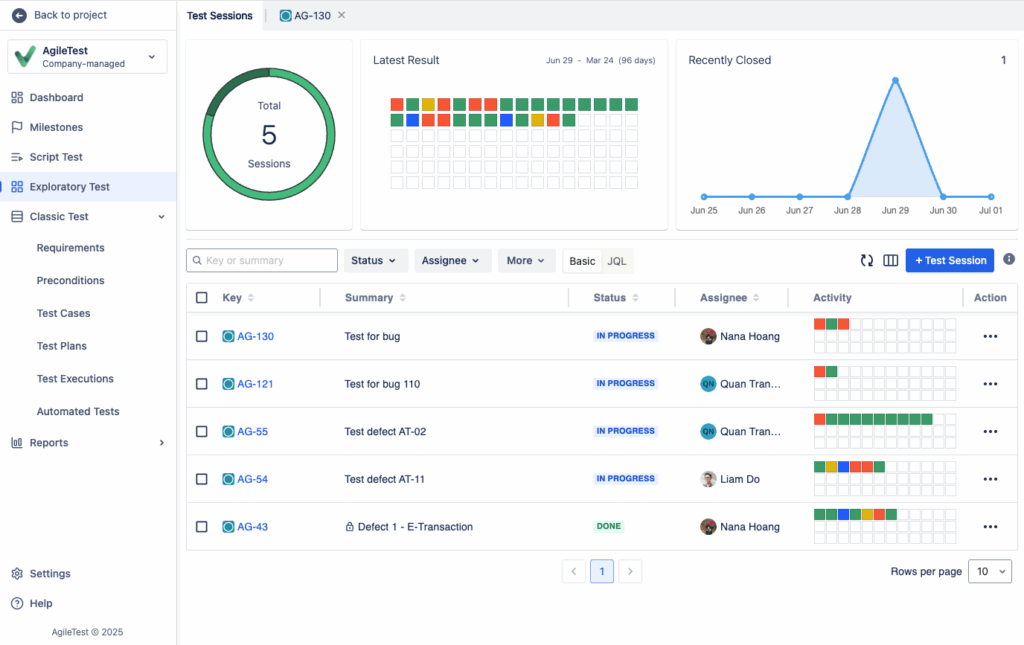
- What It Is: Simultaneous learning, test design, and test execution. It’s unscripted, curiosity-driven testing focused on exploring the application, identifying risks, and uncovering “unknown unknowns.”
- Make it Structured: Use session-based test management. Define clear charters (e.g., “Explore user profile update functionality focusing on invalid inputs and boundary conditions for 60 minutes”). Document findings concisely.
- Pair Testing Power: Grab a developer or a PO and test together! Developers gain insight into how their code behaves (and breaks!), testers understand the implementation better, and you find bugs faster. Plus, it builds collaboration!
- Timing: Interleave exploratory sessions throughout the sprint, perhaps focusing on newly developed features or high-risk areas identified by the team.
→ AgileTest supports exploratory testing within Jira – Try it free
5. Nail Your Regression Strategy
“Did my change break something else?” The eternal question.
- Automate Ruthlessly: The vast majority of regression checking should be handled by your automated test suites (Unit, API, UI) running in CI/CD.
- Risk-Based Approach: For any manual regression checks (if absolutely necessary), use risk analysis. Focus on the most critical areas or those most likely affected by recent changes. Don’t try to manually re-test everything.
- Frequency: Run automated regression tests constantly (ideally on every commit/build).
Tools of the Trade (Your Agile Testing Utility Belt)
You need the right gear! Focus on tools that integrate well and support collaboration:
- CI/CD: Jenkins, GitLab CI, GitHub Actions, Azure Pipelines, etc.
- Automation Frameworks: Selenium, Cypress, Playwright (UI); REST Assured, Postman, Pytest, JUnit, NUnit (API/Unit); Cucumber, SpecFlow (BDD).
- Test Management: Tools that integrate tightly with your issue tracker (Jira, Azure DevOps) and CI/CD pipeline (e.g., AgileTest, Xray, Zephyr Scale, TestRail, qTest, or standalone options like Testingy).
- Collaboration Platforms: Slack, Teams, integrated commenting in ALM tools.
Agile Testing Face-Plants (And How to Avoid Them):
- The Mini-Waterfall Sprint: All testing crammed into the last day or two. Symptom: Not enough collaboration or continuous testing.
→ Fix: Integrate testing activities daily! - The Automation Bottleneck: Only one person knows how to write/fix automation, becoming a blocker.
→ Fix: Treat test code like production code – code reviews, pair programming, shared ownership. Upskill the team! - Ignoring Exploratory Testing: Relying 100% on automation and missing obvious usability issues or weird edge cases.
→ Fix: Schedule time for exploratory testing! Value human intuition! - Flaky Tests Undermining Confidence: Automated tests fail randomly, eroding trust.
→ Fix: Invest time in making tests reliable! Delete or quarantine flaky tests ruthlessly until fixed. - Definition of Done Ignored: User stories are marked “Done” without meeting agreed-upon quality criteria.
→ Fix: Treat the DoD seriously! Make it visible. Hold each other accountable.
Conclusion: Go Forth and Test Awesomely!
Phew! That was a whirlwind tour, wasn’t it? Testing in Agile isn’t about following a rigid process; it’s about embracing principles of collaboration, continuous feedback, automation, and adaptability. It requires the whole team to be engaged in quality.
Use these strategies as a starting point. Experiment, inspect, adapt! Find what works best for your team, your context. Build that quality in, get that feedback fast, and deliver amazing software that makes your users (and your team!) happy.