
Hello there. Over my years in the testing world, I’ve seen it all: the last-minute release scrambles, the endless bug-fix cycles, and the heroic efforts by teams to ship a product that, despite their best intentions, is still rough around the edges. If that sounds familiar, I want to let you in on a secret that’s not really a secret: it doesn’t have to be this way.
There’s a fundamental truth in software development that we often overlook in the heat of the moment: the quality of your product is inextricably linked to the quality of your processes. If your testing process is an improvised, chaotic scramble, you can expect a chaotic, unpredictable product. But if you build a robust, intentional process, you create a foundation for consistent quality.
This is the goal of test process improvement. And one of the most powerful ways to achieve it is through a model-based approach. Think of it as switching from navigating a new city without a map to using a GPS that not only shows you where you are but gives you turn-by-turn directions to your destination.
What Exactly is Model-Based Improvement?
At its core, model-based test process improvement is about using a pre-defined, structured framework—a “model”—to guide your journey. These models aren’t dreamt up in an ivory tower; they are built from the best practices and collective wisdom of countless testing projects across the industry.
The key is that these models organize improvement in a stepwise manner. You don’t go from a chaotic process to a world-class one overnight. That would be like trying to go from your first day in the gym to running a marathon the next week. It’s overwhelming and doomed to fail. Instead, a model provides a progressive path, with clear stages or maturity levels. It helps you assess where you are right now, identify the next logical step, and gives you the tools to get there.
Two of the most respected and widely used “GPS systems” for test process improvement are the Test Maturity Model integration (TMMi®) and TPI NEXT®. Let’s unpack what they are and how they can guide your team.
The Structured Path: Test Maturity Model integration (TMMi®)
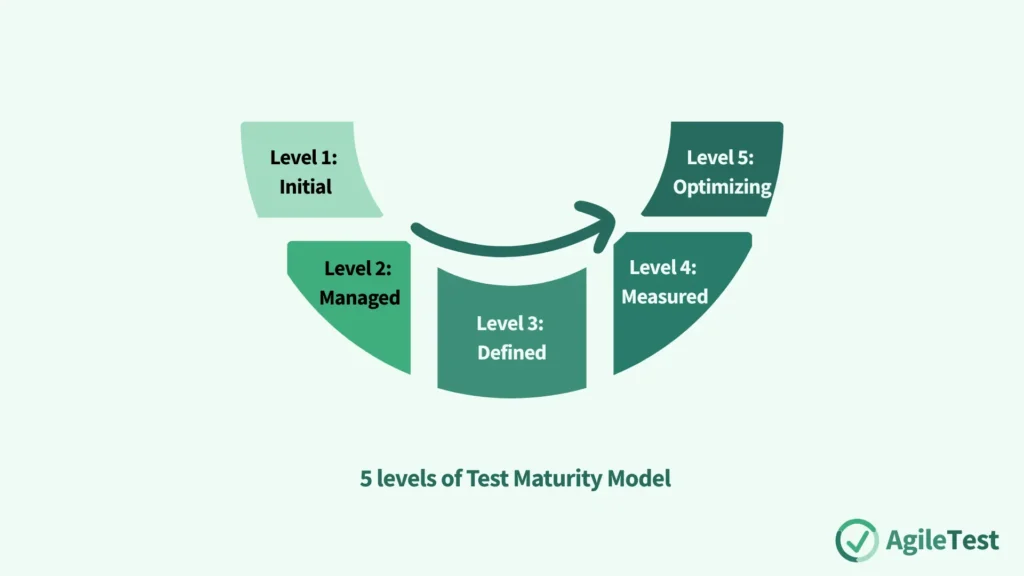
TMMi® is a comprehensive model that defines five distinct levels of process maturity. An organization’s entire testing capability is evaluated and placed at one of these levels. It provides a clear, high-level benchmark of your overall process sophistication. Initially developed to complement the Capability Maturity Model Integration (CMMI®) for development, TMMi® now stands on its own as a leading global standard for test improvement.
Here’s how the journey through the five levels typically looks:
Level 1: Initial
This is the starting point for many. Testing is largely undefined and chaotic. It’s often seen as a simple bug-hunting activity that happens right at the end of development. There are no standard processes, and success relies on the individual skills and heroics of team members. It’s stressful and unpredictable.
Level 2: Managed
At this level, you start to bring order to the chaos. Processes are established at the project level. You’ll have a defined Test Policy and Strategy, you’ll be doing Test Planning, and you’ll be monitoring and controlling your test activities. Testing is now a managed discipline, even if it’s applied differently from one project to another.
Level 3: Defined
This is a huge leap forward. At Level 3, the organization establishes a standard set of test processes that are used by everyone. These standard processes are documented and can be tailored to fit specific projects. Testing is integrated much earlier in the lifecycle, with formal peer reviews and non-functional testing becoming common practice. The organization, not just the project, now owns the process.
Discover about Traceability Matrix, which ensures the requirements are tested properly with this article: The Importance of Traceability Matrix in Testing: A complete guide
Level 4: Measured
Here, you move from just following a process to managing it with data. The organization sets quantitative quality goals. You are systematically measuring everything—test effectiveness, defect density, etc.—and using that data to drive decisions. It’s about having objective insight into your product quality and process performance.
Level 5: Optimizing
This is the pinnacle of process maturity. At Level 5, the focus is on continuous, proactive improvement. The organization uses the data gathered at Level 4 to perform root cause analysis and implement defect prevention measures. The goal is no longer just to find defects but to prevent them from ever being injected in the first place. The process itself is constantly being fine-tuned for optimal performance.
Make use of AgileTest’s custom dashboard feature to visualize your test data effectively. Try it now.
To make this journey actionable, each level (from 2 upwards) contains specific test process areas with defined goals. To achieve those goals, TMMi® provides detailed practices, sub-practices, and examples, giving you concrete guidance.
And for those of you in agile environments, don’t worry. The TMMi® Foundation has developed a specific guideline that explains exactly how the model can be beneficially applied in an Agile context, proving its flexibility for modern development.
Read our guide to improve your test process with the article: From Good to Great: A Developer’s Guide to Test Process Improvement with IDEAL
The Flexible Dashboard: TPI NEXT®
Where TMMi® gives you a single, holistic maturity level, TPI NEXT® takes a different, more granular approach. It defines 16 key areas that cover specific aspects of the test process. These include things like:
- Stakeholder Commitment
- Test Strategy
- Defect Management
- Metrics
- Test Tools
- Test Environment
For each of these 16 key areas, TPI NEXT® defines four maturity levels (Initial, Controlled, Efficient, and Optimizing). An assessment involves evaluating each key area independently and assigning it a maturity level.
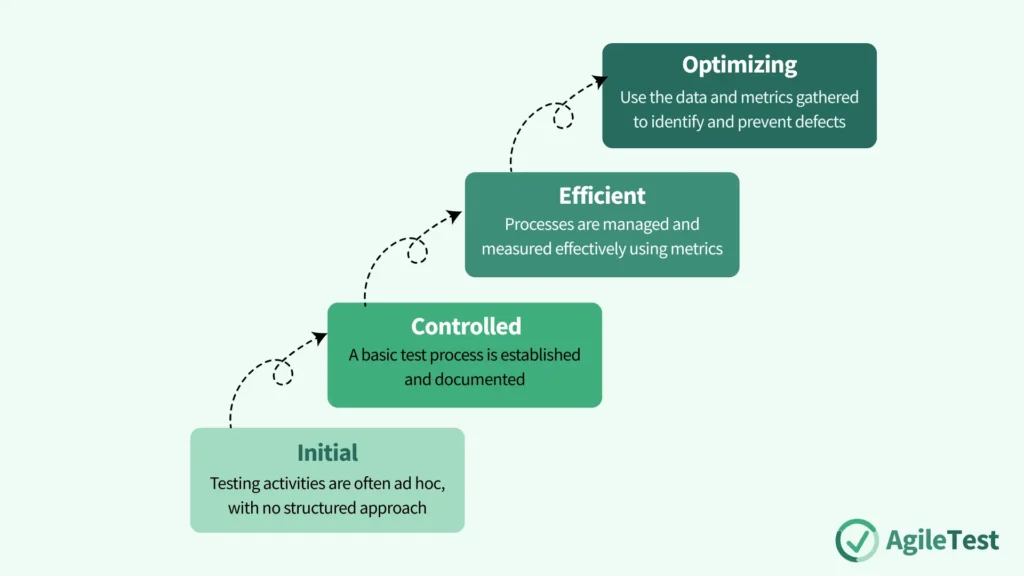
The real power of TPI NEXT® comes from how this information is presented. The results are visualized in a maturity matrix, often displayed as a spider or radar chart.
This chart gives you an immediate, easy-to-read dashboard of your testing health. You can see at a glance that your “Defect Management” process might be highly efficient, while your “Test Automation” is still at an initial, ad-hoc stage.
This approach is incredibly empowering. It allows you to focus your improvement efforts with surgical precision. Instead of a broad mandate to improve everything, you can identify your weakest links and target them directly. The assessment is guided by specific checkpoints at each level for each key area, ensuring the results are objective and evidence-based.
Making It Practical: Improvement at the Project Level
Reading about these big, comprehensive models can feel intimidating. You might be thinking, “My organization will never sign up for this.” And here’s the good news: you don’t need them to.
While these models are powerful tools for company-wide transformation, one of their most practical applications is at the project level. A single team can decide to use TMMi® or TPI NEXT® as a framework for self-improvement.
When you apply it this way, you naturally focus on the process areas most relevant to your daily work, like test planning, test design, and execution. You would largely omit the high-level organizational concerns like defining a company-wide test policy or restructuring the entire test organization.
Explore about how to master test planning with our guide: Mastering Test Planning: Your Guide from Chaos to Clarity
You can also tailor the organizational practices to fit your project’s context. For instance, instead of a 30-page formal Test Policy document, your project’s “policy” might be a single slide in your kickoff deck that defines your scope, key quality characteristics, and exit criteria. By running a successful pilot at the project level and demonstrating the benefits—fewer bugs, smoother releases, less stress—you can build a powerful grassroots case for wider adoption.
How to Get Started on Your Journey
So, how do you take the first step? It’s simpler than you think.
- Start a Conversation. Talk to your team. Frame it as a way to solve your collective pain points. Ask questions like, “What’s the most frustrating part of our testing cycle?” or “Where do we waste the most time?”
- Do an Informal Assessment. You don’t need to hire expensive consultants to begin. Use the publicly available information on TMMi® or TPI NEXT® to conduct an honest self-assessment with your team. Where do you think you are? Be real with yourselves.
- Find the Low-Hanging Fruit. Look at your assessment results. Don’t try to fix everything. Identify the one or two areas that are causing the most pain and offer the biggest return on investment.
- Make a Simple Plan. Define a few concrete, achievable actions. Assign an owner and a timeline. Maybe it’s as simple as creating a standard template for bug reports or establishing a 15-minute test planning meeting at the start of every sprint.
- Implement, Measure, and Repeat. Put your plan into action. See if it makes a difference. If it does, celebrate that win! Then, go back to your assessment and pick your next target.
Install AgileTest to enhance your test management and improve your test process now.
Test process improvement is not a one-time project; it’s a commitment to a culture of continuous learning. By using a model as your guide, you replace guesswork with a proven roadmap, empowering your team to build not just better software, but a better, more sustainable way of working.