

Imagine you’re in the middle of a critical software release. The testing team has worked tirelessly, and the project is almost at the finish line. Everyone is breathing a sigh of relief. But then, an unexpected issue arises — a feature that was promised to the customer is missing, and it turns out no one tested it.
Sounds like a nightmare, right?
This is where a Traceability Matrix in testing comes into play. It’s a vital tool that ensures every requirement is accounted for and tested properly. The traceability matrix connects your requirements directly to your test cases, offering a clear map of what’s been tested and what hasn’t. With it, you can confidently guarantee that no requirement slips through the cracks.
Let’s dive in to see what this traceability matrix is all about, and make sure no requirement gets left behind.
What is a Traceability Matrix in testing?
At its core, a Traceability Matrix (or Requirement Traceability Matrix) is a simple document (often just a spreadsheet or a feature in your test management tool) that links requirements to test cases.
Think of it as a relationship map:
- On one side: What the customer wants (requirements).
- On the other side: How you check it works (test cases).
- Sometimes in between: Design, code modules, or defects.
The goal is to ensure every requirement has at least one test case validating it. Conversely, it ensures that every test case ties back to a real requirement (no more “mystery tests” that nobody remembers why they exist).
Here’s a very simple example:
| Requirement ID | Requirement Description | Test Case ID | Test Case Description | Status |
| REQ-001 | User can log in with valid data | TC-01 | Verify login with valid creds | Passed |
| REQ-002 | Invalid login shows error | TC-02 | Verify login with wrong creds | Failed |
| REQ-003 | Reset password via email | TC-03 | Verify reset email is sent | Not run |
It doesn’t look fancy, but trust me — this little grid is the QA equivalent of a seatbelt. You don’t notice it’s there until something goes wrong, and then you’re very glad it is.
Why a Traceability Matrix in testing is important
So why bother with a TM when you already have Jira tickets, test cases, and dashboards? Let’s break it down.
1. Ensures complete test coverage
Every requirement is mapped to test cases, so nothing slips through. You can confidently say, “Yes, requirement REQ-105 is tested and here’s the proof.”
2. Prevents scope creep
We’ve all seen test cases appear out of nowhere that don’t align with any real requirement. A traceability matrix exposes these “orphan tests” and keeps everyone focused on what matters.
3. Simplifies impact analysis
When requirements change (and they always do), a TM lets you quickly see which test cases and areas are affected. No more playing detective.
4. Helps with compliance and audits
In regulated industries like healthcare, aerospace, or finance, auditors love traceability. A TM shows them that you tested everything you promised, with zero shortcuts.
5. Connects defects back to requirements
When bugs appear, you can trace them back to the requirement they broke. This is gold for root cause analysis.
6. Improves efficiency
By eliminating redundant tests and focusing effort where it’s needed, the TM keeps QA lean and effective.
In short, a traceability matrix doesn’t just help testers. It builds confidence for everyone, including developers, managers, auditors, and customers.
Traceability Matrix vs. Test Traceability
At first glance, Traceability Matrix and Test Traceability may sound like the same thing, but they serve slightly different purposes in software testing. Understanding the distinction can help teams use each concept effectively.
1. Traceability Matrix in testing
A traceability matrix is a document or table that explicitly links requirements to their corresponding test cases. It’s a planning and tracking tool that ensures every requirement is accounted for in testing.
Essentially, it’s a snapshot of coverage: you can look at the matrix and immediately know which requirements have test cases, which do not, and which have associated defects. It’s primarily requirement-focused, helping to validate that the final product meets the intended specifications.
2. Test Traceability
Test traceability, on the other hand, is a broader concept or practice rather than a single document. It refers to the ability to track the life of a requirement throughout the entire testing process, from design to execution to defect resolution.
Besides, Test traceability ensures that test cases, test results, and defects can all be traced back to the original requirement. While a traceability matrix is a common tool to achieve test traceability, test traceability also encompasses automated tracking in test management systems, reporting dashboards, and ongoing updates as requirements evolve.
In simple terms: Think of the traceability matrix as a map, showing the connections between requirements and test cases. Test traceability is the journey, making sure you can follow that map from start to finish, including results and defects.
By understanding this distinction, QA teams can leverage the matrix for planning and reporting while maintaining overall test traceability for quality control and audit compliance.
How to create a Requirement Traceability Matrix
Creating a requirement traceability matrix is a structured but straightforward process. By following a few clear steps, you can build a reliable document that keeps your testing aligned with project goals.
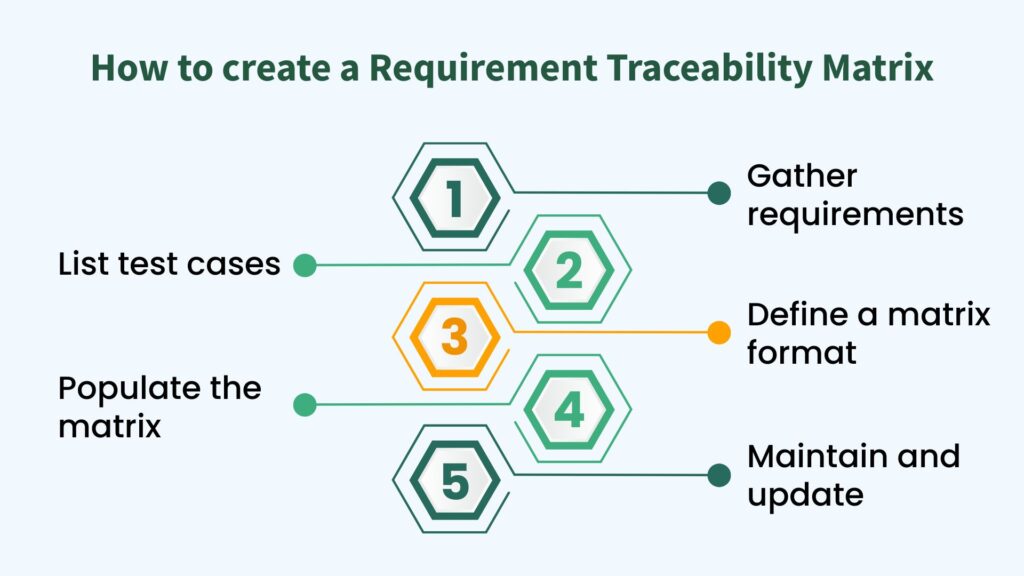
Step 1: Gather requirements
You can begin by collecting all the requirements from sources such as business requirement documents (BRD), functional specifications, or user stories in your backlog. Then, assign each requirement a unique identifier (e.g., REQ-001, REQ-002) so they can be tracked easily throughout the matrix.
Step 2: List test cases
Next, you should identify or design the test cases that validate each requirement. Give each test case a unique identifier (such as TC-001, TC-002) to maintain consistency.
At this stage, you are essentially building the “answers” to the requirements.
Step 3: Define a matrix format
Choose the format that best fits your team’s needs. For smaller projects, a simple spreadsheet in Excel or Google Sheets is often sufficient. It offers flexibility and is quick to set up.
For larger or more complex projects, a dedicated test management tool is usually the better option. Tools like Jira add-ons (something like AgileTest) allow you to simplify linking, reporting, and updating processes, reducing the overhead of manual tracking.
Step 4: Populate the matrix
With the requirements and test cases ready, you can now start building the matrix. A typical structure includes columns for Requirement ID, Requirement Description, Test Case ID, Test Case Description, Execution Status, and Defect ID (if applicable).
Filling this out ensures you can clearly see which requirements are covered, which still need attention, and which may be blocked by defects.
Step 5: Maintain and update
A traceability matrix is only valuable if it reflects the current state of your project. Remember, requirements evolve, test cases change, and new bugs surface — and the matrix must also evolve with them.
Therefore, you should make updating the matrix a regular activity, whether during sprint reviews, release planning, or regression cycles.
Pro Tips:
- Use color coding (for example, green for passed, red for failed) to make the matrix easy to scan at a glance.
- Keep the format simple and user-friendly — overcomplicating it defeats the purpose.
- Where possible, rely on automation through test management tools to minimize manual effort and errors.
By following these steps, you’ll end up with a comprehensive and practical traceability matrix. It is also the one that provides clarity, confidence, and complete visibility into your testing efforts.
Conclusion
The Traceability Matrix in testing is an indispensable tool for ensuring comprehensive test coverage and aligning requirements with test cases. It helps guarantee that all requirements are tested, preventing gaps, redundant tests, or missed functionality.
Beyond ensuring full coverage, the traceability matrix is essential for compliance in regulated industries and provides transparency throughout the project, boosting stakeholder confidence. It helps manage changes, track test results, and offers a clear view of the testing process, making it easier to spot potential issues before they escalate.
It’s not just a tool; it’s a safeguard, providing structure and accountability to your testing process.