

Discover how modern Agile teams transform defect management from a rigid process into a collaborative, cross-functional conversation. A QA Manager’s guide to lightweight, effective quality control that actually works.
From “Throwing it Over the Wall” to a Huddle at the Whiteboard
As a QA Manager who has been in the game for a while, I’ve seen it all. I remember the days of the sequential, waterfall-style projects where my team was a separate entity at the very end of the line. We’d receive a massive build, spend weeks testing it in isolation, and then generate a mountain of formal defect reports. These reports, complete with detailed attachments and severity levels, were then ceremoniously “thrown over the wall” to the development team. What followed was often a slow, disconnected process of back-and-forth comments, status updates, and the dreaded “cannot reproduce.”
Then came Agile.
Discover about Waterfall and Agile Testing with our guide: Agile Testing vs Waterfall Testing
The shift to Agile software development turned this entire model on its head, and thank goodness for that. The fast-paced, iterative nature of sprints demanded a more fluid, collaborative, and immediate approach to quality. The wall between QA, development, and product came tumbling down. Defect management was no longer a formal, bureaucratic process; it became a conversation.
Today, my goal as a QA Manager isn’t to enforce a rigid set of rules for bug tracking. It’s to foster an environment where quality is a shared responsibility and a continuous dialogue. It’s about moving from a formal ticketing system as the primary mode of communication to a quick huddle at a whiteboard (or on a Zoom call). But this doesn’t mean we abandon process entirely. The key to successful Agile defect management is finding the right balance—what I call the “formality fit”—and knowing when a quick chat is enough and when a formal record is essential.
The Agile Ideal: When a Bug Isn’t a “Ticket”
In a perfect Agile world, especially with a co-located team, many defects never even become a formal “ticket.” Imagine this scenario: one of my testers is validating a new user story. They find an issue—an incorrect calculation in a shopping cart.
Instead of immediately opening a defect tracking tool, they turn their chair around and say, “Hey Sarah [the developer], can you take a quick look at this? The sales tax calculation seems off when I add this specific item.” Sarah comes over, they look at it together, and maybe they pull in Paul [the Product Owner] to clarify the business rule. Within minutes, Sarah might spot the logical error in her code. She makes a quick fix, pushes a new build to the test environment, and the tester verifies it.
Problem found, discussed, understood, fixed, and verified—all within an hour, without a single formal defect report being written. This is the Agile ideal in action. It’s incredibly efficient, eliminates administrative overhead, and fosters a powerful sense of shared ownership. This direct communication is the lifeblood of a healthy, high-performing Agile team. It builds trust and ensures everyone has the same context, leading to better and faster resolutions.
Explore how testing takes place in Agile worlds with our guide: Testing in Traditional vs. Agile Worlds
Knowing When to Formalize: The Triggers for a Defect Report
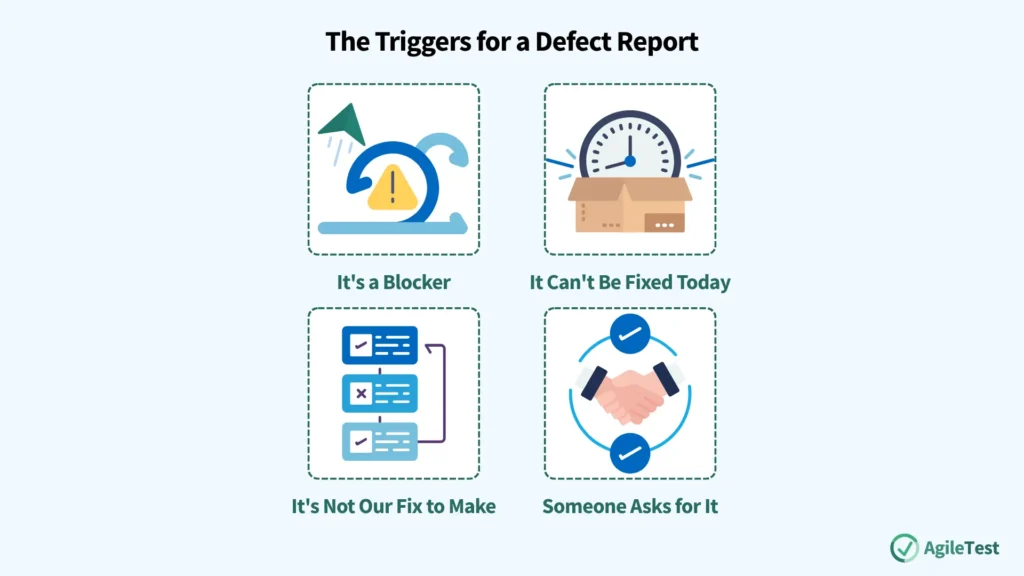
Of course, we don’t always live in that perfect world. Teams are often distributed, issues can be complex, and sometimes an immediate fix isn’t possible. The “tap on the shoulder” approach has its limits. A crucial part of my job is coaching teams to recognize the specific situations where we need to switch gears from an informal chat to creating a formal defect report. A lightweight process is great, but a forgotten defect is a failure of the process.
Here are the key triggers that tell us it’s time to write it down:
It’s a Blocker
If a defect is actively preventing a team member from making progress on a current sprint activity, it needs to be formalized. For example, if a bug in the login service prevents testers from accessing the application to test other stories, that’s a critical blocker. Creating a formal defect report makes this blocker highly visible to the entire team, allowing the Scrum Master and Product Owner to prioritize it immediately and communicate the impact on the sprint goal.
Read our guide about Scrum here: Understand Scrum Meaning: An Introduction to Scrum
It Can’t Be Fixed Today
This is a fundamental rule for many successful Agile teams. If a defect cannot be fully resolved (fixed and verified) within the same iteration—or sometimes even within the same day it’s found—it needs a formal report. This simple rule is a powerful safeguard against issues falling through the cracks. A verbal agreement to “fix it next week” is easily forgotten amidst the pressure of new sprint commitments. A formal defect report in the system ensures it has a permanent identity and won’t be lost.
Make use of the AgileTest test management feature to keep track of your testing activities effectively.
It’s Not Our Fix to Make
Modern applications are rarely built in a vacuum. We often work in multi-team organizations or rely on third-party APIs and suppliers. If my team finds a defect caused by another team’s service or a bug in a supplier’s component, a simple conversation is not enough. A formal defect report is the essential vehicle for communication. It serves as a clear, unambiguous request for action and a record of the handoff, ensuring that accountability is tracked between teams or organizations.
Someone Asks for It
Sometimes, the reason is just plain practical. A tester might show an issue to a developer who is in the middle of a complex task. The developer might say, “I see it, but I can’t switch context right now. Can you please write that up so I don’t forget it and have all the details when I’m ready?” In this case, the defect report isn’t a bureaucratic step; it’s a helpful tool for asynchronous collaboration, a to-do item that ensures the issue gets the attention it deserves later.
The Product Backlog: Where Defects and Features Coexist
So, what happens to those formalized defects that can’t be fixed in the current sprint? This is where another beautiful Agile principle comes into play. Instead of maintaining a separate, isolated “bug backlog,” the common and highly effective practice is to add the defect to the Product Backlog.
This is a game-changer.
By placing a defect in the same backlog as user stories and other features, we force a crucial, cross-functional conversation. During backlog refinement and sprint planning, the Product Owner, with input from the entire team, must now prioritize that defect against new business value.
The conversation shifts from “When can you fix this bug?” to “For the upcoming sprint, what is more valuable to our customers and our product: fixing this data export issue or building the new social media sharing feature?” This elevates the defect from a purely technical problem to a question of business value and strategy. It ensures that the team’s development capacity is always directed toward the most impactful work, whether that’s a bug fix or a new story. This is true cross-functional ownership of quality.
Finding Your “Formality Fit”: It’s Not One-Size-Fits-All
As I’ve stressed, there is no single “right” way to do defect management in Agile. The level of formality your team needs is unique. Part of my role is to help teams have a frank conversation about their specific context and decide on a process that works for them. We typically evaluate several factors:
- Team Proximity (Co-located vs. Distributed): A team sharing a physical office can rely more on informal communication. A team distributed across multiple time zones absolutely needs more formal, written documentation to bridge the communication gaps.
- Team Structure (Single vs. Multi-Team): A single, self-contained team can be very lightweight. As soon as you have multiple teams cooperating on a product, the need for formal handoffs and clear documentation increases significantly.
- Team Experience (Maturity & Size): A small, mature team that has worked together for years develops a kind of shorthand and requires less formal process. A new, larger team will benefit from more structure as they build trust and establish their working norms.
- Product Stakes (Risk & Regulation): This is paramount. If you’re building a simple content website, a very lightweight process is fine. If you’re building a financial trading platform, a medical device, or any product in a regulated industry, your defect management must be meticulous. Every defect, every decision, and every resolution needs to be formally documented for audit and compliance purposes.
- Contractual Obligations: Sometimes, the choice isn’t entirely up to the team. A contract with a client might stipulate specific requirements for defect reporting and tracking.
Don’t Keep it a Secret: Document Your Agreed-Upon Process

After the team has had these discussions and found its “formality fit,” there’s one last, crucial step: write it down.
“Lightweight” should never mean “undocumented” or “chaotic.” The team’s agreed-upon guidelines for defect management should be documented in a visible, accessible place like a team wiki or a Confluence page. This document should clearly outline:
- The triggers for creating a formal defect report.
- The essential information to include in a report.
- The process for triaging and prioritizing defects.
- How defects are handled in the Product Backlog.
This documented agreement is invaluable. It provides clarity for new team members, serves as a consistent reference point for the existing team, and helps resolve process disagreements down the road. It makes the team’s implicit understanding explicit, which is the hallmark of a mature Agile team.
Your Role as a QA Manager in an Agile World
In this dynamic, collaborative environment, my role as a QA Manager has fundamentally changed. I am no longer the police chief of a rigid process. I am a coach, a facilitator, and a champion for quality. My job is to empower my team—the whole team, not just the testers—to have the right conversations and build a process that serves them. I help them ask the right questions to find their unique “formality fit,” and I advocate for the tools and practices that make collaboration seamless.
Install AgileTest to manage your test cases and report effectively.
Ultimately, Agile defect management is about embracing quality as a continuous, team-wide conversation. It’s about being flexible but not sloppy, lightweight but not forgetful. When you get this balance right, you stop just hunting and tracking bugs and start collaboratively building better products, faster.