
There’s a question that strikes fear into the hearts of development teams everywhere. It usually comes from a project manager or a business stakeholder, and it sounds deceptively simple: “So, how long is testing going to take?”
Answering this question can feel like trying to predict the weather six months from now. It’s an act of forecasting fraught with uncertainty. Get it wrong, and you set your team up for missed deadlines, rushed work, and a lot of stress. Get it right, and you provide the business with the predictability it needs to plan effectively. This forecasting process is test estimation, and while it’s not a perfect science, it is a critical discipline and one of the most important tasks in test management.
Estimation isn’t about finding a magic number. It’s a structured activity to determine how much time, effort, and cost a task will take to complete. It’s about replacing gut feelings with a reasoned analysis. By breaking down the work, considering all the variables, and understanding the inherent trade-offs, we can move from wild guesses to creating a reasonable, data-informed forecast that helps everyone make smarter decisions.
This guide will walk you through the three pillars of a good estimate—Effort, Time, and Cost—and provide a practical framework for calculating them, all while keeping in mind the real-world constraints that every project faces.
The Three Pillars of Estimation: Effort, Time, and Cost
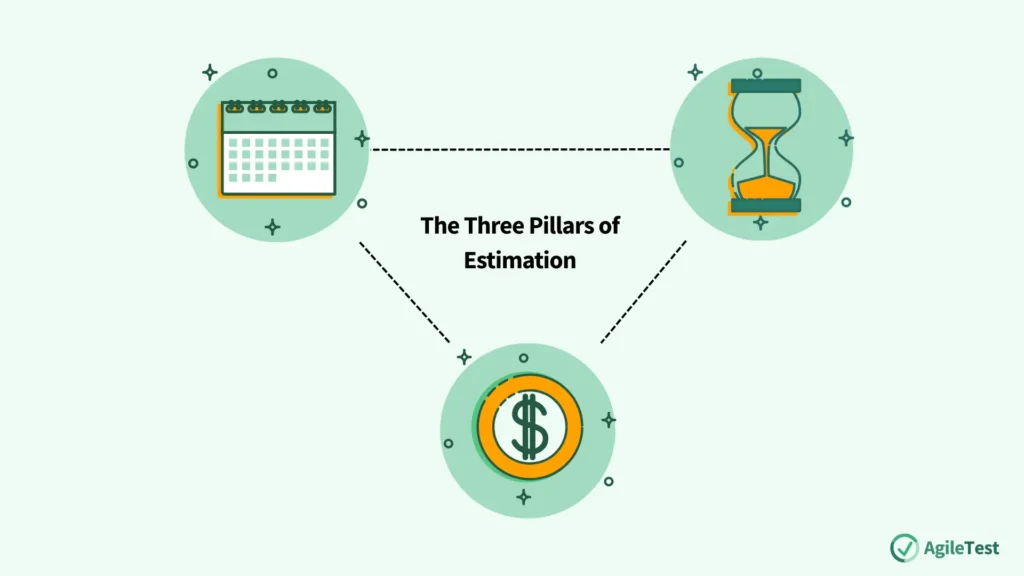
A complete test estimate isn’t a single number; it’s the answer to three distinct but related questions. Understanding the difference between them is the first step toward building a credible estimate.
1. Effort: “How much work is it?”
The first pillar is effort. This is the measure of the total amount of human labor required to complete all testing tasks. How many person-hours will it take to get the job done?
Effort is typically calculated in person hours or, in Agile contexts, story points. It represents the raw volume of work. For example, we might estimate that thoroughly testing a new feature will require 80 person-hours of work.
It’s crucial to understand that test effort and test duration (elapsed time) can be different. This is a common point of confusion. Think of it like painting a house. The job might require 40 hours of effort. If you have one painter, the duration will be 40 hours (or five 8-hour workdays). But if you hire four painters who can work simultaneously without getting in each other’s way, the duration could be just 10 hours. The total effort is the same, but the calendar time is dramatically different. Accurately estimating effort is the foundation upon which all other estimates are built.
2. Time: “How long will it take on a calendar?”
The second pillar is time, or duration. This is the metric that stakeholders usually care about most because it maps directly to deadlines and release dates. How long will it take to finish the test project?
To estimate the time required, we take the effort estimate and layer on all the real-world constraints. An 80-hour effort estimate doesn’t mean testing will be done in two weeks. You have to account for:
- Resource Availability: Do we have enough people to perform the work? If the 80 hours of effort requires a specialist who is only available 50% of the time, the duration will be longer.
- Dependencies: Is the test environment ready? Is the feature code-complete and deployed? Testing can’t start until its entry criteria are met.
- The Calendar: Time estimates must be in calendar days and working days. This means accounting for weekends, public holidays, and team members’ planned vacations.
Every project has milestones and a deadline for delivery, and the time estimate provides the roadmap to meet them.
Utilize the AgileTest custom dashboard to keep track of your test key metrics.
3. Cost: “What’s the budget?”
The third pillar is cost. What will the entire test project cost? This translates the effort and time into a monetary value. The cost is the total budget required for testing and includes several components:
- Resource Costs: This is the biggest part of the budget—the salaries and overhead for the people performing the testing work. It’s calculated based on the effort estimate.
- Tooling Costs: This includes the expenses for any specialized testing tools, such as license fees for test management platforms, performance testing tools, or automation frameworks.
- Infrastructure Costs: This covers the cost of the hardware and software needed to support testing, such as dedicated test servers, cloud environment costs, or a device lab for mobile testing.
Together, these three pillars—Effort, Time, and Cost—provide a complete, multi-dimensional view of the testing investment required for a project.
The “How-To”: A Practical Approach to Estimation
So, how do you actually come up with these numbers? The process involves deconstructing the project into manageable pieces and then estimating each piece.
Step 1: Deconstruct the Work
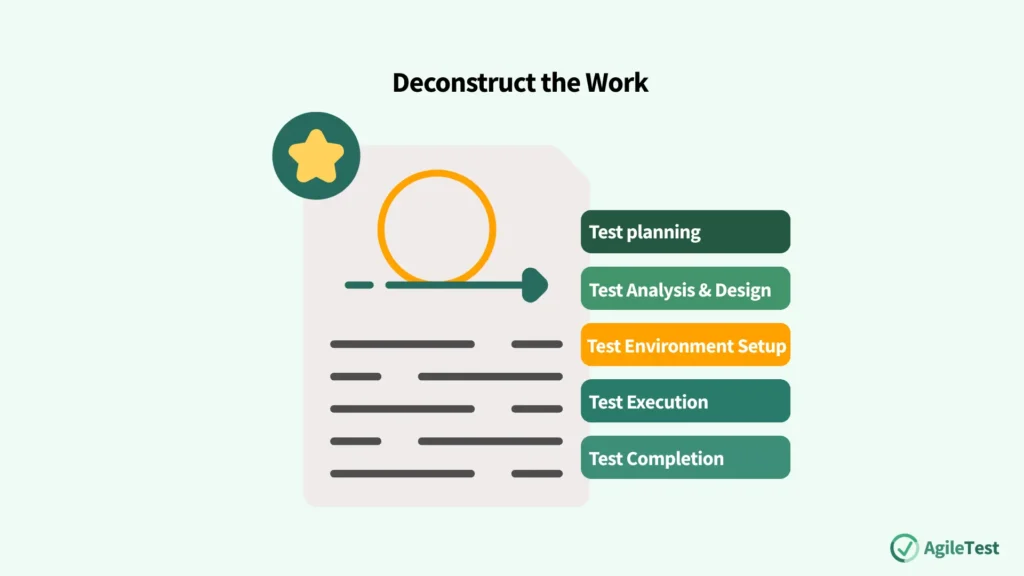
You can’t estimate a vague, monolithic task like “test the new feature.” You must first understand all the work involved. The first step is to identify the test levels, test activities and test tasks. You need to divide the testing project into its main activities within the test process.
For example, testing a new “User Profile” feature could be broken down into these activities:
- Test Planning: Researching requirements, defining scope, creating the test strategy.
- Test Analysis & Design: Writing test cases, preparing test data, scripting automated tests.
- Test Environment Setup: Configuring servers, deploying the build, setting up test accounts.
- Test Execution: Running the manual and automated tests, logging defects.
- Test Completion: Analyzing results, writing the test summary report, holding retrospectives.
By breaking the work down into these smaller, more concrete tasks, you make the act of estimating much less intimidating and far more accurate.
Read our guide about the Fundamental Test Process here: The Fundamental Test Process: A Comprehensive Guide.
Step 2: Estimate the Pieces and Roll It Up

Once you have your list of detailed tasks, you can begin to estimate the test effort required to finish each one. This is where estimation techniques like expert judgment (asking an experienced tester), analogy (comparing it to similar past work), or team-based estimation (like Planning Poker) come into play.
You would go through your list and assign an effort value (in hours or points) to each task. Then, you simply add up the estimates for all the pieces to get the total effort for the project. From that total effort, you can then derive the time and cost, as we discussed earlier.
A Note on Agile Estimation
It’s important to note that this process can look different in an Agile context. As the source material points out, in Agile projects, testing activities are estimated often within the development work, and not as separate values. This means that when a development team estimates a user story at “5 story points,” that estimate is expected to include all the work required to get the story to “Done”—including all the design, development, unit testing, integration testing, and documentation. This reinforces the “whole team” approach to quality, where testing is not a separate phase but an integrated part of the development process.
Building a credible estimate is far easier when you’re not working from memory. Accurate test estimation relies on having complete visibility into test cases, execution progress, requirements, and team collaboration. Test Manager by TestMu AI helps QA teams streamline this process by providing:
- Centralized test case management
- Test planning and execution tracking
- Requirement-to-test traceability
- Sprint-ready QA collaboration
- AI-powered test management capabilities
- Integrations with modern Agile and CI/CD workflows
You can learn more here: Test Management by TestMu AI.
The Reality Check: The Iron Triangle of Project Management
Estimation doesn’t happen in a vacuum. Testing is always a subproject within a (large) project, and it is always subject to natural project constraints. We cannot manipulate the values of our estimates arbitrarily without something else giving way.
This reality is best explained by the time-cost-quality triangle, a fundamental concept in project management. The triangle comprises three values that are interdependent, meaning they are closely connected and a change in one will inevitably affect the others.
Refer to our guide to select the test management tool: Choosing the Right Test Management Tool
This relationship is a constant balancing act, and understanding it is crucial for managing stakeholder expectations. It gives you a framework for explaining the consequences of any requested changes to your estimate.
- “Can we do it faster?” If a stakeholder wants to reduce the time, you can explain the trade-offs. To meet a shorter deadline, you will likely need to increase the cost (by adding more people or tools) or decrease the quality (by reducing the scope or depth of testing).
- “Can we do it cheaper?” If the request is to reduce the cost, the trade-offs are similar. You might have to reduce the size of the test team, which would increase the time required, or, again, you might have to sacrifice quality by cutting back on non-essential testing.
- “Can we increase the quality?” If the team wants to increase the quality by adding more comprehensive tests, this will increase the effort, which in turn will increase the time and/or cost of the project.
The iron triangle is your best tool for having mature, realistic conversations with stakeholders. It makes it clear that there is no magic wand; every decision is a trade-off.
Install AgileTest to enhance your test management process more effectively.
Conclusion
Test estimation is one of the most challenging, yet most important, activities in test management. It is a skill that blends data, experience, and a deep understanding of the project’s context.
The goal is not to produce a single, perfect number that is correct down to the last hour. That’s an impossible standard. The goal is to create a reasonable, well-reasoned forecast that provides a solid foundation for planning, scheduling, and budgeting. By breaking down the work, estimating the three pillars of Effort, Time, and Cost, and communicating clearly about the inherent trade-offs of the iron triangle, you can demystify the estimation process.
Mastering this discipline turns you from a reactive order-taker into a strategic partner. You can confidently answer that dreaded question—”how long will it take?”—not with a wild guess, but with a thoughtful estimate backed by a clear process. This empowers you to guide your project toward a realistic, achievable, and ultimately successful outcome.