
In our journey so far, we’ve identified our project’s “dragons”—all the potential quality risks that could threaten our success. We then assessed them, creating a prioritized list from the most terrifying, fire-breathing beasts down to the smaller, less threatening lizards. Now comes the most important part: the battle. How do we strategically fight these dragons to protect our users and our product?
This is where testing takes center stage. While there are other ways to handle risk, testing is the most important quality risk mitigation activity at our disposal. It is our primary weapon. But it’s not enough to just run tests; we need a battle plan. A smart testing strategy uses the risk assessment as its map, guiding us to apply the right amount of force, with the right weapons, against the right targets, at the right time.
This guide will walk you through how to use your prioritized risk list to craft and execute a test plan that strategically and efficiently tames your project’s quality risks.
Testing: Your Primary Weapon Against Risk
When faced with a risk, a team has a few options. You could create a contingency plan (e.g., preparing a workaround for users if a feature fails), engage in risk transfer (e.g., relying on the vendor of a third-party component to ensure its quality), or simply choose risk acceptance for minor issues.
But the most proactive and powerful strategy is mitigation, and for software quality, that means testing. Testing actively makes it possible to reduce the likelihood of failures reaching your users. It’s the process of shining a bright light on the dark corners of your application to find and eliminate problems before they cause harm.
The core principle of risk-based test mitigation is simple but profound: the time and effort associated with developing and executing a test should be proportional to the risk level. This is the “big hammer for big nails” approach. You don’t use the same strategy for every risk. For your highest-level risks, you bring out your strongest weapons. For the lowest-level risks, a lighter touch will do.
Discover Risk-based testing with this article: Don’t Just Find Bugs, Slay Dragons: A Guide to Testing as Risk Mitigation
Crafting Your Battle Plan: Selecting the Right Test Approach
A one-size-fits-all test plan is an ineffective one. To best mitigate risk, a test manager should analyze the following contextual factors and select an appropriate test approach tailored to the specific threats you face.
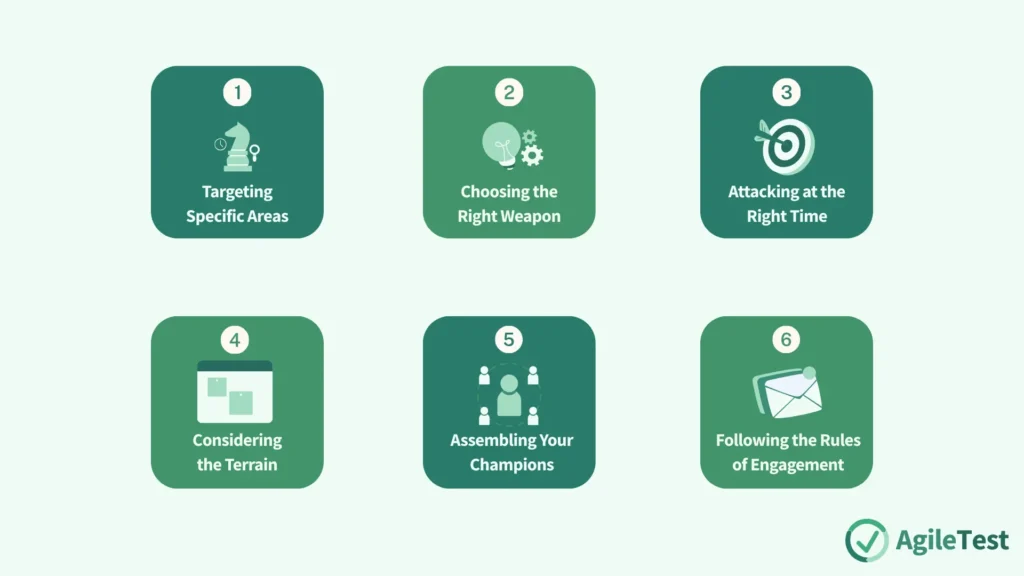
1. Targeting Specific Areas (The Test Items)
Your application is not a monolith; it’s a landscape of different features and components, each with its own risk profile. Therefore, a test object does not need to be tested with uniform rigor. You might decide that the high-risk checkout module requires an exhaustive battery of tests, while the low-risk “About Us” page only needs a quick check to see if it loads. This targeted approach ensures your most powerful testing efforts are aimed where they can do the most good.
2. Choosing the Right Weapon (The Quality Characteristics)
Different types of risks require different types of tests. A dragon that breathes fire needs a different strategy than one that is heavily armored. Risks affecting specific quality characteristics should be mitigated by associated test types. This means you need to match your test approach to the risk:
- A performance risk needs load testing, stress testing, and profiling.
- A security risk needs penetration testing, vulnerability scanning, and security code reviews.
- A usability risk needs user-centric exploratory testing and formal usability studies.
Each of these test types requires specific test effort, test environments, and testing skills.
3. Attacking at the Right Time (The Test Levels and Test Types)
When and how you test is just as important as what you test. Certain risks may only be tested dynamically on particular test levels; others by static testing. For example, a risk related to poor code maintainability is best mitigated early through static analysis and code reviews.
In contrast, a complex security vulnerability in the final product might require both a review of the architecture (static) and dynamic testing of the integrated system. A key principle here is that testing every test item as early as possible mitigates the risk of finding critical defects late in the lifecycle, which saves immense time and money.
Explore more types of testing with this article: Exploring Software Testing Types: Which One Suits You Best
4. Considering the Terrain (The SDLC)
The Software Development Life Cycle (SDLC) your team uses affects when you can start testing. In a Waterfall model, you may have to wait until the end to test the fully integrated system. In an Agile model, you can test small, vertical slices of functionality every sprint. Your mitigation plan must be realistic about when test items and environments will be ready, as all test activities have their own specific entry criteria.
Gain the key differences between Agile and Waterfall model with this article: Agile Testing vs Waterfall Testing
5. Assembling Your Champions (The Test Team)
When you’re facing your biggest dragons, you send in your best knights. The same logic applies to testing: the most qualified people should test the test items with the highest risk levels. Your senior performance engineer should lead the charge on performance risks. Your most experienced domain expert should tackle the most complex functional risks. Matching skills to risks is a simple but powerful management tactic.
6. Following the Rules of Engagement (The Regulatory Requirements)
In some industries, your test strategy is not entirely up to you. For safety-critical systems in fields like medical devices or automotive, regulatory requirements (like the IEC 61508 standard) prescribe the test techniques and the required coverage based on the integrity level of the software. In these cases, the test manager’s job is to ensure these standards are meticulously followed as part of the risk mitigation plan.
Beyond Test Cases: Risk-Informed Quality Control
The assessed risk level should influence more than just the tests you write. It should also guide your broader quality control decisions.
- Peer Reviews: Test cases designed for a high-risk feature should themselves undergo a formal review to ensure they are effective and thorough.
- Tester Independence: For the highest-risk areas, you might mandate a higher level of independence of testing from development, perhaps using a separate, dedicated QA team to avoid confirmation bias.
- Regression Testing: The extent of regression testing performed can be tailored to risk. A small change in a low-risk module might only trigger a quick smoke test, while any change to a high-risk core component should trigger the full regression suite.
Executing the Plan: Depth-First vs. Breadth-First
Once your plan is in place and your tests are ready, you need a strategy for execution. Your test prioritization should be based directly on risk levels. This ensures that from the very first day of execution, you are working on the most important things first. There are two primary strategies for this.
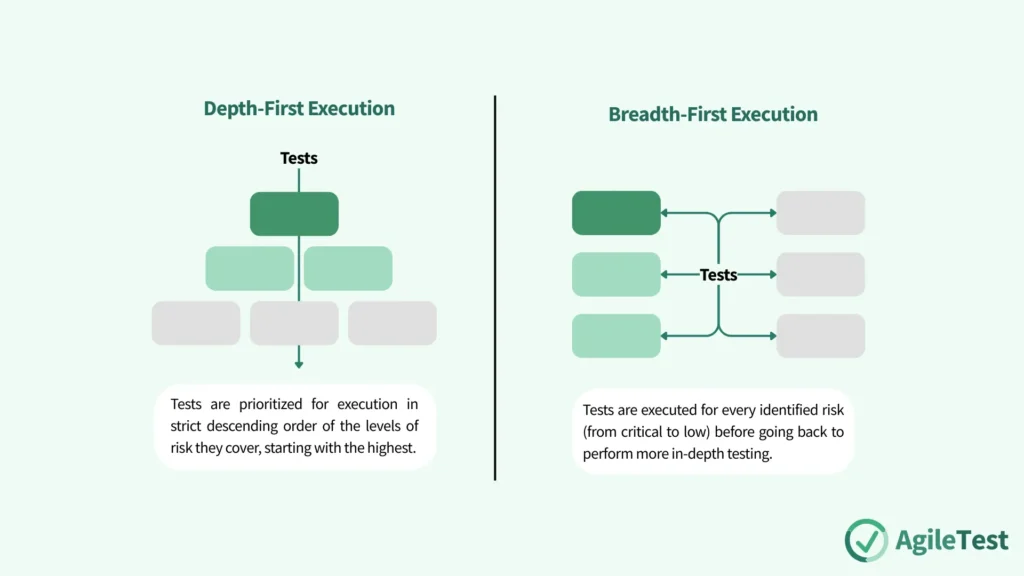
Depth-First Execution
In this approach, tests are prioritized for execution in strict descending order of the levels of risk they cover, starting with the highest. You pick the highest-risk item on your list and execute all the planned tests for it before moving on to the next-highest risk.
- Analogy: Slay the biggest dragon completely before turning your attention to the next one.
- When to Use It: This is appropriate when it is crucial to mitigate the highest level risks as early as possible. It gives you deep confidence about your most critical features first.
Breadth-First Execution
Alternatively, you can take a breadth-first approach. Here, you ensure that at least one test for each risk is assigned highest priority. You run a single, representative test for every identified risk—from critical to low—before going back to perform more in-depth testing.
- Analogy: Lightly wound all the dragons to get a quick sense of the overall battlefield before committing to a long fight with any single one.
- When to Use It: This is appropriate when stakeholders want an overall view of the product quality as early as possible. It quickly gives you a baseline understanding of quality across the entire application.
In practice, a hybrid approach is often best. You might start with a depth-first approach for your top 3-5 critical risks. Once those are thoroughly tested, you might switch to a breadth-first approach to get at least one test run against all remaining items, especially as deadlines loom.
AgileTest assists the QA and Tester team with comprehensive Test Case management features. Try it now.
Reporting from the Battlefield: Monitoring Residual Risk
One of the most powerful aspects of risk-based testing is how it transforms your reporting. Instead of just reporting on activities (“We’ve completed 70% of our planned tests”), you can report on outcomes. This is done by tracking residual risk—the amount of risk that remains after your mitigation efforts.
As tests for a high-risk item are executed and passed, your confidence in that feature increases, and its residual risk level drops. Risk-based testing allows reporting on the test progress in terms of the residual risk level at any point in time. A status update can sound like this: “This week, we have fully mitigated all ‘Critical’ risks. The residual risk for the payment system is now ‘Low,’ but the ‘High’ risk related to performance remains, as we have not yet started load testing.”
This type of reporting is incredibly valuable because it supports the development team and stakeholders in…making release decisions, based on the residual risk level. It frames the quality conversation in terms of business risk, a language everyone can understand.
Taking your testing records and performance to a next level of efficiency with AgileTest
The Final Call: When Time Runs Out
It is a near-universal truth of software projects that the time allocated for testing may be consumed without all planned tests being run. In a traditional approach, this leads to a difficult, uninformed conversation. But with a risk-based approach, you are prepared.
Because you have systematically tested based on risk priority, you know exactly what has and has not been tested. This allows you to provide a justified recommendation to management. You can state with clarity and confidence:
- “We are out of time. All remaining untested items are categorized as ‘Low’ or ‘Very Low’ risk. We have a high degree of confidence in the critical areas of the application, and we recommend accepting the remaining risk and proceeding with the release.”
- OR: “We are out of time, and two ‘High’ risk items related to data security have not yet been tested. The potential impact is severe. We strongly recommend extending the testing phase by three days to mitigate these known risks.”
This transforms the decision from a gut feeling into a rational, risk-informed choice.
Check more info about Testings in the Agile era at: Testing in Traditional vs. Agile Worlds
Conclusion
Risk mitigation through testing is the art and science of focusing your energy where it matters most. It moves testing from a reactive, and often chaotic, search for bugs into a proactive, strategic campaign to systematically reduce risk.
By creating a plan that is proportional to the risk, choosing the right techniques and people for the job, executing in a prioritized order, and reporting your progress in terms of residual risk, you elevate the role of testing. You become a key strategic partner who provides clarity, builds confidence, and empowers your entire organization to make smart, informed decisions about quality. You’re not just a bug hunter; you’re a dragon slayer with a plan.