

Have you ever been part of a project where your final result is different from what was expected, even when you already have a plan? This is where test control shows its role in the testing process. It acts as the compass that guides your testing efforts, ensuring you stay on the right path to deliver a high-quality product.
This article will walk you through the basics of test control, from what it is and why it’s important to the key activities involved and how to handle common challenges.
1. What Is Test Control?
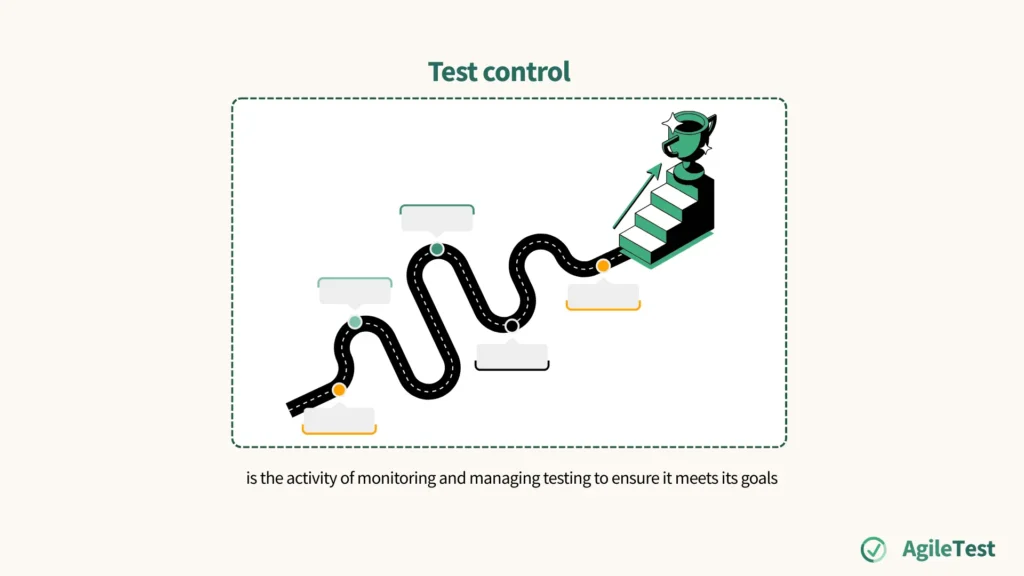
Test control is the activity of monitoring and managing testing to ensure it meets its goals. It’s about taking charge of the testing process to make sure it is efficient and on schedule. Remember that test control is an active process that happens throughout the project.
Think of it like being a captain of a ship. The test plan is your map, but test control is what you flexibly adjust and manage while sailing to reach the destination on time. In a project, this means you are constantly checking your progress against the plan, reporting on how you are doing, and making quick decisions to handle any problems that come up.
2. Key Activities
So, what exactly will you do in the Test control stage? In fact, test control involves several core activities that happen throughout the testing process. It could be mainly described by three words: monitor, evaluate, and adjust.

Monitoring
Monitoring is the foundation of test control. It’s more than tracking what tasks are done; it’s about getting aware of abnormal signals in your testing process. You don’t need to fully understand what these numbers tell at first glance; you only need to sense what could be wrong. For example, a sudden increase in failed tests might signal a serious issue with the software, while a drop in new bugs could mean you are missing some important tests. By paying attention to these trends, you could catch problems early, before they become major issues.
However, numbers don’t capture everything. Qualitative signals, like other tester feedback and observed risks, provide important context. Testers may notice confusing workflows, unexpected behavior, or potential risks that metrics alone don’t show.
Unfortunately, your sense of errors is not always correct. It’s just an initial hypothesis about your test data based on your experience. In different contexts, you may see different meanings for the same test results. For instance, imagine your team finds a sudden rise in bugs. Your initial thought might be that the code is unstable. However, if this spike happened right after you hired a team of new, highly skilled testers, it probably means your testing process is now more effective at finding bugs. The data itself didn’t change its meaning; the context of the situation did. This is why you cannot rely on a simple feeling or error.
The only method of getting a good sense of test results is through observation and reflection of practical projects. However, even experts can make misassumptions based on their experience. So, you should not completely rely on it. That leads to the next activity to evaluate your assumption with a measurable benchmark.
Evaluating
Evaluation is the next step, where you turn raw numbers into a clarification of your assumptions. By comparing your actual test results to your project’s goals, you clear all the vagueness of your hypothesis, and decide your next activities with less bias. You can rely on your original test objective to see if you are meeting the mission you set out to accomplish. Additionally, you can also look at historical data from past projects as a valid benchmark.
You can refer to our guide to set actionable and measurable objectives: Your Project’s North Star: A Practical Guide to Test Objectives
It’s recommended that you establish an acceptance range. For example, one of your test objectives is to achieve 90% test coverage at the final stage. Unexpectedly, risks arise, and you spend most of your time solving these urgent events, which leads to the outcomes of only 85% test coverage. Would it be acceptable to move on, or do you need to adjust it right now? To determine the next action, you need to discuss with stakeholders. It can be conducted at the very beginning of the test planning stage or just after you realize some abnormal signal when monitoring the process.
Adjusting
Adjustment is where test control delivers real value. Once you find a problem or something that’s not working well, you have to act. This could mean moving your team to focus on a high-risk area, updating your tests to match new requirements, or telling the development team about a critical bug. Making these timely changes ensures your testing stays on track, covers all the important areas, and prevents small issues from becoming big problems. This makes testing a living process that not only tracks progress but also actively improves the final product.
Read our relevant guide about using key metrics in Test Control now: Measuring What Matters: A Practical Guide to Test Metrics
3. Roles in test control
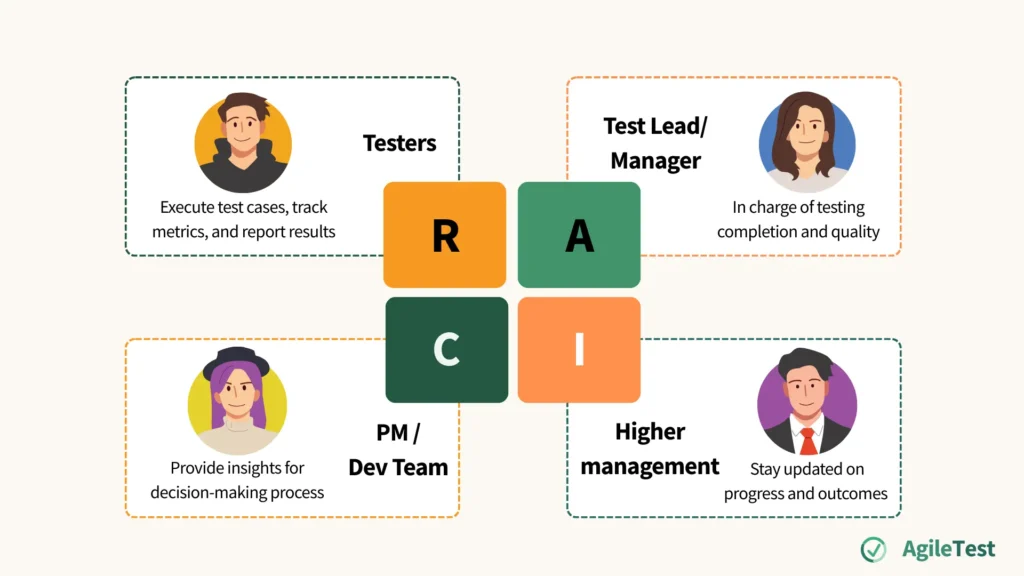
In any test control activity, a RACI matrix can be used to clearly define the scope and responsibilities of the different roles involved. The matrix clarifies who is Responsible (R) for a task, who is Accountable (A) for its completion, who must be Consulted (C) for input, and who needs to be Informed (I) of the outcome.
R – Responsible
The Responsible role performs the work and is on the front lines. In test control, this includes the testers who execute test cases, track metrics, and report results. There can be multiple “Rs” at the same time to conduct different tasks. Their role is the engine of the entire process. Their accuracy and efficiency in carrying out the day-to-day tasks are the foundation for all the data and insights used to manage the project. Without a clear “R,” no one knows who is truly doing the work, which can lead to tasks being overlooked entirely.
A – Accountable
The Accountable role is the single point of ownership for a task, the person who is in charge of its completion and quality. This role is typically held by the Test Lead or Test Manager. The key insight is that there can only be one “A” per task. This single-person accountability prevents situations where everyone feels responsible but no one takes final ownership. The “A” makes the crucial decisions, signs off on adjustments, and is the final authority that ensures the test control process meets its goals.
C – Consulted
The Consulted role involves experts or stakeholders whose input is considered before making decisions. In test control, this may include the Project Manager or the Development Team. The “C” provides crucial insights thanks to their expertise, experience, and understanding of products. Their suggestions ensure that decisions are well-informed and aligned with the broader project. There can be several “Cs” in the test control to give you feedback, but the decision to follow these or not depends on the “A” role.
I – Informed
The Informed role is for individuals who need to stay updated on progress and outcomes but are not directly involved in the work. This could include stakeholders or higher management. Instead of pulling these key people into daily meetings, you give them a one-way communication channel, typically through regular reports or dashboards. This maintains a high level of transparency and alignment across the entire organization without wasting their time on the day-to-day details.
4. Why Test Control Matters
Test control is crucial because it ensures that testing is not a separate and single activity but a structured process. By monitoring your testing process, you can keep your testing activity on track, mitigate risk, and improve quality.
Tracking your timeline
Test control helps you stay on track throughout the project. When you first plan your testing, there will be some areas for which you cannot accurately forecast the due dates. If you just strictly follow your plan, there will be some tasks that exceed the timeline and even your lagging time. The situation may even be worse when your task dependencies are “Finish-to-Start”, which would disrupt the whole timeframe. By continuously monitoring the progress of testing against your schedule, you can ensure you meet important deadlines and prevent unexpected delays that could prolong the entire project.
Mitigating risks
Test control also helps you handle risks effectively. When a problem arises, like a new bug or a sudden delay, regularly checking up on your test activities gives you early detection of the issue instead of surprisingly realizing it at the end of your testing process, especially with those processes following the Waterfall approach. Thus, you can actively adjust the priority of tasks and resources to solve these issues and minimize the impact of the problem on the overall test process.
Improve quality
By keeping a close eye on the testing process, test control helps to improve quality. During your testing process, some tasks can be conducted independently. This saves you lots of time but creates gaps when everyone just focuses on their tasks. Monitoring testing activities allows you to make sure that all the important parts of the application are being tested thoroughly and are intertwined with each other. You can spot areas that are falling behind or being overlooked, then redirect resources to ensure the final product is comprehensive and reliable.
5. Common Challenges
Even with a great plan, test control can be difficult when there is a lack of clear communication from other teams and a shortage of resources.
A lack of clear communication is a major block to effective test control. The testing team needs to know immediately when something changes, whether it’s a bug fix from a developer or a new feature request. When this information isn’t shared clearly and on time, it creates delays and confusion, even resistance to change. You may know what and why exactly to fix, but not everyone does. They may have questions about your changes and see your direction to change as an overburdened workload.
Another major challenge is a shortage of resources, especially test tools. Test control is about managing the process, but if you don’t have the right tools to do the work, no amount of management can fix it. Outdated or unsuitable tools can slow down the entire process, making it difficult to accurately track progress and find bugs. For example, if you’re stuck using a basic spreadsheet to track hundreds of bugs, you won’t be able to get a quick, accurate view of the project’s health. This lack of proper tools makes it harder to control the testing process and directly affects the quality of the final product.
Explore AgileTest, one unified tool that helps your test management and control become more effective.
6. Tips and tricks
To perform test control effectively, you should start early. Don’t wait for testing to begin; start planning and monitoring from the very beginning of the project. At the same time, use the right tools to get a clear, real-time view of your progress. Some tools can automate much of the tracking, allowing you to focus on the bigger picture.
Most importantly, communicate, communicate, communicate. Keep everyone informed about the testing status. Be clear about what’s going well and what’s not, and always be open about any risks you see. A good test controller also knows how to be flexible. Projects are unpredictable, so be ready to adapt to unexpected changes. A good test controller knows when to stick to the plan and when to adjust it for the benefit of the project.
Final Thoughts
Test control is more than just a task; it’s a mindset of continuous management and oversight. By actively monitoring your progress and making quick, informed decisions, you can ensure that your testing efforts are not just busy but truly effective. This disciplined approach helps you guide your project to a successful launch, delivering a high-quality product every time.