

Stepping into a role where you lead a software test team is one of the most challenging, dynamic, and ultimately rewarding positions in the entire tech landscape. It’s a job that goes far beyond simply assigning tasks and tracking bug counts. You are the chief advocate for quality, the strategic planner, the team’s coach, and often, the calm in the eye of the project storm.
A great test lead or manager doesn’t just manage a process; they build and nurture a high-performing team. They blend deep technical understanding with sharp human insight, creating an environment where testers can do their best work. But what does it actually take to succeed in this role?
The required skills can be broken down into three essential pillars: Professional and Methodological Competence (your foundation), Social and Personal Competence (your ability to connect and inspire), and Situational Leadership (your ability to adapt to the ever-changing dynamics of a team). This guide will provide a playbook for mastering each of these areas, transforming you from a good manager into an exceptional leader. 🚀
Read our related guide about essential test team skills here: Building a Dream Team: The Ultimate Guide to Essential Test Team Member Skills
Pillar 1: Professional & Methodological Competence – The Bedrock of Credibility
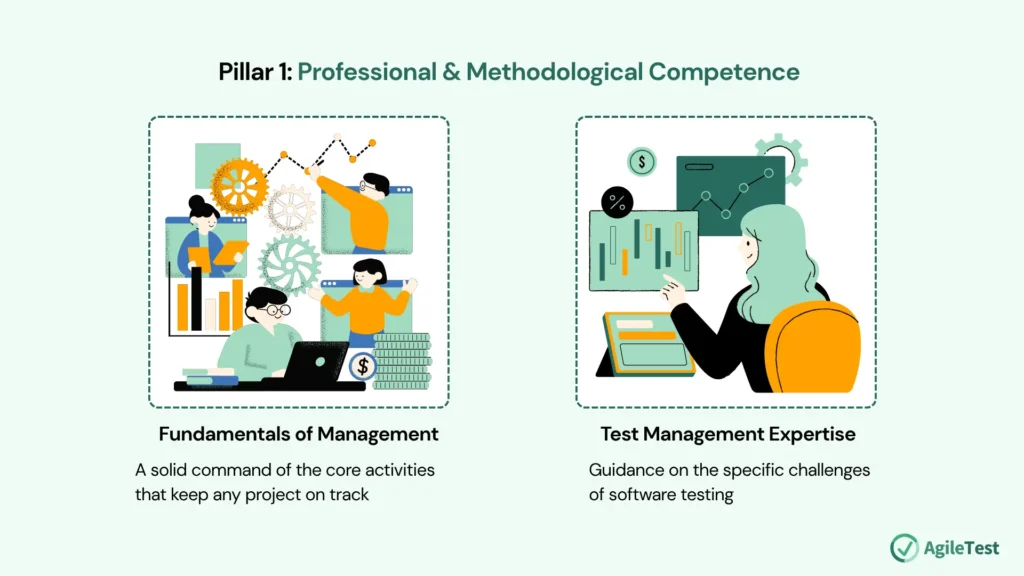
This first pillar is your foundation. It’s the “what you know” that earns you the respect of your team and the trust of your stakeholders. Without a firm grasp of both general management principles and the specific nuances of test management, it’s nearly impossible to lead effectively.
Mastering the Fundamentals of Management
Before you can be a great test manager, you have to be a great manager. This means having a solid command of the core activities that keep any project on track.
- Planning: A test manager is a strategist. Your job isn’t just to decide what to test, but to develop a comprehensive test strategy that aligns with project goals, timelines, and budgets. You’re like an architect designing the blueprint for the entire quality assurance effort, considering risks, resources, and the right mix of testing types (manual, automated, performance, etc.).
- Monitoring Progress: Once the plan is in motion, you become the conductor ensuring the train stays on the tracks. This requires skills in monitoring key metrics, tracking progress against milestones, and using tools like Jira dashboards or test management platforms to maintain a clear view of the team’s activities and the product’s quality status.
- Controlling and Reporting: Things rarely go exactly as planned. Controlling involves making adjustments based on your monitoring—reallocating resources, adjusting priorities, and managing risks. This is followed by reporting, which is the art of storytelling with data. You must be able to communicate the team’s findings, the current level of quality, and any critical risks to stakeholders in a way that is clear, concise, and actionable.
Explore more about Test control activities with our article: Test Control: What’s all you should know about
Specialized Test Management Expertise
This is what separates a generic project manager from a true test leader. Your team will look to you for guidance on the specific challenges of software testing, and you need the knowledge to provide it.
- Deep Knowledge of Test Approaches: You need to understand the pros and cons of different test approaches (e.g., risk-based testing, requirements-based testing) and know which one is best suited for your project’s context.
- Fluency in the SDLC: Whether your organization uses Agile, Waterfall, DevOps, or a hybrid model, you must understand the software development lifecycle inside and out. This fluency allows you to integrate testing activities seamlessly into the development process, ensuring quality is built-in from the start, not inspected at the end.
- Familiarity with Test Techniques: While you don’t need to be the reigning expert on every single test technique, you should have a strong working knowledge of the tools in your team’s toolbox, from exploratory testing to boundary value analysis. This allows you to guide your team in choosing the most effective techniques for the task at hand.
Learn more about testing in Agile worlds with our article: Rock Your Agile Testing: Strategies for Velocity, Quality, and Keeping Your Sanity!
Pillar 2: Social & Personal Competence – The Heart of Leadership
If professional competence is your foundation, social and personal competence is the framework you build upon it. These are the “soft skills” that determine your ability to build trust, motivate your team, and champion quality across the entire organization.
Have a look at our related article about test team skill development: Level Up Your QA Team: 5 Proven Strategies for Skill Development
Building a Resilient and Empowered Team
Your first responsibility is to the people you lead. Creating a positive and productive environment requires a specific set of personal attributes.
- Resilience: Test teams are often under immense pressure, especially near release dates. A great leader acts as a “shock absorber,” shielding the team from unnecessary organizational stress and maintaining a calm, positive demeanor even when things go wrong. Your resilience sets the tone for the entire team.
- The Art of Delegation: True delegation isn’t just offloading tasks you don’t want to do. It’s an act of trust and empowerment. It means giving your team members ownership and personal responsibility, providing them with opportunities to learn new skills and grow their careers.
- The Capacity to be Accepted: Leadership is a role that must be earned, not just assigned. You gain the acceptance of your team by demonstrating your competence, being fair and transparent, actively listening to their concerns, and most importantly, having their back when challenges arise.
Championing Quality Across the Organization
Your influence must extend beyond your own team. As a test lead, you are the primary advocate for product quality in the project.
- Promoting the Benefits of Testing: You must be able to articulate the “why” behind your team’s work. This means moving the conversation beyond bug counts and linking quality assurance activities directly to business value, such as protecting brand reputation, increasing customer satisfaction, and reducing the long-term cost of development.
- Asserting Test Interests: You will often need to be a firm but fair negotiator. This includes advocating for realistic timelines, securing the necessary tools and test environments, and pushing back against pressure to cut quality corners. This requires the ability to present a data-driven case for why testing needs a seat at the table.
- Communicating and Resolving Conflicts: Conflict is inevitable. You will have to navigate disagreements with developers over bug priorities, with project managers over scope, and sometimes even within your own team. Strong conflict resolution skills—centered on active listening, empathy, and focusing on shared goals—are absolutely essential.
Pillar 3: Situational Leadership – Adapting to Your Team’s Journey
This final pillar is arguably the most advanced. It’s the ability to understand that there is no one-size-fits-all leadership style. The best leaders are chameleons, adapting their approach based on the people they are leading and the situation they are in.
The Foundation: Analyzing Your Environment
Before you can adapt, you must observe. This means developing keen skills in analyzing the social, team, and working conditions of your project. Ask yourself:
- Is my team composed of senior experts or junior testers who need more guidance?
- Are we co-located and collaborating in person, or are we a fully remote team that needs different communication strategies?
- What is the overall project culture? Is it a fast-paced, agile environment or a more structured, traditional one?
Based on this analysis, you can make informed decisions. Sometimes, you need to help the team adapt to the working conditions. Other times, you may need to advocate for changing the working conditions to better suit the team.
Install AgileTest, one unified tool to keep track and manage your test cases effectively.
Navigating the 5 Stages of Team Development (The Tuckman Model)
One of the most powerful frameworks for situational leadership is Bruce Tuckman’s model of group development. It outlines five predictable stages that most teams go through. A great leader understands these stages and applies the right skills at the right time to help the team move forward successfully.
1. Forming: The Welcoming Guide
In this initial stage, the team is new, polite, and often a bit anxious. Members are figuring out their roles and getting to know each other.
- Your Required Skill: A willingness to help test team members join. Your role is to be a facilitator. Provide clear direction, define roles and responsibilities, and create a welcoming, psychologically safe environment where everyone feels comfortable contributing.
2. Storming: The Calm Mediator
This is often the most difficult stage. Personalities may clash, and disagreements arise about processes and technical approaches.
- Your Required Skill: The ability to resolve conflicts within the test team. Don’t ignore friction; address it head-on. Mediate discussions, help the team establish ground rules for healthy debate, and guide them toward a consensus that respects different viewpoints.
3. Norming: The Disciplined Leader
The team begins to resolve its conflicts and starts to agree on common values, rules, and processes. A sense of cohesion emerges.
- Your Required Skill: Discipline and target-oriented leadership. Your job is to help solidify these newly formed norms. Reinforce the agreed-upon values and ensure the team adheres to the rules and processes they’ve created together, keeping everyone focused on the project’s goals.
4. Performing: The Empowering Delegator
The team is now a well-oiled machine. Members are autonomous, interdependent, and highly productive. They can handle decision-making and problem-solving on their own.
- Your Required Skill: The ability to delegate. This is where your hard work pays off. Your role shifts from director to coach. You must trust your team, give them personal responsibility, and focus on removing obstacles so they can perform at their best.
5. Adjourning: The Appreciative Closer
The project comes to an end, and the team prepares to disband. This stage can be bittersweet.
- Your Required Skill: The ability to act with appreciation and confidence. It’s crucial to manage this final stage with grace. Take the time to celebrate the team’s successes, acknowledge each individual’s contributions, and provide a sense of closure, helping members transition confidently to their next roles.
Conclusion: The Three-Dimensional Leader
Becoming a truly effective test team leader is a journey, not a destination. It requires a dynamic blend of skills. Your professional competence gives you the credibility to lead. Your social and personal skills allow you to build the trust and relationships that inspire a team. And your situational leadership gives you the wisdom to apply the right approach at the right time.
By continuously developing yourself across all three of these pillars, you can move beyond simply managing a group of testers and become the kind of leader who builds, empowers, and guides a team to achieve outstanding results.
Frequently Asked Questions (FAQ)
Q1: What is the difference between a test manager and a test lead?
While the titles are often used interchangeably, a Test Manager typically has a broader scope, focusing more on project-level strategy, budget, and resource allocation. A Test Lead is often more hands-on, providing daily technical and tactical guidance to the test team. However, both roles require the core leadership skills discussed in this article.
Q2: How can I improve my conflict resolution skills as a QA lead?
Start by practicing active listening—seek to understand the other person’s perspective before stating your own. Focus on objective data and the shared goal of product quality, rather than personal opinions. Taking workshops on communication or mediation can also be extremely beneficial.
Q3: What is the single most important skill for a new test manager?
While all skills are important, for a new manager, the ability to earn the acceptance and trust of the team is paramount. If your team doesn’t trust you or respect your leadership, even the best plans and processes will fail. Focus on being competent, fair, and supportive from day one.
Q4: Why is the Tuckman model so useful for managing a test team?
The Tuckman model provides a simple yet powerful roadmap for understanding team dynamics. It helps you anticipate the challenges your team will likely face (like conflict in the “Storming” phase) and equips you with a strategy to guide them through it, making you a more proactive and effective leader.