
Artificial intelligence now plays two roles in software quality, and AI voice agent testing sits right at the center of both.
First, AI can be the product that needs testing. A voice agent is a good example. It listens to users, understands requests, connects with business systems, and gives spoken answers.
Second, AI can support the testing team. It can help QA teams create test cases, organize requirements, manage test runs, and review results.
Testing an ai voice agent shows why both roles matter. The agent must understand real people in real situations. At the same time, testers need a clear way to manage conversation paths, failures, risks, and results.
Reliable AI experiences need two things. Teams must test the AI system carefully, and they must use smart tools to manage the testing process. AI voice agent testing is harder than testing normal software features
Why AI Voice Agents Are Difficult to Test
Voice agents are harder to test than normal software features. People may speak quickly, use regional words, pause, change their request, or provide incomplete details.
Speech Recognition
Different accents, speaking styles, tones, and voice levels can affect speech recognition.
Testers should use different voices and check unclear speech, repeated words, and self-corrections.
Intent and Context
Correctly hearing words is not enough. The agent must understand what the user wants.
For example, “I cannot come tomorrow” may mean the user wants to cancel or change an appointment. The agent should ask a clear question before taking action.
It must also remember earlier details during a multi-turn conversation. If the user changes a date or time, the agent should update the correct information.
Noise, Latency, and Interruptions
Teams should test traffic sounds, nearby voices, poor connections, and low audio quality. They should also measure how long the agent takes to reply.
Users may interrupt while the agent is speaking. The system should stop, listen, and continue without losing context.
Error Recovery
The agent should ask users to repeat or explain unclear details.
It should not guess when important information is missing. Like any agentic AI system, it should also send high-risk cases to a human.
What Quality Means for an AI Agent
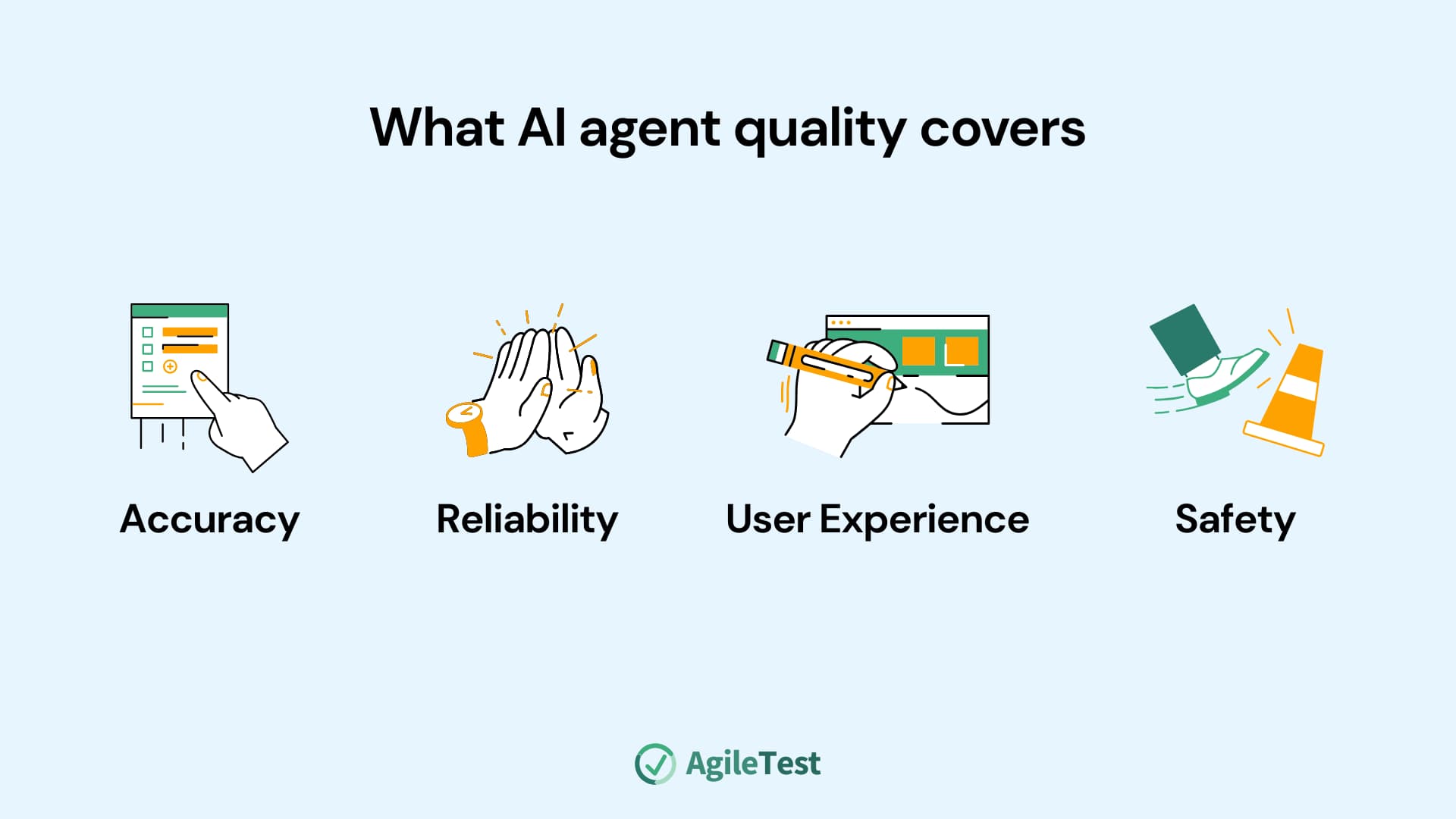
AI quality should be measured across several areas.
Accuracy
The agent should understand the user and complete the correct action.
Testing should cover both the spoken reply and the final system result. An agent may give the right answer but save the wrong date or update the wrong record.
Reliability
The agent should behave consistently across users and situations.
User Experience
The conversation should be clear, natural, and easy to complete.
The agent should avoid long pauses and unnecessary questions. It should confirm important details before completing an action.
Safety
Voice agents may handle private information. They must protect user data and follow access rules.
The system should not share sensitive details before checking identity. It should also send high-risk cases to a human.
Turning Conversations into Test Cases
Teams can make voice-agent testing easier by turning user journeys into structured test cases.
Start with common tasks such as booking an appointment, cancelling a service, checking an order, or updating account information.
Positive tests cover normal requests. Negative tests use missing or incorrect information. Edge cases include unusual but possible behavior. Failure tests check what happens when another system is slow or unavailable.
Expected results should focus on the final outcome. AI responses may use different words, so checking one exact sentence is often not useful.
Instead, testers should check whether the agent understood the intent, collected the required details, followed the right rules, completed the action, and gave a clear confirmation.
Managing AI-Agent Testing at Scale
Teams running AI voice agent testing at scale need a clear system for requirements, test cases, test runs, defects, and evidence.
Each AI capability should connect to related tests. This traceability shows which requirements are covered and which areas still need testing.
Testers may also save transcripts, audio files, response times, logs, and screenshots. This evidence helps developers locate the cause of a failure.
Regression testing is also important. Teams should repeat key tests whenever models, prompts, APIs, or conversation flows change.
Try AgileTest on Jira for free.
Using AI to Improve Test Preparation
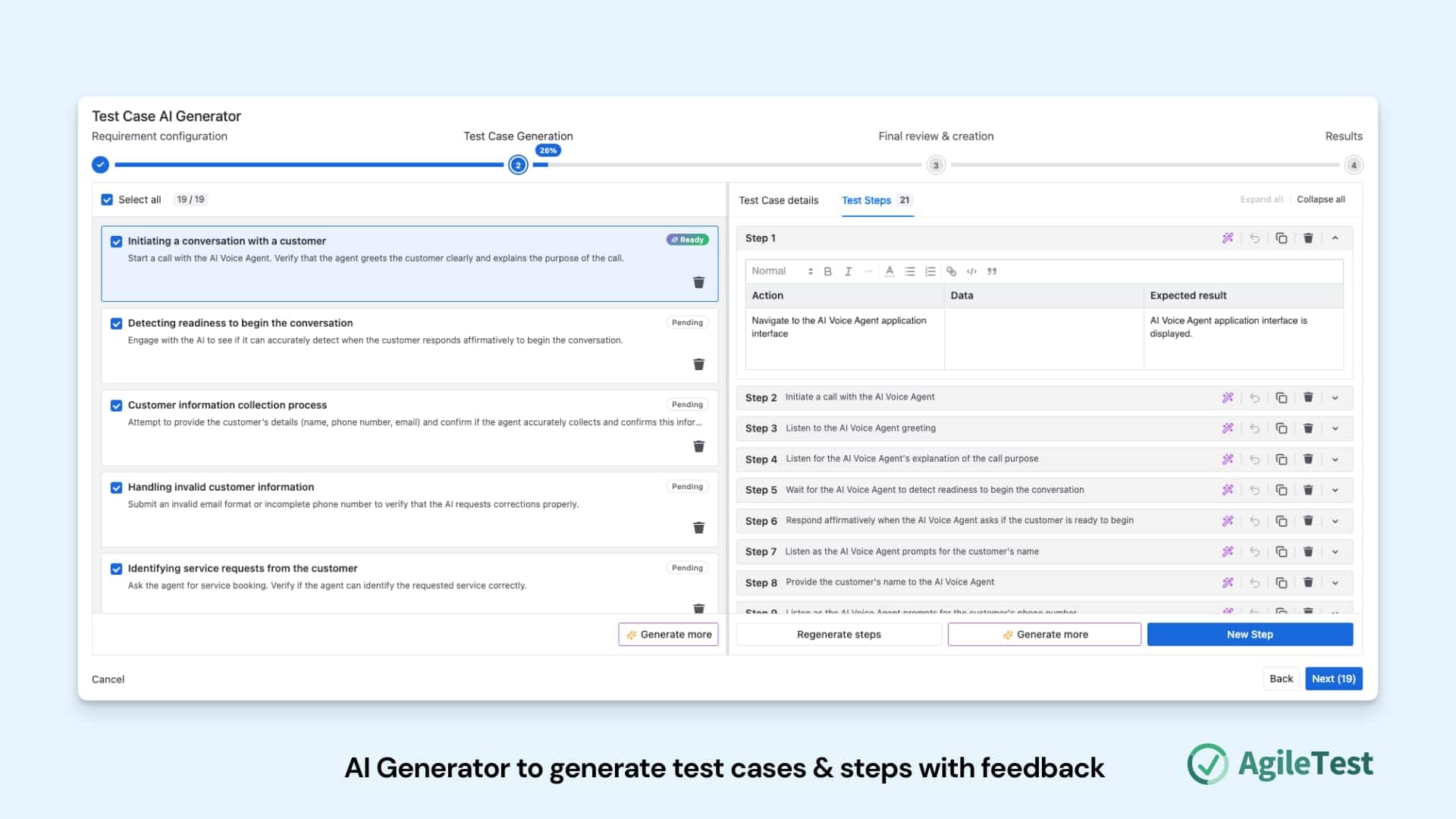
AgileTest Generator can use requirement descriptions to create an initial set of structured test cases, steps, and expected results.
For example, a booking requirement may include services, business hours, required customer details, and cancellation rules. The generator can use this information to suggest normal, negative, and edge-case scenarios.
Human testers should review every generated test. They understand business risk, customer behavior, and product limits. Generated cases should be treated as a starting point, not the final test plan.
Using AI to Analyze Test Results
Large test cycles may include failed tests, open defects, untested requirements, and incomplete test runs.
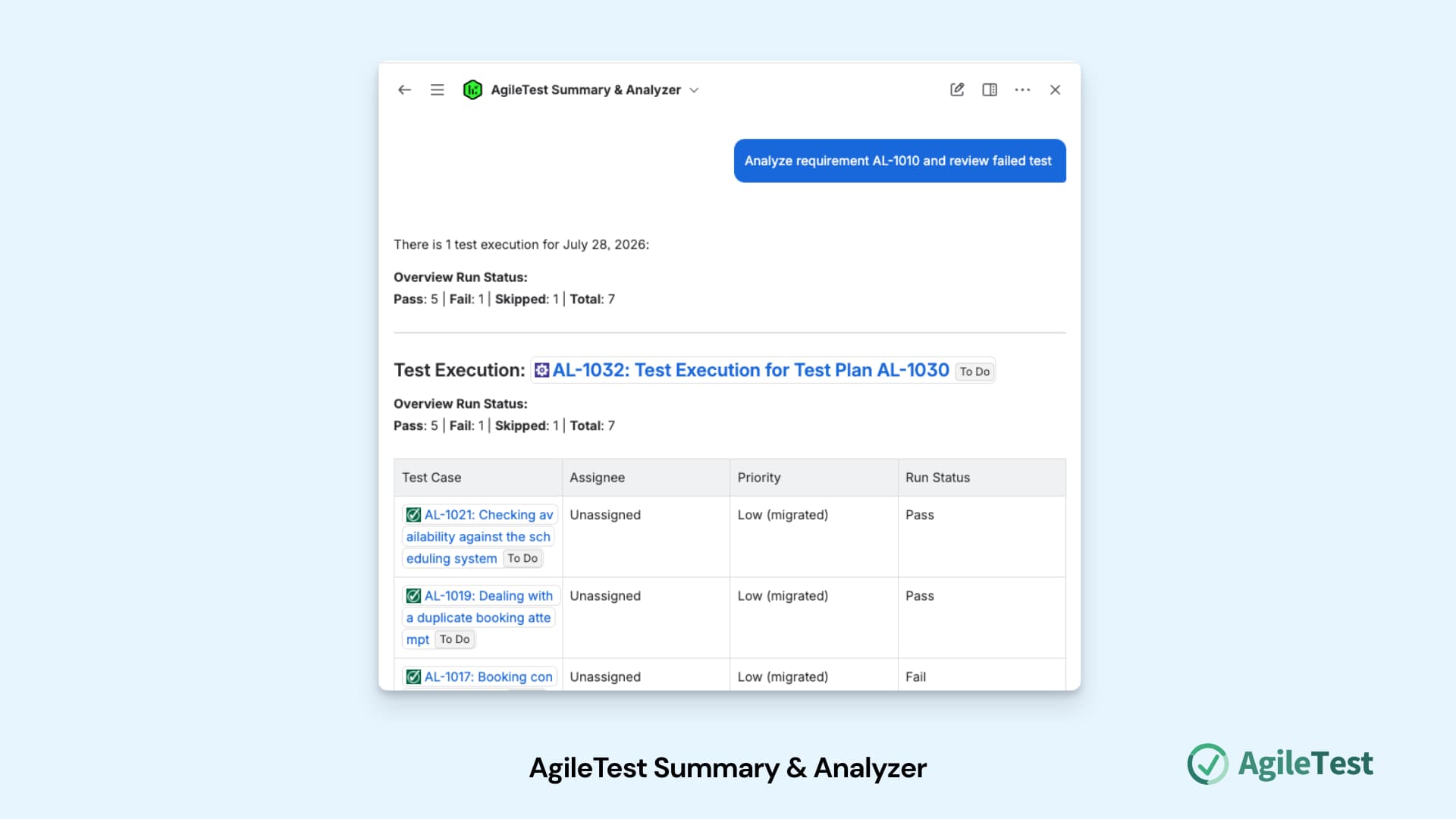
AgileTest Summary & Analyzer can help teams review this information and find useful patterns.
QA teams can identify tests that fail often, requirements with no coverage, and areas that may create release risk.
These insights help teams decide what to investigate first. Human testers must still review each failure and judge its business impact.
Practical Example: Testing a Voice Booking Agent
Consider a voice agent that books service appointments.
The team first defines the requirements. The agent must collect customer details, understand the requested service, check available times, create the booking, and confirm the information.
Next, the team creates scenarios for unclear dates, background noise, interruptions, invalid details, unavailable time slots, and requests for human support.
AgileTest Generator can help create the first set of tests. Testers then add product risks and real customer situations.
During execution, the team checks accuracy, response time, reliability, safety, and user experience. Failures are recorded with transcripts, system results, and linked defects.
AgileTest Summary & Analyzer can help the team review failed areas, missing coverage, and release risks.
Important scenarios are then added to the regression suite and repeated after changes to the model, prompts, integrations, or booking rules.
Human and AI Collaboration in Testing
AI can speed up test creation and result review, but it cannot replace human testers.
Human testers understand business impact, customer needs, safety concerns, and real conversation quality. They can notice when an answer feels confusing, slow, or unsafe.
The best approach combines AI support with human judgment. Human testers decide what matters and whether the product is ready.
Conclusion
AI quality has two connected sides.
Teams must test the AI product for accuracy, reliability, safety, and user experience. They must also manage requirements, scenarios, test runs, defects, and results clearly.
Tools such as AgileTest Generator and AgileTest Summary & Analyzer can support test preparation and result analysis. However, human review remains essential.
Reliable AI experiences require both careful testing of the AI system and intelligent tools that help QA teams manage the testing process.