
AI for regression testing is becoming increasingly relevant since software teams release changes faster and more frequently. Traditional regression testing plays a critical role in protecting existing functionality, but it often struggles.
This article briefly walks through the regression testing, along with the common challenges QA/QC teams face today. Then, it will show how AI (e.g., AgileTest Generator and AgileTest Summary & Analyzer) can already support regression testing workflows. Finally, we will discuss what teams can expect in the near future.
1. What Is Regression Testing, In Short?
Regression testing is the practice of verifying that existing components of features continue to function properly after changes are made. Whenever new functionality is added or a defect is fixed, there are risks that another area may be unintentionally affected.
For example, an online shopping app updates its current code base to support a new payment method. Regression testing helps ensure that existing payment options, order confirmation, and receipts continue to work as they did before.
For testers and QA/QC teams, regression testing helps avoid critical defects before a release. Your system may have worked just fine yesterday, before you cleaned up your codebase. However, when launching the app, you discovered that a small change (but critical) had crashed the entire system. Regression testing helps catch these problems early, before they turn into last-minute stress. It also gives QA teams confidence that the features they already tested are still working when it’s time to release.
2. Challenges With Traditional Regression Testing
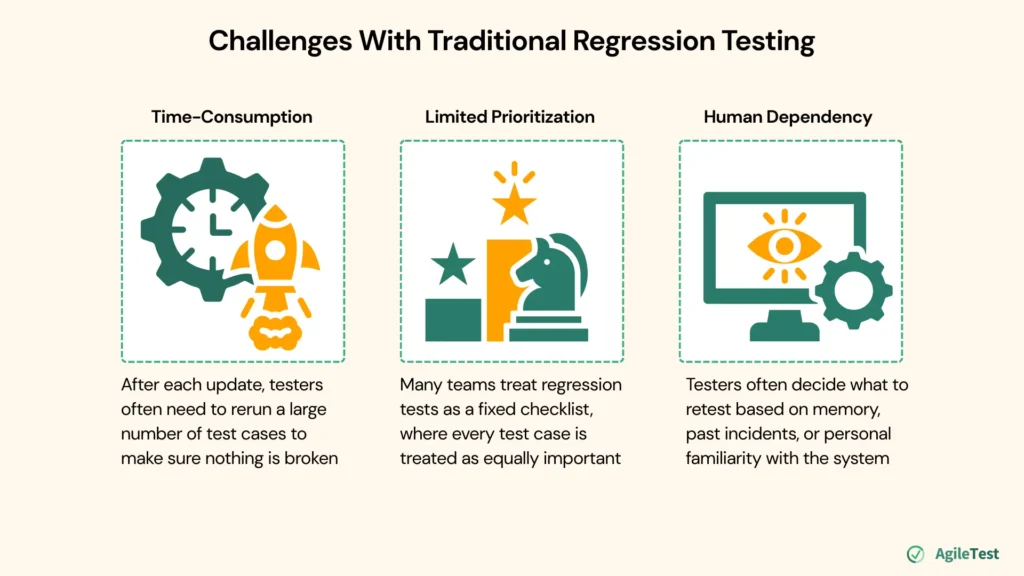
As software grows and changes more frequently, regression testing becomes harder to manage. What once felt manageable can quickly turn into a major bottleneck for QA teams. Three main challenges for the traditional regression testing include:
Time-Consumption
Time consumption is one of the biggest challenges. After each update, testers often need to rerun a large number of test cases to make sure nothing is broken. On the one hand, this helps you track back immediately to the causes of malfunctions after each update. On the other hand, you have to spend tremendous time, especially for large projects with hundreds of features, to run the whole test. You also need to prepare test data, along with a long list of test cases, before testing. This can take hours or even days, especially when releases are frequent.
Limited Prioritization
Limited prioritization is another common challenge in regression testing. In many teams, regression tests are run as a fixed checklist, where every test case is treated as equally important. In practice, not all features carry the same level of risk. Core business flows may be just as critical as edge cases, yet both receive the same attention. When time is limited, testers are forced to make quick decisions, often without clear guidance. This can result in important areas being tested too late or not thoroughly enough.
Human Dependency
Regression testing also relies heavily on human experience and accumulated knowledge. Testers often decide what to retest based on memory, past incidents, or personal familiarity with the system. While this knowledge is valuable, it doesn’t always scale well. When projects grow or team members change, important context can be lost. New testers may not know which areas are risky to prioritize. Experienced testers may become bottlenecks when all decisions are waiting for them. As a result, it leads to inconsistent coverage and overlooked issues.
Together, these challenges make traditional regression testing increasingly slow, inconsistent, and difficult to scale. This highlights the growing need for AI to help QA teams run regression testing faster, smarter, and with greater confidence.
Learn more about regression testing strategies here.
3. What Can AI Help With in Today’s Regression Testing
Today, AI already plays a practical role in supporting regression testing, especially in time-consuming tasks. Rather than replacing testers, AI helps reduce repetitive work and makes regression testing easier to manage.
Test Case and Test Step Generation
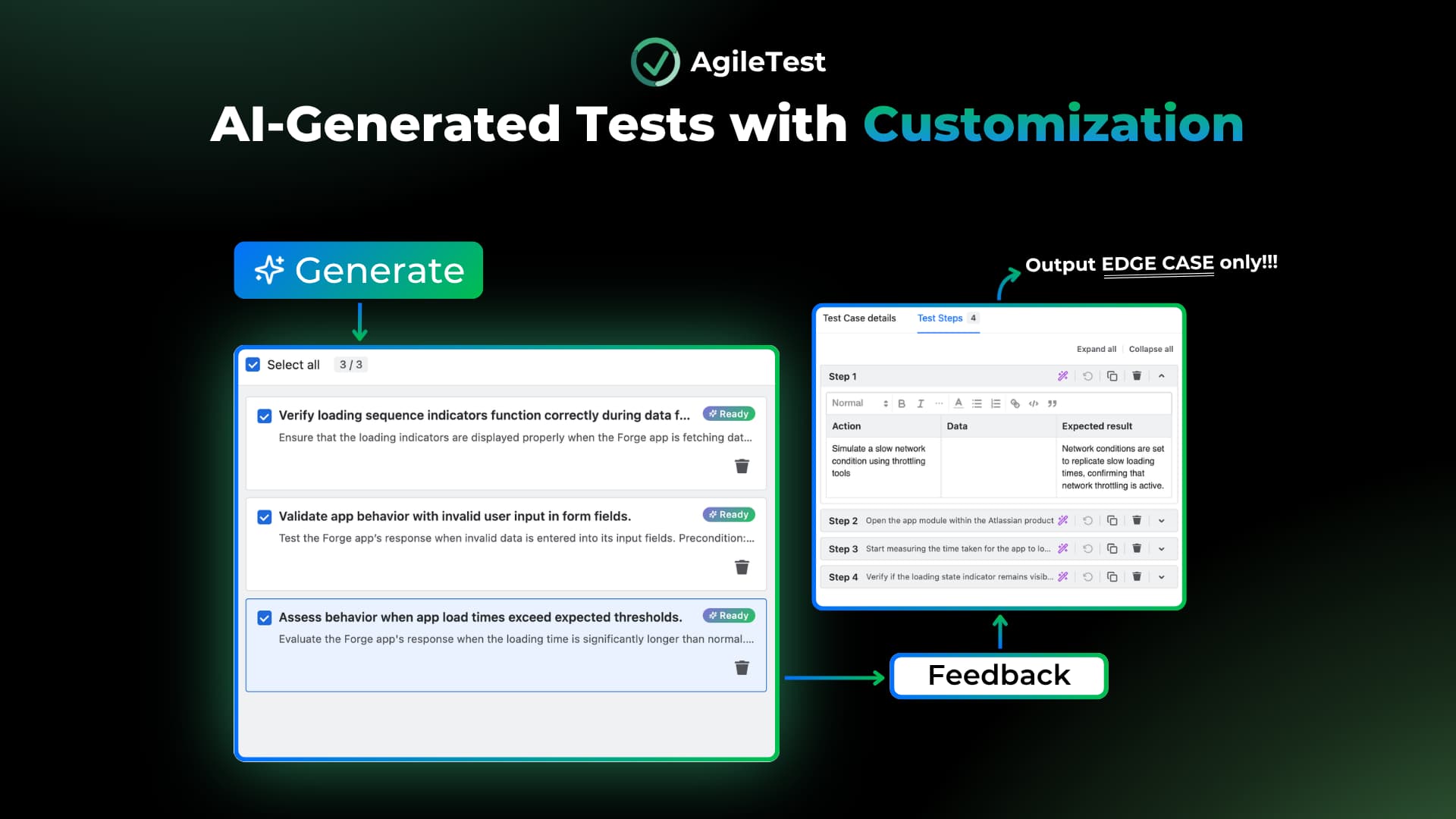
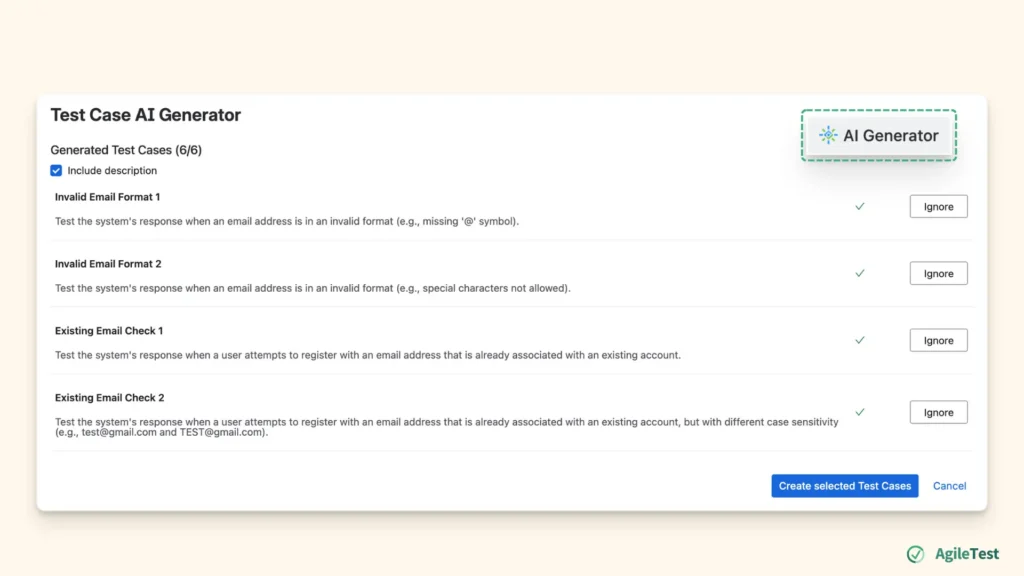
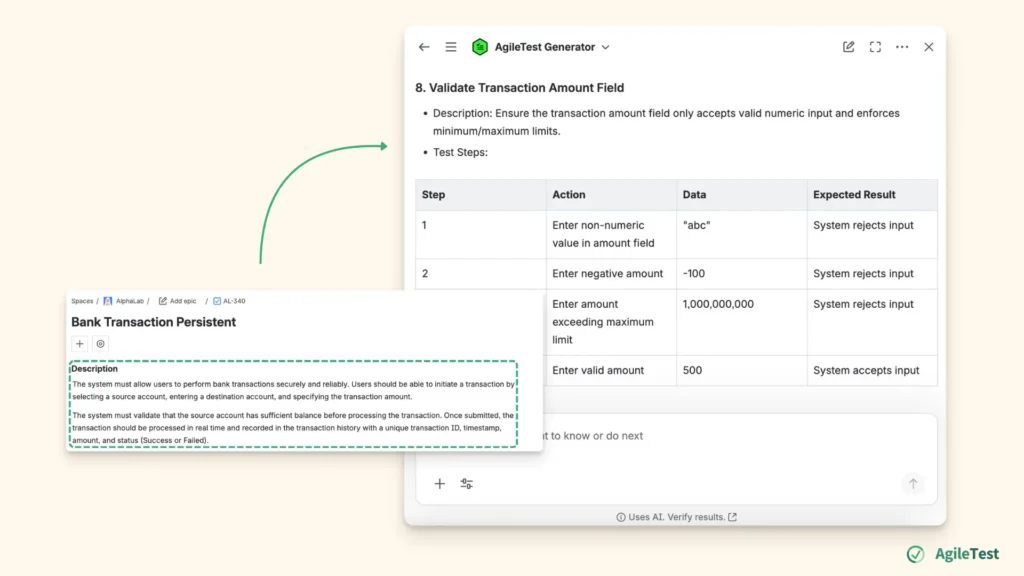
One of the most immediate benefits of AI is helping testers create and update regression test cases. For example, AI Generator, powered by AgileTest, can analyze requirement descriptions and suggest structured test cases with detailed test steps. This is especially helpful when new features are added or existing ones change. Instead of creating new test cases one by one, testers can update the requirement description. Then, testers can ask the AI Generator to generate relevant test cases, saving time while still maintaining test quality.
Test Data Preparation
Preparing test data is another area where AI can significantly reduce manual effort. Instead of asking testers to think through and enter sample data for every test step, AgileTest Generator can automatically suggest realistic test data based on each step’s context. For example, when a test step requires user credentials, the AI can provide sample values such as User01@gmail.com. This saves testers from repeatedly typing similar data and helps them focus on verifying behavior rather than preparing inputs.
Test Prioritization
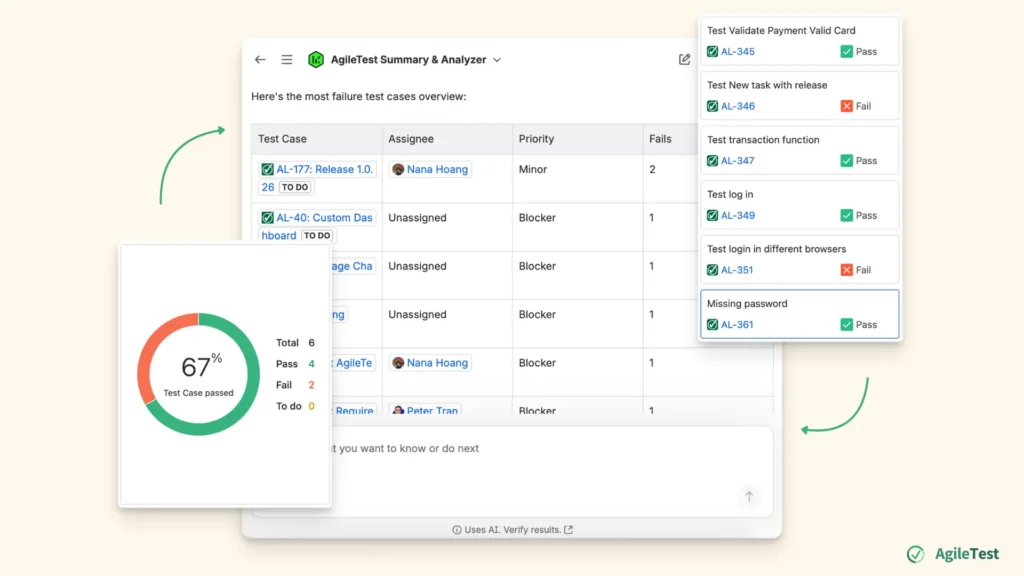
AI can also provide partial support for the test prioritization. For example, testers can ask AgileTest Summary & Analyzer most recent failed test cases and create executions based on that list. Grouping test cases with similar status, such as recent failures, helps testers focus on problematic areas and spot recurring issues. This approach also helps QA/QC teams understand which test cases should be prioritized during regression testing. As a result, it is easier to focus limited time and effort on the areas with the highest risk.
4. What Can You Expect In The Future of AI For Regression Testing
As AI continues to evolve, its role in regression testing will move beyond basic assistance toward smarter decision support for QA teams.
Comprehensive Test Prioritization
Test prioritization is expected to become more comprehensive. Instead of relying mainly on past failures, AI will consider multiple signals (recent changes, test history, and feature impact) to help QA/QC teams decide which tests matter most for each release. In addition, AI may go a step further by automatically creating focused test execution lists, not just ranking test cases. Hopefully, it would be easier for teams to act on those priorities.
Defect Detection and Analysis
AI will also improve defect detection and analysis. By learning from historical test results, teams can expect AI to help identify recurring failure patterns and highlight potential problems. This makes it easier for testers to understand why issues happen, not just that they happened.
Reducing Dependency
AI also helps reduce dependency on individual experience and knowledge. Instead of relying on testers’ memory to decide what to test or retest, AI can analyze existing requirements, past executions, and test results to provide consistent suggestions. This makes regression testing less dependent on who is available on the team and helps new or less experienced testers work with the same context and confidence.
Progress Tracking and Monitoring
In the future, AI may help QA/QC teams better track regression progress and assess release readiness. By analyzing execution results and unresolved issues, AI can help indicate the potential risk of releasing without running certain critical checks. Instead of guessing, teams could receive clearer signals about which areas still need attention. This helps teams to decide whether to proceed with a release or focus on additional regression testing.
Final thoughts
AI for regression testing is not about replacing testers or removing human judgment. Instead, it helps QA/QC teams reduce repetitive work, manage growing projects, and make better testing decisions with less effort. As AI continues to evolve, regression testing is likely to become more focused and efficient, helping teams release with greater confidence and less stress.
AgileTest is a Jira Test Management tool that utilizes AI to help you generate test cases effectively. Try it now