

You’re deep into a sprint, and feedback is coming at you from all directions. The Product Owner is intensely focused on the new feature’s functionality. A senior executive casually mentions in a meeting that the system’s performance needs to be “rock solid.” A support agent is forwarding complaints about a minor UI quirk, and your development lead is asking about unit test coverage for a specific module.
All of this feedback is valid, but it’s impossible to treat it all with the same level of urgency. How do you decide where to focus your energy? How do you manage all these competing expectations without getting overwhelmed?
The answer lies in a simple but incredibly powerful tool from the world of test management: the stakeholder matrix. This isn’t some complex, bureaucratic chart for corporate politics. It’s a practical map that helps you, as a developer or tester, navigate your project’s social universe. It brings order to the chaos by helping you understand who to talk to, when to talk to them, and what they actually care about.
Beyond the Bug Report: Why Engaging Stakeholders Matters
Before diving into the matrix itself, it’s important to understand why this kind of strategic thinking is so valuable. Consciously managing your stakeholders isn’t just about making people happy; it’s about making your testing more effective and, ultimately, building a better product. A tool like the stakeholder matrix helps you do three things exceptionally well.
1. Utilize a Goldmine of Expertise
Your team doesn’t have all the answers. The most valuable insights often come from outside your immediate circle. The matrix guides you to the right experts for the right questions. When you need to understand a real-world user workflow, who better to ask than the end-users themselves?
When you need to assess security vulnerabilities, your technical teams (like the security or operations specialists) are the ones to consult. The matrix ensures you’re not just guessing; you’re actively utilizing stakeholders’ expertise to strengthen your test coverage.
2. Supercharge Your Risk Management
Testing is fundamentally about managing risk. The stakeholder matrix is a critical tool in this effort. By plotting out your stakeholders, you immediately start to see the landscape of interests and influence. This allows you to be proactive. Instead of waiting for a high-influence stakeholder to question why a certain area wasn’t tested, you can engage them early.
The matrix supports risk management by highlighting stakeholder interests and influence, encouraging proactive conversations and mitigation efforts. It helps you get buy-in for testing activities that target the risks your most important stakeholders care about.
3. Embrace the Power of Diverse Perspectives
It’s easy to fall into the trap of only listening to the loudest or most powerful voices in the room. But sometimes, the most game-changing feedback comes from an unexpected source. The matrix encourages you to value diverse perspectives.
That junior support agent who keeps flagging user frustrations might not have the power to change a deadline, but their feedback is a direct line to your user experience. By systematically considering all stakeholders, you ensure you’re getting a well-rounded view of product quality, not just the view from the top.
Quadrant Deep Dive: Meet the Players
Understanding these four groups is the key to unlocking the matrix’s power. For each one, we’ll look at who they are, who they might be in your project, and what your game plan should be for working with them.

Promoters (High Influence, High Interest)
Who they are: These are your most important allies. The source describes them as key collaborators with high influence and high interest, vital for shaping the test strategy and plan. They have the power to make things happen and are deeply invested in the outcome of your work.
- Typical Examples: This is often your Product Owner, the primary business sponsor, the project manager, or a key client representative. On a technically complex project, it could also be the lead architect or development manager.
- What’s the Game Plan? (Manage Closely): You need to collaborate with Promoters constantly and closely.
- Involve them: Bring them into your test planning and risk analysis sessions.
- Communicate frequently: Provide them with regular, detailed updates on progress, key findings, and critical defects.
- Build a partnership: Treat them as a true partner in quality. Their support can unblock resources, defend your timelines, and champion the importance of testing to the rest of the organization. Keep them happy and engaged above all else.
Latents (High Influence, Low Interest)
Who they are: These are the powerful but distant stakeholders. The source notes that while they may not have a strong interest in the day-to-day tasks, their decisions are critical for resource allocation and high-level project direction. They might not care about your test case count, but a single decision from them can change your project’s entire trajectory.
- Typical Examples: The head of your department, a C-level executive (like the CTO or CIO), or a senior manager in the client’s organization. They hold the purse strings or set the overall strategy.
- What’s the Game Plan? (Keep Satisfied): The goal here is to keep them feeling confident and informed without overwhelming them with details they don’t care about.
- Communicate efficiently: Provide high-level executive summaries, not detailed reports. Focus on milestones, budget status, and major risks (and your plan to mitigate them).
- Be prepared: Their interest is low, but it can spike suddenly if something goes wrong. Have your details ready in case they decide to dive in.
- Don’t be a stranger: A periodic, concise update ensures they aren’t surprised by anything and feel that the project is in good hands.
Defenders (Low Influence, High Interest)
Who they are: These are your biggest fans and your best source of on-the-ground intelligence. They are highly interested in what you are doing but lack the formal power to make major decisions. The source notes that they often provide qualitative feedback.
- Typical Examples: An experienced end-user who knows the system inside and out, a passionate support agent who deals with customer issues all day, or a developer from an adjacent team whose service depends on yours.
- What’s the Game Plan? (Keep Informed): Defenders are a treasure trove of information. Your strategy is to harness their interest and make them feel valued.
- Listen actively: They can be your “canary in the coal mine,” spotting usability issues and real-world problems that scripted tests might miss.
- Involve them appropriately: Invite them to demos, include them in User Acceptance Testing (UAT), and ask for their feedback on new features.
- Communicate regularly: Keep them in the loop with regular updates, perhaps through a newsletter, a shared Slack channel, or release notes. They don’t need decision-making power to be incredibly valuable to the testing process.
Apathetics (Low Influence, Low Interest)
Who they are: This group is the most disengaged from your day-to-day work. As the name suggests, they have little power to affect your project and little interest in its details.
- Typical Examples: A manager from a completely unrelated department, or users who only interact with a very minor part of the application on rare occasions.
- What’s the Game Plan? (Monitor): The strategy here is minimal effort, but not zero effort. You don’t want to bombard them with information they don’t need.
- Don’t spam them: General, project-wide communications (like a major release announcement) are usually sufficient.
- Stay aware: The key insight from the source is to seek their input on particular issues. A stakeholder’s position on the matrix is not static. A project change could suddenly increase their interest or influence. For instance, if your project suddenly requires an integration with their department’s system, an “Apathetic” can quickly become a “Defender” or even a “Promoter.” A light touch is fine, but don’t forget they exist.
Putting It Into Practice: Your 3-Step Action Plan
The test manager’s role often includes leading this effort, but every developer and tester can benefit from this thinking. Here’s how you can apply it on your next project.
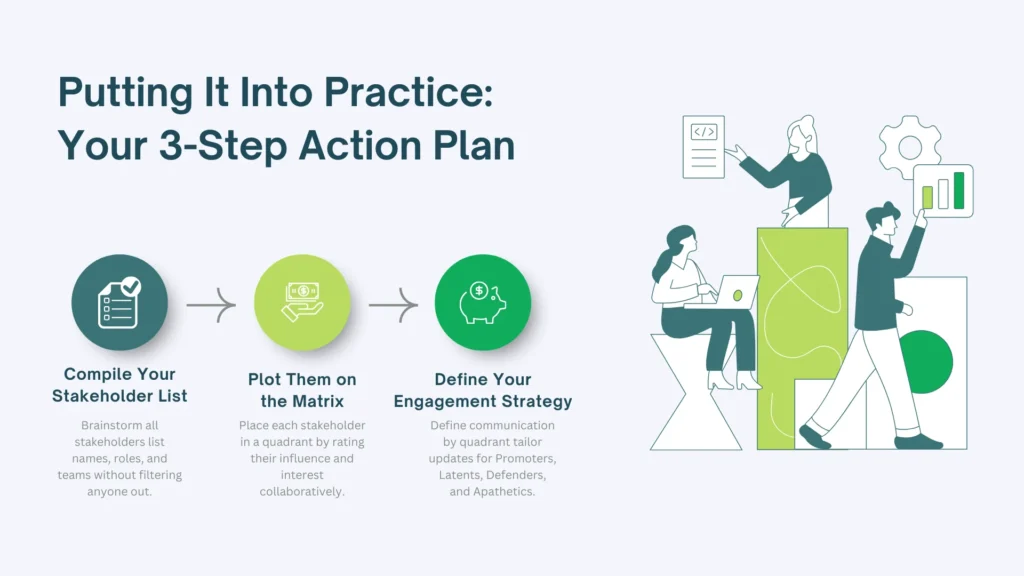
Step 1: Compile Your Stakeholder List
As a team, brainstorm everyone who has a stake in your project’s quality. Write down names, roles, and teams. Don’t filter at this stage—just create a comprehensive list. Think about developers, managers, product owners, users, support agents, operations engineers, and anyone else who comes to mind.
Step 2: Plot Them on the Matrix
Take your list and, one by one, place each stakeholder into one of the four quadrants. This is best done as a collaborative exercise. For each person, ask two simple questions:
- On a scale of low to high, how much influence do they have over our project?
- On a scale of low to high, how much interest do they have in our daily testing?
This will spark valuable conversations and help align the team’s understanding of the project’s social dynamics.
Step 3: Define Your Engagement Strategy
Now that you have your map, create your communication plan. Based on each stakeholder’s quadrant, decide on the “what” and “how” of your communication.
- Promoters: Schedule a weekly deep-dive meeting. Add them to your detailed daily reports.
- Latents: Create a monthly executive summary email.
- Defenders: Set up a “user feedback” Slack channel and invite them to sprint demos.
- Apathetics: Ensure they are on the company-wide release announcement list.
This turns communication from a random activity into a purposeful and efficient strategy.
Conclusion
Testing is never done in a vacuum. It’s a deeply human and collaborative process. The stakeholder matrix is a simple tool that helps you manage this complexity with confidence. It pushes you beyond the code and the test cases to consider the network of people who are all counting on you to help deliver a quality product.
By taking the time to understand who your stakeholders are, what they care about, and how much influence they have, you can transform your communication from noise into a targeted, effective, and valuable part of your workflow. You’ll know whose expertise to tap, whose buy-in you need, and whose feedback provides a window into your users’ world. You’ll know exactly who is in your corner and how to work with them to build something truly great.