

Test management isn’t just a task for dedicated managers; it’s a crucial discipline that directly impacts the quality, efficiency, and success of software development.
For developers and testers on the ground, understanding and applying effective test management practices means smoother workflows, clearer communication, higher quality software, and ultimately, less rework and frustration.
Effective test management encompasses planning, designing, executing, monitoring, and reporting on testing activities throughout the software development lifecycle (SDLC). It ensures that testing efforts are organized, targeted, and provide valuable feedback.
Let’s dive into the 10 best practices that developers and testers can leverage.
1. Start with a Clear Test Strategy and Plan
What: Before writing a single test case, define what needs testing, how it will be tested, who will test it, and when. This involves creating a test strategy (high-level approach) and a more detailed test plan (specifics for a project or release).
Why: A clear plan aligns everyone (devs, testers, BAs, product owners) on the scope, objectives, resources, schedule, assumptions, risks, and deliverables of testing. It prevents ambiguity and ensures testing goals support business objectives.
How for Devs/Testers:
- Actively participate in planning discussions. Provide input on technical risks, dependencies, and realistic timelines.
- Understand the defined scope, entry/exit criteria, and types of testing required (unit, integration, E2E, performance, security, etc.).
- Know the target environments and required test data.
2. Establish Requirements Traceability
What: Linking requirements (user stories, functional specs) directly to test cases, test execution results, and defects.

Why: Traceability ensures comprehensive test coverage (every requirement has corresponding tests), helps assess the impact of changes (which tests need updating/re-running if a requirement changes?), and provides clear evidence of testing for stakeholders.
How for Devs/Testers:
- Ensure test cases explicitly reference the requirement ID they cover.
- Use test management tools (like Jira with AgileTest, Zephyr, Xray, TestRail) that facilitate this linking.
- When logging defects, link them back to the failed test case and, consequently, the requirement.
- For developers, understanding which tests cover specific code sections (via requirements or feature mapping) aids in targeted testing after changes.
3. Prioritize Based on Risk
What: Focusing testing efforts on areas of the application that pose the highest risk – considering factors like business criticality, complexity, frequency of use, potential financial/reputational impact of failure, and areas with recent or significant code changes.
Why: You rarely have time to test everything exhaustively. Risk-based testing (RBT) optimizes limited resources by concentrating effort where defects would be most impactful or likely to occur.
How for Devs/Testers:
- Collaborate to identify high-risk modules or features. Developers have insight into code complexity and recent churn; testers understand usage patterns and historical problem areas.
- Assign priority levels to test cases based on the risk of the feature they cover.
- Execute high-priority tests earlier and more frequently.
4. Design Reusable and Maintainable Test Cases
What: Writing test cases that are clear, concise, modular, independent, and easy to update as the application evolves.

Why: Reduces test creation time, simplifies maintenance (a change in one feature doesn’t require rewriting dozens of tests), promotes consistency, and makes test suites easier to understand and execute.
How for Devs/Testers:
- Follow a standard test case template (e.g., ID, Title, Preconditions, Steps, Expected Results, Priority).
- Write clear, unambiguous steps and expected results. Avoid jargon where possible, unless clearly defined.
- Break down complex end-to-end scenarios into smaller, modular tests where feasible.
- Parameterize tests (especially automated ones) to run with different data inputs without changing the script logic.
- Use descriptive naming conventions for tests and test suites.
- Regularly review and refactor test suites to remove redundancy and improve clarity.
5. Implement Strategic Test Automation
What: Automating the execution of test cases, particularly those that are repetitive, time-consuming, critical for regression, or difficult to perform manually.
Why: Increases testing speed, improves coverage (especially for regression), ensures consistency, enables frequent testing (e.g., in CI/CD pipelines), and frees up manual testers for more exploratory or complex testing.
How for Devs/Testers:
- Identify good candidates for automation: regression suites, smoke tests, data-driven tests, stable features.
- Choose appropriate tools and frameworks (e.g., Selenium, Cypress, Playwright for UI; REST Assured, Postman for API; JUnit, NUnit, Pytest for unit).
- Write robust and maintainable automation scripts. Use design patterns (like Page Object Model for UI tests).
- Integrate automated tests into the CI/CD pipeline for early feedback.
- Treat test code like production code: use version control, conduct code reviews, and refactor regularly.
- Don’t try to automate everything. Manual and exploratory testing remain crucial.
→ Related content: How to Write Test Cases for Automated Tests
6. Manage Test Environments Effectively
What: Ensuring that the environments where testing occurs (Dev, QA, Staging, etc.) are available, stable, configured correctly, and representative (as much as feasible) of the production environment.
Why: Unreliable or inconsistent test environments lead to false positives/negatives, wasted time debugging environment issues instead of application bugs, and reduced confidence in test results.
How for Devs/Testers:
- Clearly document environment configurations and dependencies.
- Implement processes for environment setup, data seeding/refreshing, and booking/scheduling if environments are shared.
- Leverage Infrastructure as Code (IaC) tools (like Terraform, Ansible) and containerization (Docker, Kubernetes) to create consistent and reproducible environments.
- Establish clear communication channels for reporting and resolving environment issues.
- Ensure appropriate monitoring and logging are in place for test environments.
7. Standardize Defect Management
What: Implementing a clear, consistent process for logging, tracking, prioritizing, assigning, resolving, and verifying defects.

Why: Ensures bugs aren’t lost, facilitates communication about issues, helps prioritize development effort, provides metrics for process improvement, and builds a knowledge base of issues encountered.
How for Devs/Testers:
- Use a centralized bug tracking system (e.g., Jira, Bugzilla, Azure DevOps Boards).
- Log defects with clear, concise titles, detailed steps to reproduce, actual vs. expected results, environment details, severity (impact), priority (urgency), screenshots/logs/videos.
- Define and adhere to a standard defect lifecycle workflow (e.g., New → Assigned → In Progress → Fixed → Ready for Retest → Retested → Closed/Reopened).
- Regularly triage new defects to assign priority and ownership.
- Developers: Provide clear comments when resolving defects (e.g., commit IDs).
- Testers: Thoroughly retest fixes, testing related areas (regression) as needed before closing.
8. Utilize Appropriate Test Management Tools
What: Employing software tools specifically designed to manage test artifacts, track execution progress, manage requirements traceability, log defects, and generate reports.
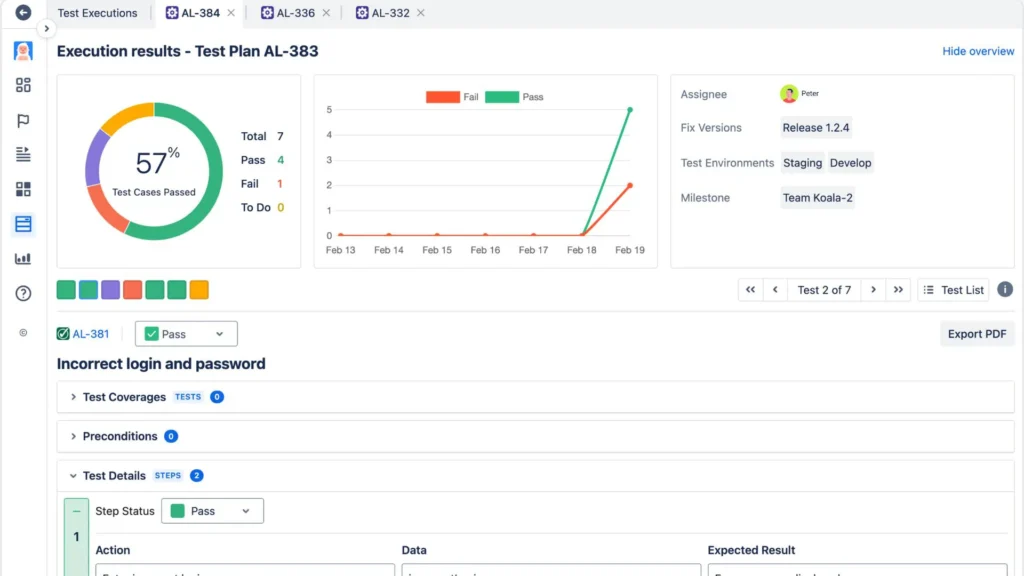
Why: Improves efficiency, centralizes information, enhances collaboration, provides visibility into test progress and quality metrics, and supports other best practices like traceability and reporting.
How for Devs/Testers:
- Select and use tools that fit the team’s workflow and integrate well (e.g., Test Management System integrated with the bug tracker and CI/CD server).
- Examples: AgileTest, TestRail, Zephyr Squad/Scale, Xray, qTest, Azure Test Plans.
- Ensure team members are trained on how to use the chosen tools effectively.
- Leverage tool features for dashboards, reporting, and traceability matrices.
→ Try out AgileTest for Jira
9. Foster Collaboration and Communication
What: Encouraging open and frequent communication between developers, testers, product owners, BAs, and other stakeholders regarding requirements, test planning, execution status, defects, and risks.
Why: Breaks down silos, promotes shared understanding of quality goals, enables earlier feedback (“shift-left” testing concepts), speeds up defect resolution, and builds a culture of shared responsibility for quality.
How for Devs/Testers:
- Participate in backlog grooming, sprint planning, and retrospectives, providing quality-related input.
- Practice techniques like Behavior-Driven Development (BDD) or Acceptance Test-Driven Development (ATDD) to create shared understanding via executable specifications.
- Engage in informal communication (e.g., quick chats, pair testing) to clarify requirements or debug issues quickly.
- Use shared communication platforms (Slack, Teams) and ensure test/defect tracking tools provide clear visibility.
- Developers: Understand the tests being run; potentially review test cases or automation scripts.
- Testers: Provide timely and constructive feedback on usability, functionality, and potential risks.
10. Measure, Report, and Continuously Improve
What: Defining key metrics to track testing effectiveness and efficiency, regularly reporting on progress and quality status, and using this data to identify areas for improvement in the testing process.
Why: Provides objective insights into the state of quality, helps identify bottlenecks or recurring problems, demonstrates the value of testing, informs release decisions, and drives ongoing optimization of the testing strategy.
How for Devs/Testers:
- Track relevant metrics: Test execution progress (passed/failed/blocked), defect density (bugs per feature/module), defect detection rate, defect leakage (bugs found post-release), requirements coverage, automation pass rates.
- Use dashboards in test management or bug tracking tools for real-time visibility.
- Participate in sprint reviews and retrospectives to discuss what worked well, what didn’t, and how to improve the testing process for the next cycle.
- Analyze trends over time (e.g., are certain modules consistently buggier? Is test automation becoming unstable?).
Conclusion
Effective test management is a collective effort, not solely the domain of a test lead or manager. By embracing these ten best practices, developers and testers can significantly enhance their contribution to building high-quality software.
These practices foster clarity, efficiency, collaboration, and a proactive approach to quality, ultimately leading to more robust products, faster feedback cycles, and more confident releases. Continuously applying, reviewing, and adapting these principles to your specific project context is key to sustained success.