
Deciding on a new tool for your team can feel like navigating a maze. One path leads to a shiny, cutting-edge open-source framework that the engineering team is excited about. Another leads to a powerful, expensive commercial suite that management has heard good things about. Both paths are filled with promises of increased productivity and better quality, but also with hidden traps like compatibility issues, unforeseen costs, and steep learning curves.
Making the right choice is one of the most impactful decisions you can make for your team’s success. It’s far more than just a technical evaluation; it’s a strategic business decision that requires a holistic view. A great tool, seamlessly integrated, can act as a force multiplier for your team. A poor choice can become a source of technical debt, frustration, and wasted resources.
To navigate this complexity, you need a playbook. The key is to evaluate every potential tool through four critical lenses: your existing technical landscape, the regulatory and security rules you must follow, the needs of your people, and the true financial cost. By analyzing each of these areas, you can move from being swayed by a slick demo to making a clear-headed, strategic decision that will pay dividends for years to come.
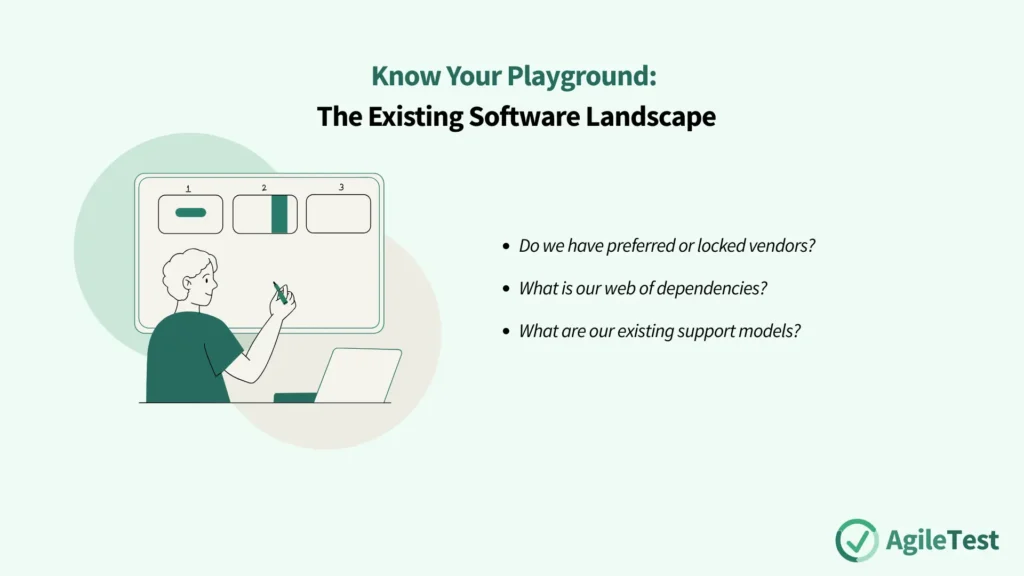
Know Your Playground: The Existing Software Landscape
Before you even start looking at new tools, you must first look inward. You can’t successfully introduce a new piece into a puzzle without understanding the shape of the puzzle itself. Your starting point must be a thorough evaluation of your organization’s existing software landscape and tool strategy. This is the reality check that grounds your search and defines your boundaries.
This means asking a few key questions:
- Do we have preferred or locked vendors? In many organizations, especially larger enterprises, strategic partnerships are already in place. There might be a company-wide licensing deal with Microsoft that makes their testing suite highly cost-effective, or a deep-rooted relationship with Atlassian that means any new tool must have best-in-class Jira integration. Ignoring these existing relationships can make procurement and support a nightmare.
- What is our web of dependencies? Modern software workflows are a web of integrated systems. Your requirements tool talks to your test management platform, which talks to your version control system, which triggers your CI/CD pipeline, which reports back to your defect tracker. A new tool must be a good citizen in this ecosystem. If it can’t connect to these other systems, you risk creating isolated data silos and forcing your team into tedious, error-prone manual work to bridge the gaps.
- What are our existing support models? Some companies have a full-service support model with a dedicated internal IT team or a comprehensive contract with an external provider that covers the entire technology stack. If you introduce a new tool that falls outside this umbrella, you’re often on your own when things go wrong. You must factor in whether your team has the expertise and bandwidth to support this new tool independently.
Analyzing your landscape first prevents you from wasting time on options that are non-starters from day one. It defines your constraints and allows you to focus your search on tools that have a realistic chance of succeeding in your specific environment.
Install AgileTest to comprehensively manage your test cases with different test types on a single platform.
Following the Rules: Regulations and Security
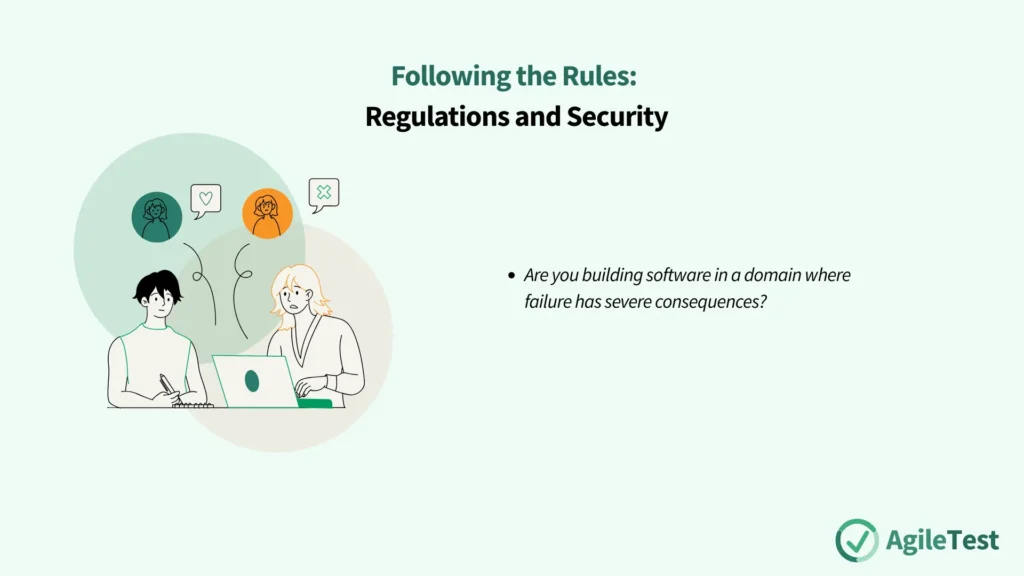
Once you understand your internal landscape, the next critical filter is your external obligations. This is often a simple, binary question: are you building software in a domain where failure has severe consequences? For organizations that develop safety-critical or mission-critical software, or are subject to regulatory compliance, this is a non-negotiable checkpoint.
In industries like healthcare (HIPAA), finance (PCI DSS), or automotive (ISO 26262), the bar for quality and process validation is incredibly high. In these scenarios, teams often prefer commercial tools, and for good reason. These tools frequently come with the necessary certification to prove they meet the required standards.
Explore more about key criteria for evaluating test management tools with our article: Choosing the Right Test Management Tool
Think of it this way: when an auditor asks you to demonstrate that your testing processes are compliant, showing them a certification from a reputable tool vendor is a powerful piece of evidence. The vendor has done the hard work of validating their tool against specific industry regulations, which shifts some of the compliance burden away from your team. This pre-packaged assurance is something that is very difficult, expensive, and time-consuming to achieve with open-source or custom-built solutions. In a regulated environment, the cost of a commercial tool is often a small price to pay for compliance and peace of mind.
Solving for People: Stakeholder Needs and Requirements
With your technical and regulatory boundaries established, you can now focus on the most important part of the puzzle: the people. A tool is ultimately meant to solve a problem for the individuals who will use it every day. If it fails to do so, it will be abandoned, no matter how technically elegant or affordable it is.
This is why it is absolutely essential to gather the requirements from all stakeholders to identify the most appropriate tool. A “stakeholder” isn’t just the end-user; it’s a diverse group with different needs:
- Testers and QA Engineers need a tool that is efficient, makes their workflow smoother, and helps them organize complex test suites.
- Developers may need a tool that integrates seamlessly with their IDE, provides clear and actionable bug reports, and supports test-driven development practices.
- Product Managers and Business Analysts need high-level dashboards that provide a clear view of product quality, test coverage against requirements, and overall risk levels.
- Leadership needs concise reports that help them make informed go/no-go decisions based on quality data.
Have a look at the AgileTest custom dashboard feature that helps you create a diverse dashboard that suits every stakeholder’s needs.
By involving all these groups, you build a holistic picture of what “success” looks like for a new tool. This process also builds crucial buy-in. When people feel their voice has been heard, they are far more likely to become champions for the tool’s adoption.
This process will also force you to confront a classic dilemma: buy versus build, or more accurately, “good enough” versus “the perfect fit.”
- Commercial and open-source tools are built for a broad market. They may not fulfill all your requirements in detail, meaning you might need to adapt some of your processes to fit the tool’s workflow.
- Custom tools, on the other hand, can be the best choice to meet all individual requirements. If your needs are highly specialized and no other tool provides the required functionality, building your own may be the only option. This gives you a perfect fit but comes with the significant overhead of designing, developing, and maintaining an entire software product yourself.
Read our related guide to understand how you should introduce new tools without the chaos: The Right Tool for the Job: My Playbook for Introducing New Tools Without the Chaos.
Counting the Costs: A Deep Dive into Financials
Finally, we arrive at the topic that is on every leader’s mind: the cost. But a smart financial analysis goes far beyond the initial price tag. To make a sound business decision, you must calculate the Total Cost of Ownership (TCO) over the tool’s entire lifespan. It’s a truth of software that all tools may have high maintenance and support costs.
Let’s break down the financial models of the three main options:
- Open-Source Tools: These are incredibly appealing due to their lower initial cost—often zero. But they are not free. Their cost is paid in your team’s time. This includes the engineering hours required for setup, configuration, integration, and ongoing maintenance. When problems arise, you rely on community support, which means your engineers will be spending time on forums and message boards instead of on your product.
- Commercial Tools: These have a more straightforward financial model, often with a one-time purchase price for a perpetual license or, more commonly today, recurring license costs for a subscription. This predictability makes budgeting easier, but the costs can be significant.
- Custom Tools: For a custom tool, the initial cost is difficult to determine because it is, in itself, a full-scale software development project. You bear 100% of the development, testing, and deployment costs.
To make an honest comparison, you must look at the TCO, which includes these key components:
- Initial Cost: The license fee or the internal development budget.
- Implementation Costs: The time and resources needed to install, configure, and integrate the tool into your existing landscape.
- Training Costs: The budget required to get your entire team proficient with the new tool.
- Maintenance and Support Costs: The ongoing cost, whether it’s the annual support contract for a commercial tool or the salaries of the internal staff dedicated to maintaining an open-source or custom solution.
A thorough TCO analysis is the only way to prevent sticker shock from turning into long-term budget pain. It allows you to make a sound, data-driven business case for your chosen solution.
Read our analysis about the next 5 years in test management to make well-informed decisions: The Next 5 Years in Test Management
Making the Call: A Balanced Decision
Choosing a tool is a balancing act. You have to weigh the constraints of your technical landscape, the mandates of your industry, the needs of your people, and the realities of your budget. The “best” tool is never a universal answer; it’s the one that provides the optimal balance of these four factors for your specific context.
By methodically working through these four pillars, you move the conversation away from “which tool is coolest?” to “which tool is the most strategic asset for our team?” You ensure that your decision is not just a technical preference but a well-rounded business choice. This disciplined approach is the surest path to selecting a tool that will be embraced by your team, supported by your organization, and deliver real, lasting value to your quality efforts.