
AI Testing Techniques in the Design Stage are rapidly changing how modern software teams build products. Today, testing can begin before development even starts. These insights open the door to fewer surprises, clearer decisions, and far more confident planning.
In this article, we’ll explore what design-stage testing truly means, why traditional QA has struggled to participate in it, and how AI removes those barriers. We’ll also examine the key benefits teams gain when testing shifts left, along with the core AI techniques that make this early validation possible.
1. What “Design-Stage Testing” Means in Modern Software Development
In modern software teams, testing is no longer something that happens only after code is written. “Design-stage testing” refers to evaluating the quality, clarity, and feasibility of a product before development begins. This takes place while requirements, user flows, and system behavior are still being shaped.
Why Traditional QA Rarely Tests at the Design Phase
In most teams, QA is brought into the process only once something exists to test. While this feels natural from a workflow perspective, it unintentionally places QA at a disadvantage during the design stage.
QA’s expertise shines when they can interact with a real system, click through flows, submit forms, and verify states. But in the design phase, there’s only documentation, mockups, or assumptions. Without behavior to observe, traditional QA has little opportunity to uncover hidden logic issues or missing paths.
By the time QA sees requirements, it often lacks context or contains ambiguities that only become obvious once development begins. Without the full picture, QA cannot confidently identify gaps or challenge the design.
How Things Change With AI Testing in the Design Phase
AI testing fundamentally reshapes what’s possible in early-stage testing. Instead of waiting for a working build, teams can now test the design itself, long before any code exists. Modern AI techniques allow QA, designers, and product teams to validate logic, uncover gaps, and simulate system behavior directly from early documentation.
This shift is powerful because it means teams can prevent issues instead of reacting to them. AI turns design documents into something testable, helping catch problems that normally wouldn’t appear until weeks later.
2. Key Benefits of AI Testing in the Design Phase
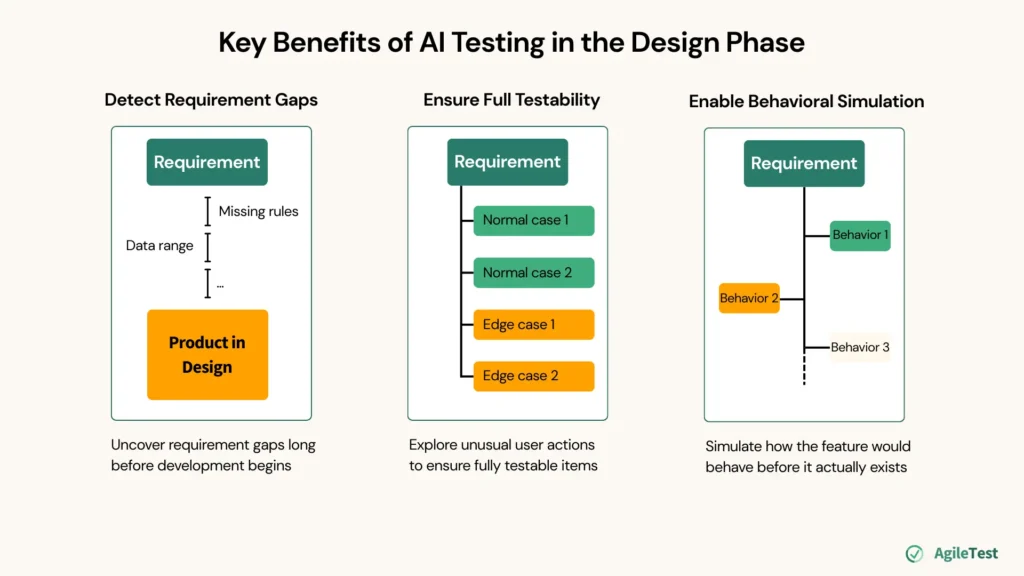
Detects Requirement Gaps Before Development Begins
One of the biggest advantages of AI in the design phase is its ability to uncover requirement gaps long before development begins. Consider a team planning a new account deletion feature. The initial requirement might be as simple as: “Users can delete their account from the settings page”. At first glance, it seems clear, but when AI analyzes the requirement, it immediately identifies unanswered questions:
- What happens to related data?
- Should the system ask for password confirmation?
- Is the action reversible?
- What happens if the user has active subscriptions or pending invoices?
These questions often don’t come up until much later, sometimes after developers have already built part of the feature. By catching these gaps early, AI helps teams fix problems before they turn into delays or rework. In simple terms, AI acts like an early reviewer that asks all the important questions humans might overlook.
Ensures Full Testability From Day One
Even once the requirement is expanded, there are many situations a real user might run into that the team hasn’t thought about yet. Based on the same example, some unexpected scenarios can happen. Maybe the user tries to delete their account but enters the wrong password. Or, they’re offline. Sometimes, they change their mind halfway through. In many projects, these scenarios only come up when testers finally receive a working version to try out.
AI changes this by generating possible test situations as soon as the design is written. It explores ordinary actions as well as unusual or problematic ones. When the AI realizes it can’t create a clear test because the design doesn’t specify an outcome, it flags that missing detail immediately. This ensures the feature is fully testable from the beginning, with no surprises waiting later in the development cycle.
Enables Early Behavioral Simulation
Perhaps the most impressive contribution of AI is that it can simulate how the feature would behave before it actually exists. Instead of waiting for developers to build the first version, AI takes the design and plays out different scenarios as if they were already real. It can test what happens if the user has an active subscription, if the password confirmation fails, or if the user starts the deletion process but never finishes it.
Through these simulations, AI often uncovers problems that would normally appear only after the first version is built, like steps that don’t lead anywhere, rules that contradict each other, or states that the design never addressed. By discovering these issues early, teams can adjust the design quickly and confidently, saving time and avoiding frustration for both developers and users.
3. The Four Main AI Testing Techniques In Use
Now that we’ve seen why design-stage testing matters and how AI improves the quality of early decisions. The next step is understanding how these capabilities actually work. Below are the key AI testing techniques applied in the design stage.
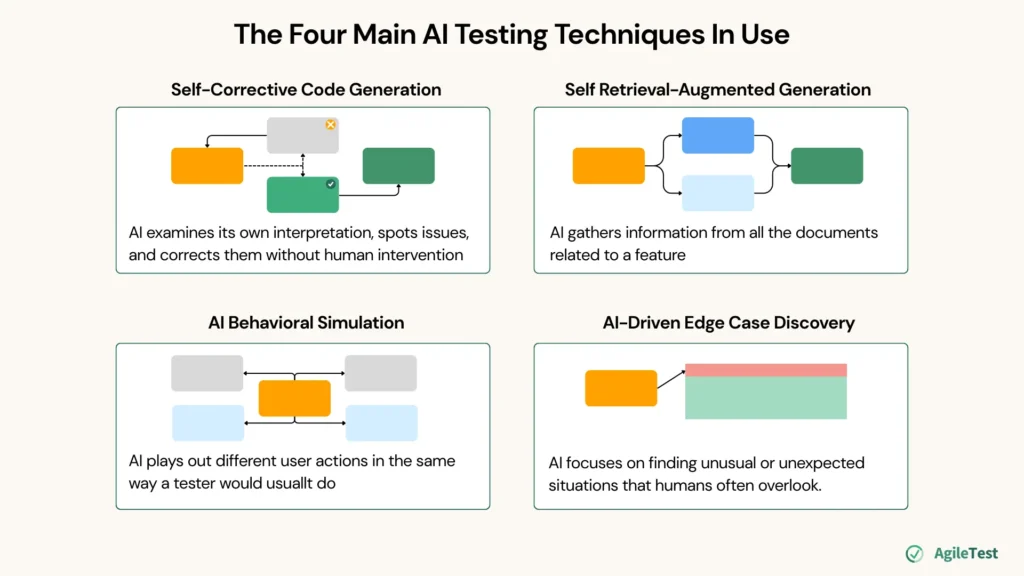
Self-Corrective Code Generation
Self-Corrective Code Generation is one of the most transformative AI techniques used in design-stage testing. It allows AI to read written requirements and create a version of how the system should behave behind the scenes. But the real value comes from what happens next: the AI examines its own interpretation, spots issues, and corrects them without human intervention.
This is similar to having an assistant who drafts a plan, reviews it, and rewrites it until it becomes good. If the requirement forgets to mention what happens after a specific user’s action, the AI will notice the missing rule and raise the concern immediately. This early feedback prevents teams from discovering these issues only after development begins. In short, Self-Corrective Code Generation strengthens the logic of the design while it’s still flexible and easy to adjust.
Self-RAG
Self-RAG (Self Retrieval-Augmented Generation) gives AI the ability to gather information from all the documents related to a feature. They can be requirements, design notes, business rules, and more, then compare them for consistency. Human teams rarely have time to cross-check every document, which means contradictions often slip through unnoticed. Self-RAG acts like a highly attentive reviewer who reads everything and instantly sees when two sources don’t match.
For example, if one document requires password confirmation for account deletion but another doesn’t mention it, Self-RAG will detect the conflict. This technique ensures everyone is working from the same, accurate understanding rather than fragmented assumptions. It brings alignment early in the process, reducing misunderstandings and making the design more stable before developers begin translating it into real code.
AI Behavioral Simulation
AI Behavioral Simulation allows teams to preview how a feature will behave long before any code is written. After reading the design, the AI “plays out” different user actions in the same way a tester would do. It tries not only the straightforward flow, but also more complicated situations. Using the account deletion feature as an example, AI can explore some complicated situations, such as entering the wrong password, losing internet connection, etc.
This technique makes it easier to spot design gaps before development starts. If the AI reaches a point where the design doesn’t specify what should happen, it highlights the uncertainty immediately. It also reduces the late-stage surprises and makes the design closer to what users will experience in real life.
AI-Driven Edge Case Discovery
AI-Driven Edge Case Discovery focuses on finding unusual or unexpected situations that humans often overlook. While teams tend to think about the most common user actions, edge cases are the ones that often cause bugs. AI pushes the design by asking many “what if?” questions that the team might not consider. For instance:
- What if the user tries to delete their account while offline?
- What if they click the delete button twice?
- What if their subscription renews at the same moment they try to delete?
These edge-case explorations reveal the less defined areas of a design and give teams the chance to strengthen them early. By understanding how a feature behaves under both normal and unusual conditions, the products can be more reliable and user-friendly. Instead of discovering these problems during late testing, AI surfaces them when the cost of fixing them is still low.
Final thought
AI Testing techniques in the design stage are transforming the design phase from a static planning step into a stage where real testing and validation can happen. Those techniques give product, design, QA, and engineering teams a clearer, more reliable starting point. As these capabilities continue to grow, design-stage testing will become an essential part of building better software, faster.
AgileTest is a Jira Test Management tool that utilizes AI to help you generate test cases effectively. Try it now