
AI Testing is revolutionizing software testing by automating tasks, improving accuracy, and enhancing efficiency. As AI systems evolve, they are becoming central to the testing process, offering both opportunities and challenges. Therefore, testing AI becomes crucial to ensure the final outputs in the whole testing process.
This article explores the three waves of AI’s impact on testing, outlines why it’s important to test AI at different stages to ensure quality outcomes. We will also outline when to test AI throughout the three phases of the development lifecycle.
1. The Three Waves of AI Impact on Testing
AI is reshaping software testing in three major waves, each one changing how test teams apply it in their testing process.
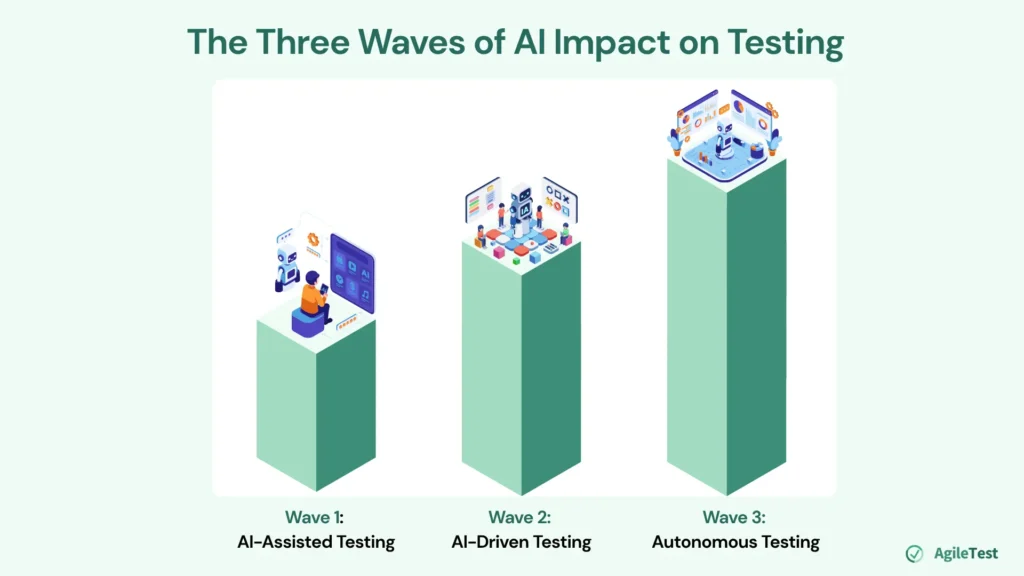
Wave 1: AI-Assisted Testing (2020-2025)
In the first wave, AI acts like a smart assistant for testers. Teams apply it to speed up simple routine work, such as gathering defined work items, summarizing test results into reports, etc. This helps the testing process run faster and more accurately. Testers spend less time on manual tasks and more time solving real problems. This wave is all about efficiency and smarter workflows.
Wave 2: AI-Driven Testing (2026-2030)
In the second wave, AI itself becomes the engine that drives the tests. Instead of relying on testers to manually create, run, or maintain tests, AI systems begin to handle these tasks on their own with minimal human oversight. AI can now automatically generate test cases directly from requirements, run full regression suites across platforms with minimal human setup, etc. In this phase, testers shift from being hands-on executors to becoming informed overseers, focusing on guiding the AI, validating its output, and ensuring the overall quality of its work rather than doing every task directly.
Wave 3: Autonomous Testing (2030+)
In the third wave, AI plays a long-term role as a quality guardian after a product is launched. User behavior, trends, and real-world data constantly change, and AI helps teams monitor these shifts. It can analyze data and alert them when accuracy drops, when new risks appear, or when the system behaves differently from expected behavior. Testing evolves from a one-time phase into continuous oversight.
2. Why Testing AI Matters?
Many teams are now reaching the end of Wave 1, where AI handles small, predefined testing tasks. Moving into Wave 2 means letting AI take on much larger responsibilities: becoming the main engine that drives the testing process. But this shift brings new challenges. As AI moves beyond simple tasks, teams must ensure it remains reliable, transparent, and under control. It’s important to understand the risks and set clear guidelines for how humans and AI will work together.
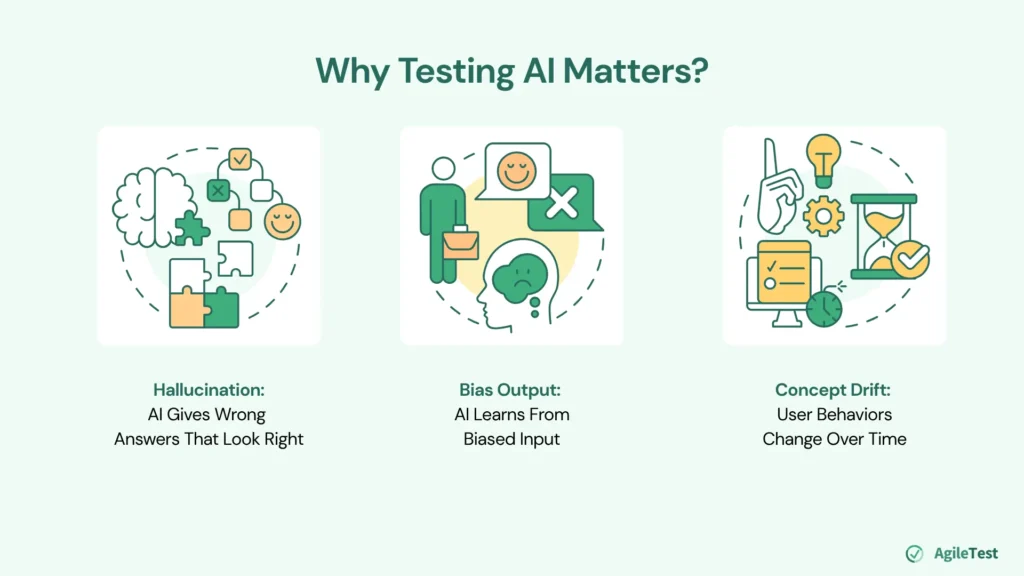
AI Gives Wrong Answers That Look Right
One of the biggest risks with AI systems is that they can produce answers that sound confident and accurate, even when they’re completely wrong. This is often called “hallucination”. Studies show that even large, advanced AI models still produce incorrect outputs with high confidence, especially in ambiguous scenarios (OpenAI, 2025). This happens because, when faced with ambiguity, AI may piece together information in a way that looks coherent but isn’t logically valid.
In software testing, this creates real risks. For example, an AI test generator might create a test case that appears well-structured but is built on faulty assumptions, such as using outdated API behavior or misinterpreting acceptance criteria. Because the result looks polished, testers may trust it at face value, leading to coverage gaps or misleading test results.
AI Learns From Biased Input
Another threat is that AI can provide biased output. AI systems learn from the data you have trained them on. Data, by default, should not contain any stereotypes; it needs to be a means of facts to analyze. However, if that data contains bias, whether from historical trends, human errors, or imbalanced datasets, the AI will absorb and reproduce it.
The output that AI provides in this case is not wrong, but it is not enough. For example, when an AI test optimizer is trained mainly on desktop usage patterns, it may under-test mobile scenarios, leading to missed bugs in responsive layouts or device-specific behaviors.
User Behaviors Change Over Time
The final risk is that the AI that performs well today may degrade tomorrow. This is called “concept drift”. This happens when real-world behavior gradually changes and the AI no longer matches user expectations.
New usage patterns, new devices, and new feature expansions can make old AI assumptions outdated. For instance, an AI model that prioritizes test cases based on historical failure patterns may become ineffective if users suddenly adopt a new feature more heavily. Without continuous testing, the AI will keep sending resources toward outdated areas while ignoring emerging risk zones.
3. When To Test AI in The Testing Process
These risks make one thing clear: AI cannot be treated like traditional software that is tested once and considered stable. Because AI behavior depends on data, context, and continuous learning, testing needs to happen throughout the entire development lifecycle—not just at the end. To ensure AI stays accurate, unbiased, and aligned with user needs, teams must test it at the right stages and with the right focus.
This brings us to the next question: When should AI be tested in the process to ensure it performs reliably from design to post-production?
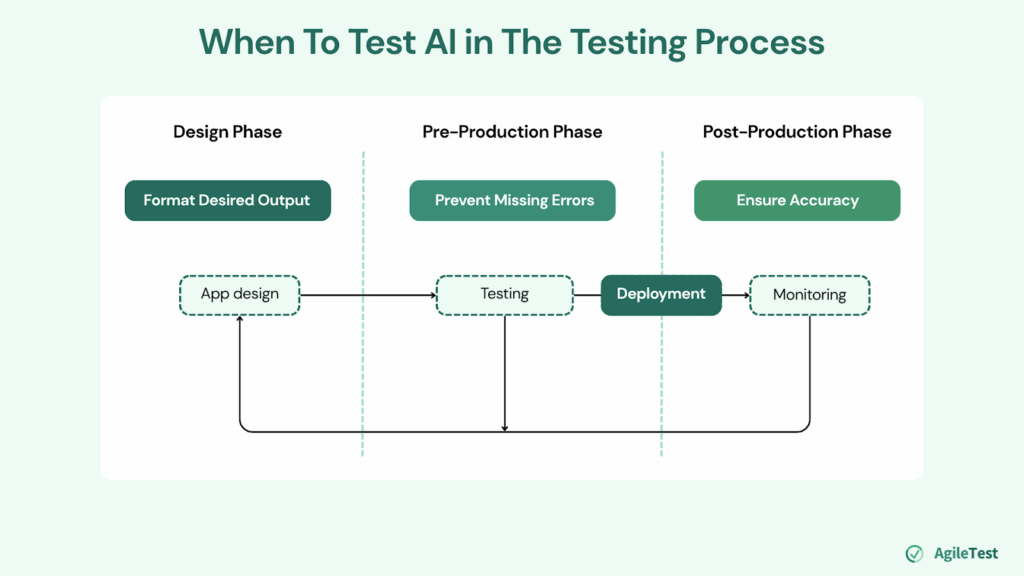
Design Phase: Format Your Desired Output
The main purpose is to validate the intended behavior of the AI before development begins. As previously mentioned, AI output can sometimes be biased and hallucinated. At this step, teams conduct tests to ensure that you get the correct outputs as you desire.
Testing teams will focus on defining the model’s goals clearly and performing initial tests to ensure the AI responds as expected. This phase also provides an opportunity to reinforce the AI’s behavior through structured feedback, helping it adjust and learn from the early tests. By identifying and addressing issues like bias, misinterpretation, or faulty logic, teams can set a strong foundation for the AI’s performance.
Pre-Production: Prevent Errors From Reaching Users
After you have developed your system, you need some checks to ensure no bugs escaped from your staging environment. This serves as the final checkpoint before the AI reaches real users. Without efficient time and effort spent in this stage, significant issues may go unnoticed, leading to bugs and unexpected behaviors in production.
Testing teams will apply various techniques to enhance data quality, establish reliable AI outputs, and minimize ambiguity. The primary aim is to catch and fix all errors before launching the apps to real users.
Post-Production: Ensure Accuracy Over Time
At this phase, you will shift your main focus from bug detection to ongoing monitoring and adaptation. The goal is to ensure that you can maintain the accurate quality & relevant results of AI over time. As discussed, AI models can experience concept drift, where their performance may degrade as user behavior, data trends, or external conditions change.
Testing teams must implement continuous monitoring to track the AI’s performance and detect any signs of degradation or unexpected behavior. User feedback is invaluable at this stage, as it provides direct insights into the AI’s effectiveness in real-world conditions. It acts like a feedback loop when teams can gather insights and put them back into the two previous phases to improve quality in the AI Testing process.
Final thoughts
By testing AI throughout the design, pre-production, and post-production phases, teams can ensure the accuracy, fairness, and reliability of their systems. Continuous testing and feedback are essential to maintaining AI’s effectiveness in real-world environments. As AI continues to shape the future of testing, adopting a structured approach will be crucial for achieving high-quality results and meeting user needs.
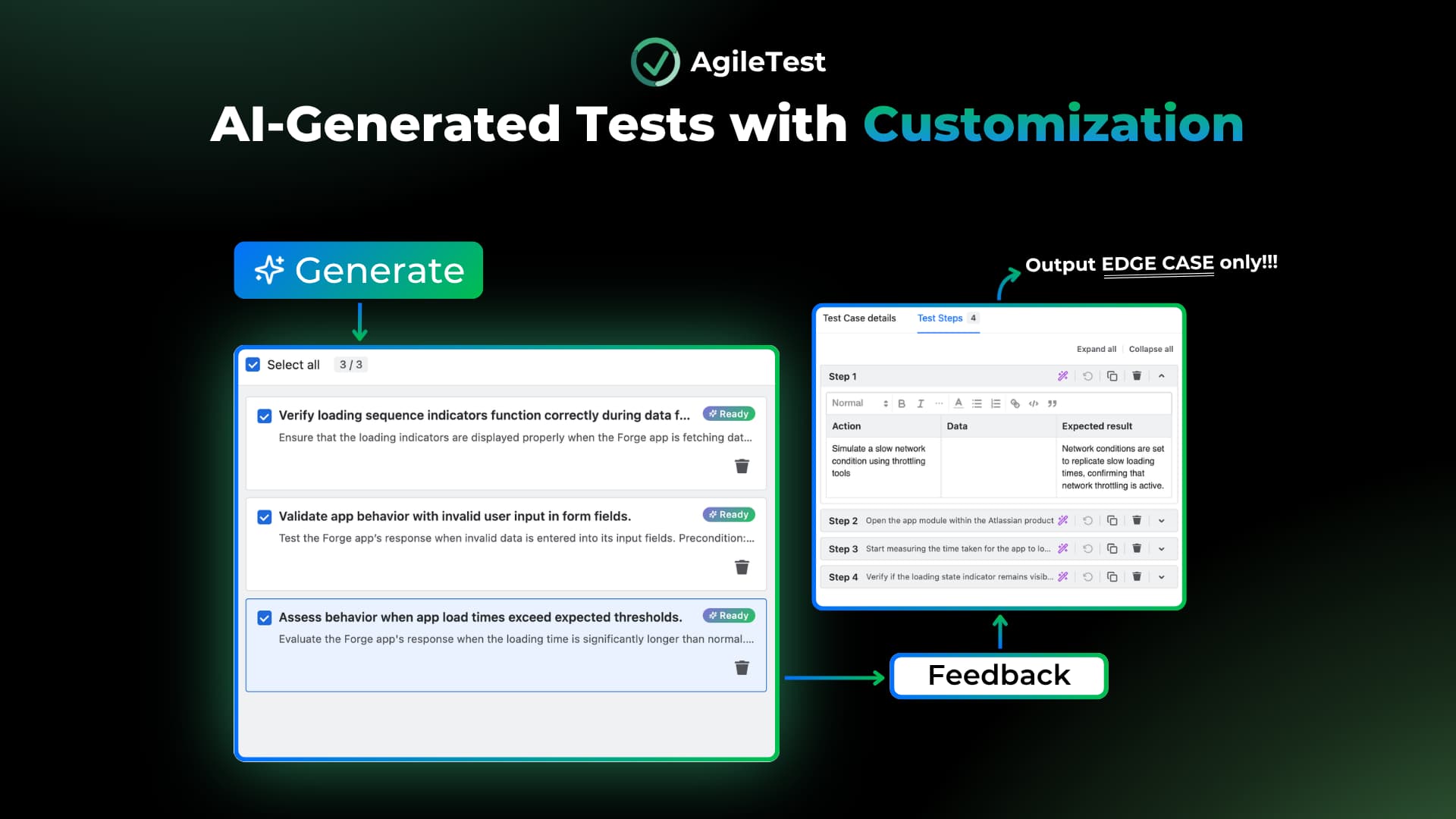
AgileTest is a Jira Test Management tool that utilizes AI to help you generate test cases effectively. Try it now