

Every app and website you use has gone through a test process. This process ensures quality and builds confidence in the product before reaching users. But, when should you determine if it’s time to complete your test run after numerous runs and re-runs? This is where test completion criteria come into play.
This article will scrutinize the test completion criteria. We will explore what these criteria are and why they are so important. We will also learn how to define them effectively. By the end, you will understand how to set a clear finish line for your testing efforts. This will help you release a quality product with confidence.
1. What Are Test Completion Criteria, Really?
Definition
Think of test completion criteria as your project’s finish line. They are a predefined set of conditions or metrics. You can imagine these completion criteria as a formal checklist. Testers must meet these conditions to declare a testing phase complete. They provide a clear, objective end goal for your testing. This means you have a solid reason to stop, instead of just an emotional decision. For instance, you could decide that the test is done when “95% of your planned tests have been successfully run”. Or you might set a rule that “the number of critical bugs found must be zero”. In general, they are concrete rules you settled on for ending a test activity.
Misconceptions
Test objective and test completion criteria
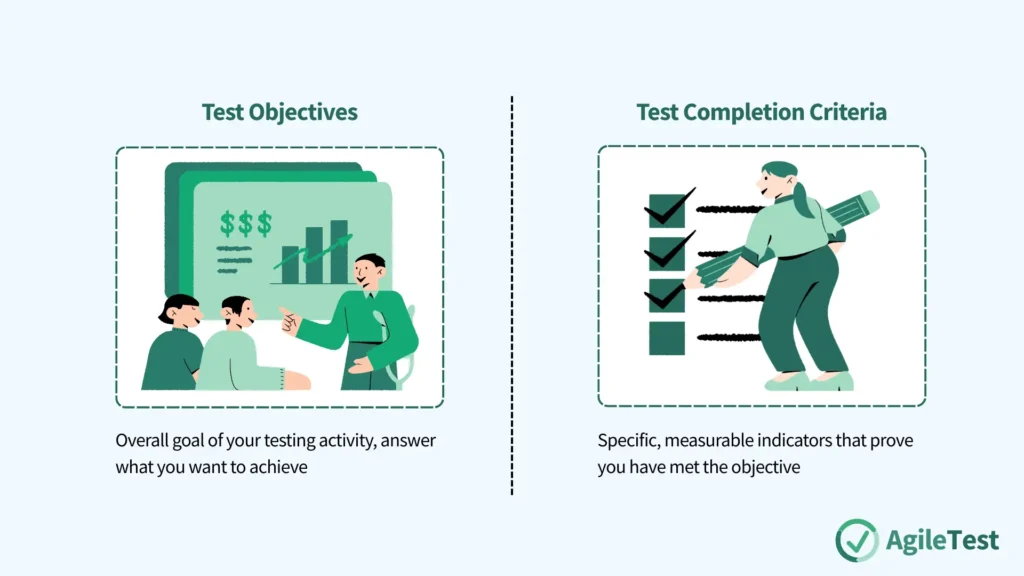
Sometimes, you may be a little bit unclear about the test objective and the test completion criteria. Test objectives are your “WHY.” They state the purpose of your testing. For example, “To ensure that users can successfully log in to the application.” This is the overall goal of your testing activity. It defines what you want to achieve.
On the other hand, test completion criteria are the “WHAT” They are the specific, measurable conditions that prove you have met the objective. Following the login example, your completion criteria might be: “95% of login test cases must pass,” or “No critical bugs found in the login feature.” To sum up, the objective is the target, while the completion criteria are the proof that you’ve hit that target.
You can read our guide to set up actionable objectives with this article: Your Project’s North Star: A Practical Guide to Test Objectives
Test exit criteria and test completion criteria
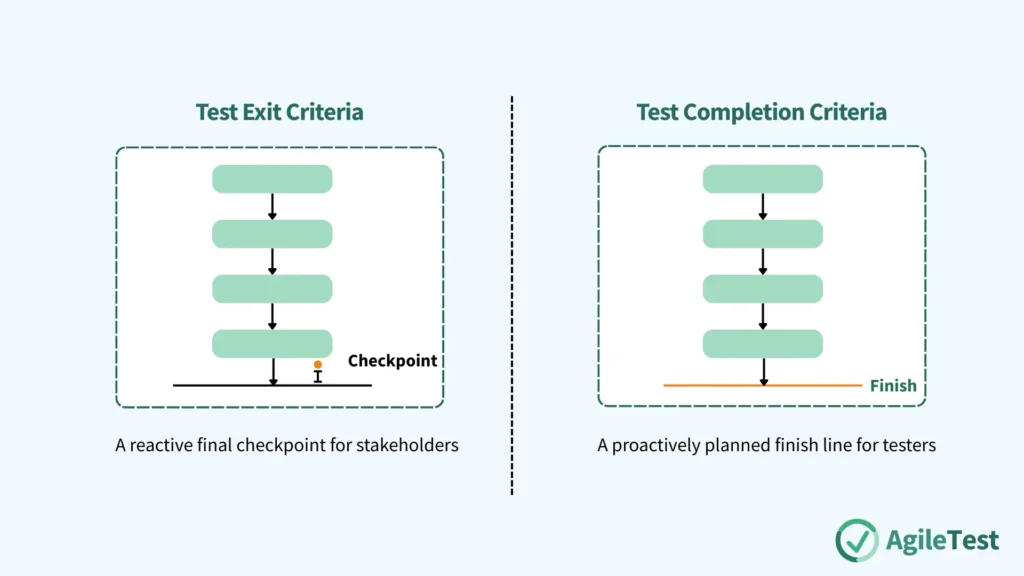
In many cases, test exit criteria and test completion criteria can be used interchangeably. They both define the conditions needed to finish a testing phase. However, a subtle difference can exist. Think of test completion criteria as the goals or benchmarks you set before testing. They are the proactively planned finish line for testers. For instance, your completion criteria could be “90% of test cases must be executed and no critical bugs remain“.
In contrast, test exit criteria are the formal rules used at the end of a testing phase. Their core function is to be the reactive final checkpoint for stakeholders. You use them to evaluate your test results and confirm that you have met your planned completion criteria. As an illustration, the exit criteria checkpoint verifies: “Did we actually run 90% of test cases? Do defect reports confirm zero open critical bugs?” If both conditions are true, the exit criteria are satisfied, and testing can formally close.
Generally, completion criteria are what you plan as the finish line, while exit criteria are the formal evaluation of whether you’ve crossed that finish line.
2. The Dangers of Ineffective Criteria
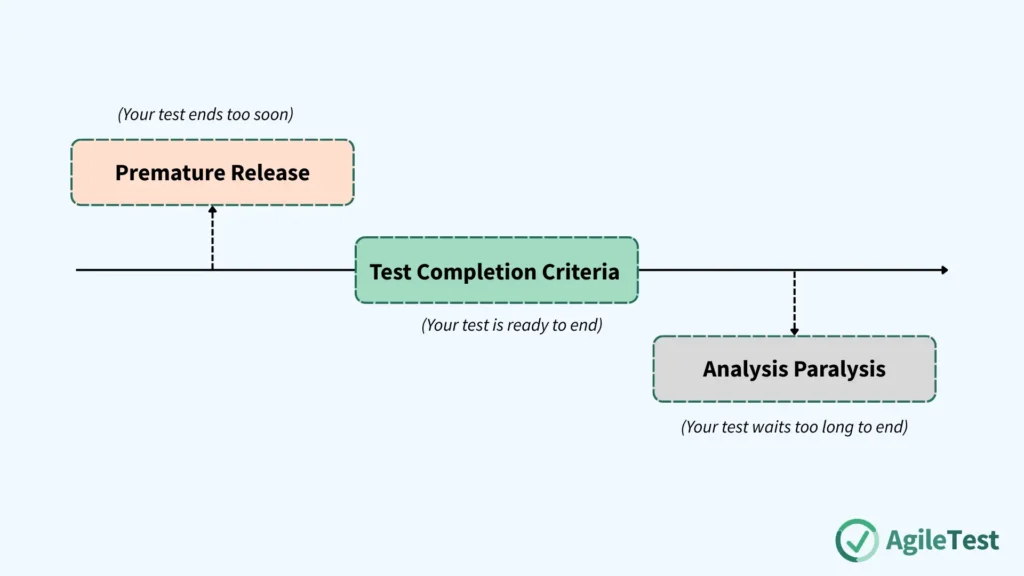
You already know that setting up effective completion criteria at the test planning stage helps you decide when to stop your test runs efficiently. So, what if you do not have one or yours are ineffective? This often results in two main scenarios: you close the test too soon, or you wait too long to do it.
Premature release:
A lack of proper criteria can lead to a premature release. This means you stop testing too soon, and a faulty product goes live. A common mistake is using a simple bug count as your only metric. If the number of new bugs found goes down, you might assume the product is stable and become overconfident in the app’s performance. However, this is a dangerous assumption. When a bug has not yet been found, this does not mean that they do not exist, but instead, you may not choose a proper test approach to find it.
Discover different test types with our article: Test Management in Different Test Types
These critical but hidden bugs, once found, could impact the whole operation process. Imagine releasing an e-commerce site. Your team tested the shopping cart and checkout process thoroughly. But they missed a bug that prevents users from applying discount codes. This can cost the company thousands in lost sales and hurt customer trust.
Analysis paralysis:
Conversely, without clear criteria, your team can fall into a trap called “analysis paralysis”. This means you keep testing long after they should have stopped. Some criteria, such as “All found bugs must be fixed and re-tested”, seem ideal when you only have 3-5 bugs. But what if you have more than 20 bugs with minor issues? You may continue to find low-priority bugs and feel the need to fix them all. This prolongs the testing cycle, wasting your resources, delaying your test plan, and exhausting your team with overscoping work.
3. Core Categories of Test Completion Criteria
Now, you may wonder what to do to avoid ineffective completion criteria in your test plan. But before getting to know how to structure effective completion criteria, you will need to understand its components.
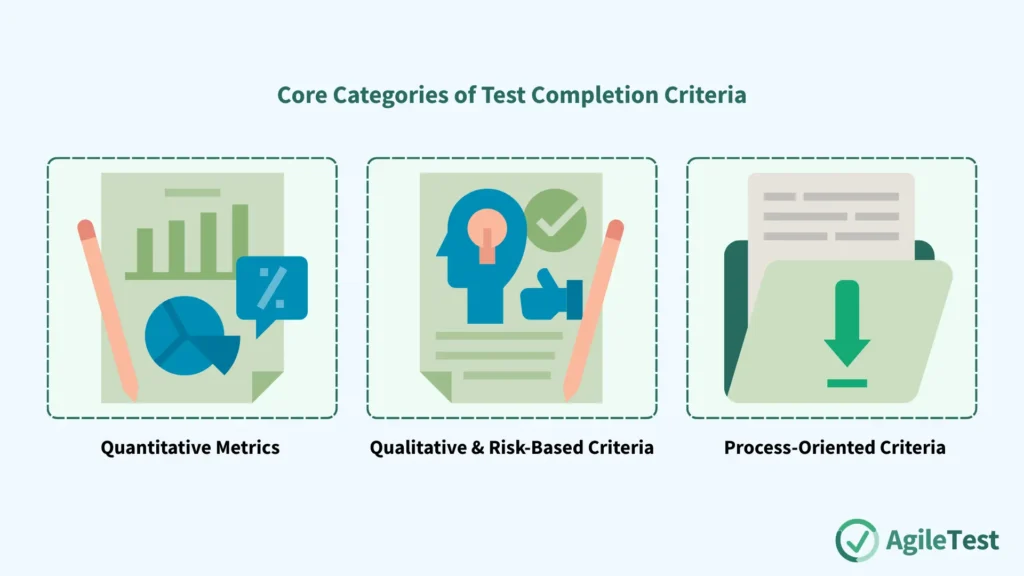
Test completion criteria are not just one type of metric. They fall into a few key categories. Each one gives you a different way to measure success.
Quantitative Metrics
Quantitative metrics based on numbers. These are the most common and easiest to track. They give you a clear, objective view of your progress. You should use quantitative metrics when you need clear, data-driven proof of progress, especially in large or complex projects. In Waterfall projects, which have fixed stages and long test cycles, these metrics are a high priority. They act as clear checkpoints for managers to decide if the project can move forward or not. Some common quantitative metrics include:
Test Case Execution:
Test case execution metric is the percentage of test cases that have been run. For example: “95% of planned test cases have been executed.” You can apply it when you want to have a process bar that tracks your test case run and see how close you are to your goal.
Bug Rate:
Bug rate measures the number of bugs you have found and fixed. A criterion could be, “The number of high-priority bugs is zero”. This type of measurement is especially helpful when you want to prioritize testing based on the severity of issues, ensuring that specific types of defects are resolved before release.
Test Coverage:
Test coverage shows how much of the application has been tested, whether in terms of requirements or code. A typical example of this criterion is, “90% of the main requirements have been covered by tests”. Using this metric ensures that key features are not overlooked and your testing efforts provide broad and meaningful coverage. It also helps you avoid blind spots in your testing.
Qualitative & Risk-Based Criteria
Qualitative & Risk-based criteria are less about numbers. They focus on the quality and potential risks of the software. These are best used when you need to guide decision-making in situations where not all areas can be tested equally or with data. In Agile teams, these criteria are highly recommended. Since Agile focuses on customer value, you should prioritize features that deliver the most value or carry the most risk. Two main criteria are:
Risk-Based:
Risk-based criteria prioritize testing based on what is most likely to fail or cause the most damage. Your criterion might be, “Payment features have been thoroughly tested.” This is best used in time-constrained situations where you want to shift focus to the really important issue rather than everything equally. It ensures that resources are invested where they will have the most impact.
User Acceptance:
User acceptance criterion is more about getting approval from the customer or end-users. A criterion could be, “70% users find it easier with new guidance in the payment page.” User acceptance criteria are most appropriate when the product’s success depends on client or end-user approval. They confirm that the software not only functions correctly but also delivers value to its intended audience.
Read our article to explore more about Agile and Waterfall approaches: Agile Testing vs Waterfall Testing
Process-Oriented Criteria
Process-oriented criteria focus on the effectiveness of the testing activities themselves, rather than on the product under test. These criteria are especially valuable when you want to strengthen team discipline, maintain transparency, and build a knowledge base that benefits future projects. Two key criteria include:
Documentation:
Documentation criterion ensures all necessary documents are complete. For example, “All test cases and test results have been documented.” This helps you keep a clear record of the work and enhance the traceability. Documentation usually becomes a compulsory criterion when your team aims to establish and update your testing knowledge base through a process-over-process approach.
Lessons Learned:
Lessons Learned criteria focus on reflection and growth. For example, a criterion could be: “A ‘lessons learned’ meeting has been held with the full team.” This practice goes beyond simple retrospectives; it encourages open discussion of strengths, weaknesses, and opportunities for improvement. With these insights, teams foster a culture of continuous improvement that enhances not just the current project but also the quality and efficiency of all future testing efforts. This is also the main goal of setting this aspect in the completion criteria.
4. Best Practices for Defining Completion Criteria
After having a foundation of the completion criteria, you come to the main part of how to build an effective one.
Phase 1: Planning and Alignment
The first step is to analyze your test plan carefully. You need to understand the project’s scope and objectives. This helps you understand what your completion criteria need from the start. Think of it as planning a road trip: you must know your destination before you choose which roads to take.
At this stage, alignment with stakeholders is critical. Testers, developers, project managers, etc. should all agree on the criteria. This ensures that everyone shares the same definition of “done.” Without alignment, you risk disagreements later. Best practice is to document this alignment in the test plan so it becomes a reference point for the entire team.
Phase 2: Choosing Your Metrics
Once you have aligned your goals, it’s time to choose the right metrics. An effective approach is to mix and match different types of criteria. In either of the metrics you may pick up, it should be actionable. You can refer to many frameworks, such as SMART goals. For instance, set a Test Case Execution goal that is Specific and Measurable. Instead of a vague goal like “test the payment page,” your criterion should be, “ensure 90% of test cases for the payment page have been executed “.
Also, there are no official numbers of metrics you need to pick up for your completion criteria. Again, you will need to carefully analyze the test objective and scope. The key is to select only the ones that are relevant to your project’s goals. Picking too many metrics can be confusing and lead to “analysis paralysis”. Meanwhile, choosing only 1 metric could lead to a biased decision, which could result in a premature release.
Phase 3: Revisit and Adjust
Completion criteria are not “set and forget” . During a project, things can change. Do you still remember that you need to conduct a test control activity to deal with changes and keep your testing process on track? Revisiting and adjusting your completion criteria is also included in this process.
If a new critical feature is added, update your completion criteria to ensure it is covered. If deadlines are shortened, adjust metrics to prioritize high-risk areas over low-value tasks. The key is flexibility: criteria should guide you, not trap you. By proactively tracking and adjusting, you keep your testing process relevant, efficient, and aligned with project realities.
Final Thoughts
Mastering test completion criteria is vital. It is how you move beyond just counting bugs. By defining a clear finish line, you ensure your work is effective. You prevent wasted time and resources. This strategic approach gives your team a clear direction. It also builds confidence in the final product. Remember to use a mix of metrics. Always set clear, S.M.A.R.T. criteria. This will help you deliver high-quality software every time.