

Automated Test Report has changed the way teams utilize it. Test reporting in 2026 is no longer a passive, end-of-pipeline activity. In modern environments, test reporting has evolved into a critical feedback mechanism that enables teams to understand quality risk, diagnose failures faster, and ship software with confidence.
Effective test reporting now plays a direct role in decision-making across the development lifecycle.
As CI pipelines become more complex and testing runs continuously, teams need more than basic pass/fail results. Modern test reporting must explain why failures occur, track trends over time, and support both manual test reporting and automated test reporting.
Effective CI test reporting delivers role-specific insights for QA teams, developers, and engineering leaders, helping teams move faster with confidence.
This article explores how test reporting is evolving across both manual and automated testing, the key challenges teams still face, and the reporting features that matter most for building reliable, high-velocity delivery pipelines in 2026.
Test Reporting as a Continuous Agile Feedback System
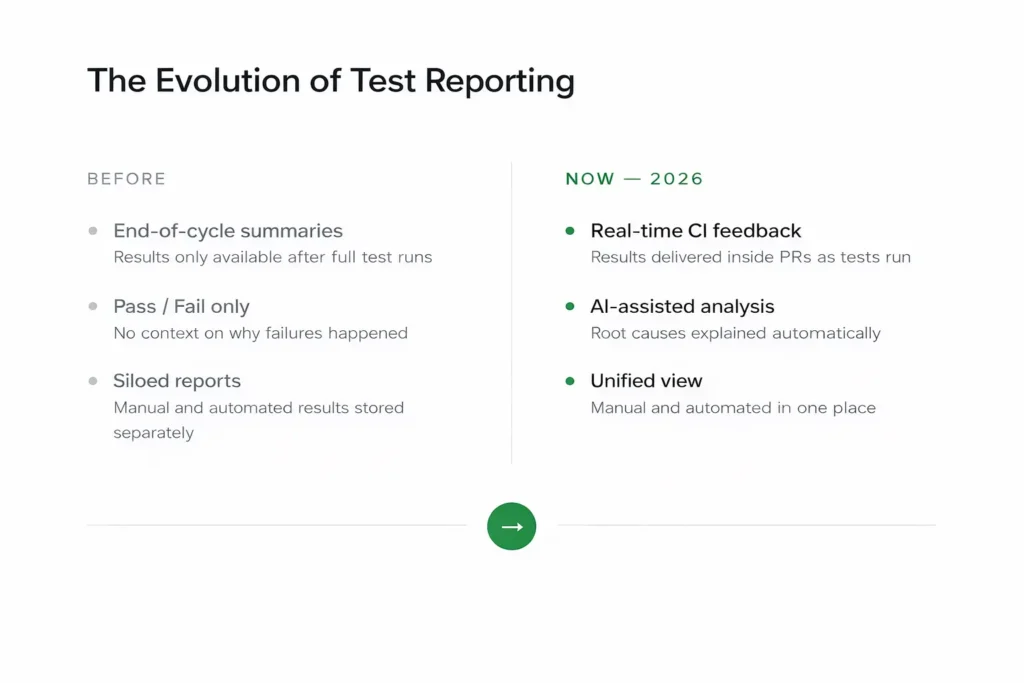
Agile teams in 2026 operate in an environment where:
- Tests are executed on every pull request and deployment
- Multiple test types run in parallel (UI, API, performance, security)
- Releases are evaluated continuously, not at the end of a cycle
In this context, test reporting is no longer about summarizing outcomes after execution. It functions as a continuous feedback layer embedded directly into CI pipelines and agile workflows.
Modern test reporting systems are:
- CI-native, delivering feedback inside pull requests and pipelines
- Evidence-rich, aggregating logs, screenshots, videos, traces, and environment data
- Insight-driven, focusing on trends, risk signals, and root causes
Instead of asking “Did tests pass?”, teams now ask:
- Is this change increasing release risk?
- Are failures new, recurring, or environment-specific?
- Is quality improving from print to sprint?
Test reporting answers these questions in real time.
Manual Testing Still Matters: Reporting Makes It Scalable
Even in 2026, when automation is widespread, manual testing is still very important. Many types of testing cannot be fully automated and still need human judgment and experience. Manual testing is especially useful for:
- Exploratory testing, where testers explore the application freely to find unexpected issues
- Usability and accessibility testing, where human observation is needed to understand the real user experience
- Risk-based and edge-case testing, where testers focus on high-impact areas that automation might miss
Because of this, manual testing continues to provide valuable quality signals, but only if it is reported clearly and consistently.
How Manual Test Reporting Has Matured
Modern agile teams no longer treat manual test results as standalone documents or disconnected checklists. Instead, manual testing contributes structured, contextual signals into the same reporting stream as automation.
Key changes include:
1. Unified test reporting:
- Manual test cases and results are now tracked alongside automated test runs.
- This allows teams to see both manual and automated outcomes in one place instead of switching between tools.
2. Contextual linkage:
- Manual test results are linked to specific builds, releases, pull requests, and environments.
- This makes it clear when and where an issue was found, which helps developers fix problems faster.
3. Trend visibility over time:
- Instead of reviewing manual test results in isolation, teams can now spot repeated issues, risky areas, or recurring failures across multiple releases.
- This helps teams focus their testing efforts where it matters most.
Modern reporting platforms also make it easier to manage both manual and automated test cases, so teams don’t lose important context when switching between testing types.
When manual findings are connected with automated test history, screenshots, logs, and environment data, teams gain a much clearer understanding of overall quality.
The Main Challenges:
The biggest challenge with manual test reporting is finding the right balance. Reports need enough structure to support insights, trends, and decision-making, but they should not slow testers down with heavy documentation or duplicate work.
The best manual test reporting approaches focus on:
- Capturing meaningful results quickly
- Linking manual outcomes to automated data and CI runs
- Supporting collaboration between QA, developers, and managers
When done well, manual test reporting becomes a strong complement to automation, helping teams make smarter release decisions with confidence.
Automated Test Reporting: From Raw Data to Quality Intelligence
Automated testing generates massive volumes of execution data in modern pipelines. By 2026, collecting logs, screenshots, videos, and traces is table stakes. The real differentiator is how reporting systems transform that data into insight.
The Problem with Raw Automation Results
Most modern test frameworks generate large amounts of data, including screenshots, videos, logs, and execution traces. While this data is valuable, it quickly becomes overwhelming if it is not organized properly.
Common problems teams face include:
- Information overload
Developers and QA teams struggle to find the most important details among thousands of logs and artifacts. - Flaky tests hiding real issues
Unstable tests often fail randomly, making it difficult to know whether a failure is caused by a real bug or test instability. - Time wasted reproducing failures locally.
Engineers spend significant time rerunning tests and trying to recreate issues instead of fixing them.
Simply collecting more data does not improve quality. Automated test reporting must turn raw output into clear, actionable insight.
How Modern Reporting Solves the Raw Data Challenge:
Rather than overwhelming teams with artifacts, intelligent reporting systems provide:
1. Failure intelligence:
- Automated analysis correlates logs, traces, and historical behavior to explain why a failure occurred, not just where it happened.
2. Flaky test classification:
- Historical execution patterns identify unstable tests and separate them from genuine product defects, reducing false alarms during pull request reviews.
3. Targeted reruns:
- Teams rerun only impacted or failed tests instead of entire suites, keeping feedback loops fast without sacrificing confidence.
4. Cross-branch and cross-environment:
- Failures are compared across branches, environments, and releases to expose regressions, configuration issues, and long-term stability trends.
Automated test reporting in 2026 is no longer about visibility; it’s about maintaining delivery speed at scale.
Test Reporting Across Agile Roles:
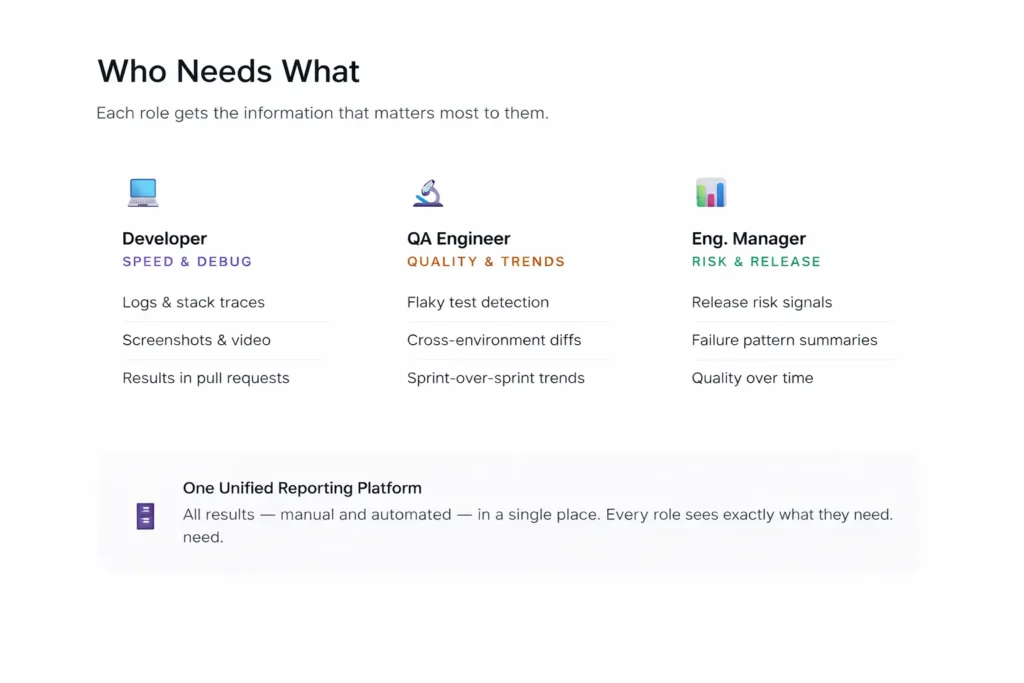
One of the biggest changes in modern test reporting is the understanding that reports are not only for QA teams.
In CI-driven environments, test results are shared across multiple roles, and each role needs different information to do their job effectively.
How Different Roles Use Test Reporting:
1. Developers:
- Developers need fast, detailed feedback when tests fail.
- This includes easy access to logs, screenshots, videos, and execution traces so they can quickly understand what went wrong without rerunning tests locally.
- Reports that appear directly in pull requests or CI pipelines help developers fix issues earlier in the workflow.
2. QA teams:
- QA engineers focus on overall test health rather than individual failures.
- They rely on test reporting to identify trends, detect flaky tests, compare environments, and understand where instability is increasing over time.
- Historical insights help QA teams improve test reliability and coverage.
3. Engineering managers:
- Managers need a high-level view of quality and risk.
- Instead of technical details, they look for signals such as release stability, failure patterns, and whether quality is improving or declining across sprints and releases.
Role-Based dashboards in Reporting:
Modern test reporting tools address these different needs by offering role-based dashboards. Each stakeholder sees the level of detail that matters to them without unnecessary noise.
Developers get deep debugging context, QA teams get trends and insights, and managers get clear quality signals.
By serving all roles effectively, test reporting becomes a shared source of truth that supports better collaboration, faster decision-making, and more confident releases.
Features That Matter Most in Test Reporting in 2026
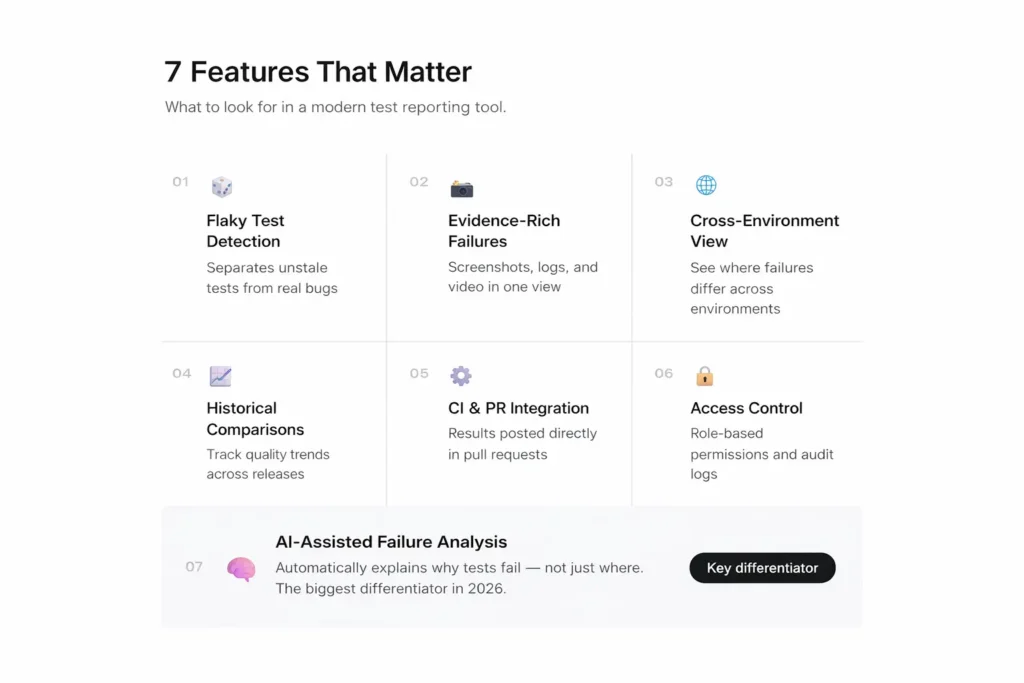
When choosing a test reporting solution in 2026, teams need to look beyond simple pass/fail charts.
Modern software delivery requires reporting tools that provide context, insights, and support for fast decision-making across CI pipelines and teams.
Below are the most important features that make test reporting truly effective.
1. Flaky Test Detection
- Not all test failures are equal. Some tests fail randomly due to timing issues, environment instability, or data problems.
- Modern test reporting analyzes historical behavior to identify flaky tests instead of treating every failure as a product bug.
- This reduces false alarms and helps teams focus on real issues.
2. Evidence-Rich Failure Views:
- Effective test reporting brings all failure evidence into one place.
- Screenshots, videos, logs, execution traces, and step-by-step details should be available in a single view.
- This saves time by eliminating the need to jump between tools or rerun tests just to understand what went wrong.
3. Cross-Environment Insights:
- Tests often behave differently across QA, staging, and production environments.
- Modern test reporting makes these differences visible by clearly showing where and why failures occur in each environment.
- This helps teams detect configuration issues and environment-specific bugs early.
4. Historical and Branch Comparisons:
- Test reporting should provide historical context, not just current results.
- Teams need to compare pull requests against base branches, track release-to-release stability, and monitor trends over time.
- These insights help identify long-term quality risks and measure improvement.
5. CI and PR Workflow:
- Test reporting works best when it fits naturally into existing workflows. In 2026, this means deep CI and pull request integration.
- Reports should automatically post results as PR comments, update commit statuses, and allow teams to rerun only failed tests instead of full suites.
6. AI-Assisted Failure Analysis:
- AI-driven test reporting is becoming increasingly important.
- By analyzing logs, traces, and historical data, AI can help explain why a test failed, highlight likely root causes, and reduce the manual effort required to debug complex issues.
7. Secure Sharing and Access Control:
- As test reports include more detailed data, security becomes critical.
- Modern test reporting tools offer role-based access control, audit logs, and secure sharing options.
- This ensures the right people have access to the right information, especially in distributed or enterprise teams.
Bridging Manual and Automated Reporting for Release Confidence
High-performing teams in 2026 no longer treat manual test reporting and automated test reporting as separate activities. Instead of working in silos, teams combine results from both types of testing to get a complete and accurate view of product quality.
Why Unified Test Reporting Matters
When manual and automated test results are managed together, teams benefit in several important ways:
1. A single source of truth for quality:
- All test results, manual and automated, are visible in one place.
- This reduces confusion, eliminates duplicate reporting, and helps teams trust the data they are reviewing.
2. Consistent reporting standards:
- Using the same reporting structure for all tests makes it easier to compare results, track trends, and understand quality signals across the entire testing process.
3. Better release-level risk visibility:
- Unified test reporting helps teams see how manual findings and automated failures impact a release as a whole.
- This makes it easier to assess risk before deployment and make confident release decisions.
Conclusion
Test reporting in 2026 has evolved from simple pass/fail summaries into a critical feedback system that helps teams understand quality, manage risk, and move faster with confidence.
Modern test reporting connects manual and automated testing, delivers role-specific insights, and supports CI-driven workflows across the development lifecycle.
As test suites and pipelines scale, teams need test reporting that provides context, intelligence, and visibility rather than raw data alone.
Organizations that invest in modern, scalable test reporting practices will be better positioned to deliver reliable software and make confident release decisions in 2026 and beyond.
FAQs
1. How has automated test report evolved to support shift-left testing in agile teams?
Automated Test report now delivers real-time quality signals directly in pull requests and CI pipelines, allowing teams to detect risk as early as code creation. Historical comparisons help teams prevent defects from progressing deeper into the delivery lifecycle.
2. How do agile teams use automated test report during sprint ceremonies?
Teams use test reporting in sprint planning to prioritize high-risk areas and in standups to surface active quality blockers. During reviews and retrospectives, historical trends help evaluate release readiness and continuous improvement.
3. What emerging challenges do AI-augmented test suites introduce for reporting in 2026?
AI-driven test suites increase execution volume and variability, making failure interpretation more complex. Automated test report must provide explainability and confidence signals to prevent noise from slowing delivery.
4. How does modern automated test report connect manual testing with automated results?
Manual test findings are reported alongside automated results and linked to the same builds, user stories, and releases. This creates a unified quality view that supports accurate release-level risk assessment.
5. Why is test observability becoming critical for reporting in 2026?
Test observability correlates failures with logs, traces, and environment data to reveal root causes faster. This reduces time spent reproducing issues and improves decision-making accuracy.
6. What role does automated test report play in continuous deployment and release confidence?
Test reporting acts as a continuous risk signal rather than a final approval step. Teams use trends and stability indicators to deploy frequently while maintaining confidence in quality.
AgileTest is a Jira Test Management tool that utilizes AI to help you generate test cases effectively. Try it now