
Extreme Programming (XP) is a focused Agile approach designed to significantly improve software quality and help teams respond quickly to customer needs and technical changes. In modern development, where customer expectations are high and features change constantly, XP’s disciplined practices are highly relevant because they ensure the code remains clean, stable, and easy to adjust without creating costly delays. This article will explain what XP is, clear up common misunderstandings, show how it revolutionizes the testing process, and detail the five core values that drive its success.
1. What Is Extreme Programming (XP)?
Extreme Programming is a software development method that focuses on code quality and keeps the cost of making changes low. Instead of building an entire work before testing, XP encourages small, frequent releases, ensuring features are always tested, both manually and automatically, as they are developed.
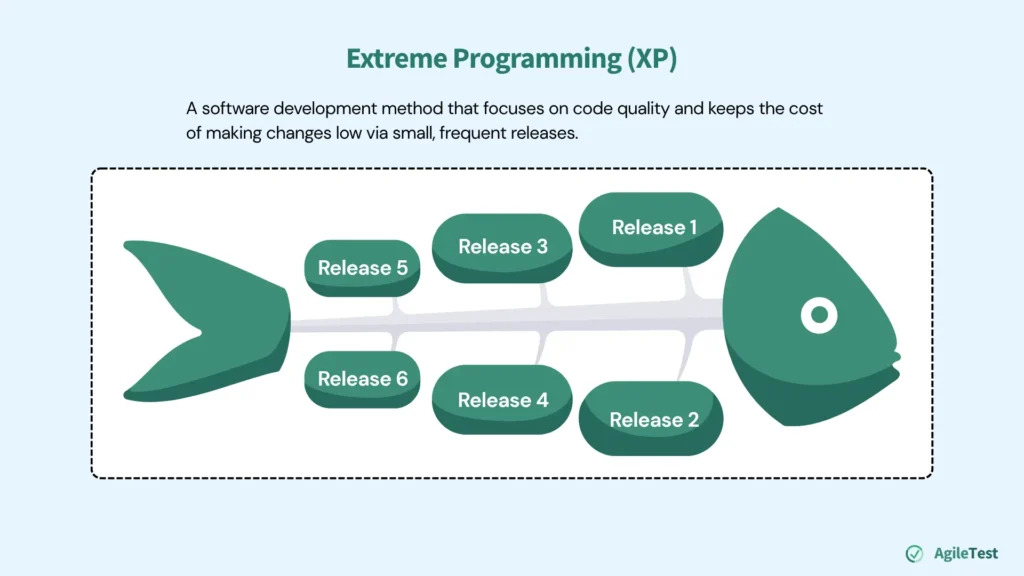
For example, the team could release the login page first. Developers write automated tests that immediately check whether the login works correctly. Testers and developers collaborate daily to fix small issues as soon as they appear. When users report problems, the team can adjust the feature quickly without slowing down the entire project.
“ Similar to other Agile software development methods, XP uses adaptable, test-driven development for software engineering. But unlike other methods, extreme programming has strict rules and guiding values that govern how the work gets done. “
Asana, 2025
XP requires daily discipline, but reduces costly rework and improves results without increasing overall workload. Thus, you can see how XP gets you with better results, not by working harder, but by working smarter.
2. The Five Core Values of XP
The heart of Extreme Programming is not its rules, but the five simple values that guide every decision the team makes.
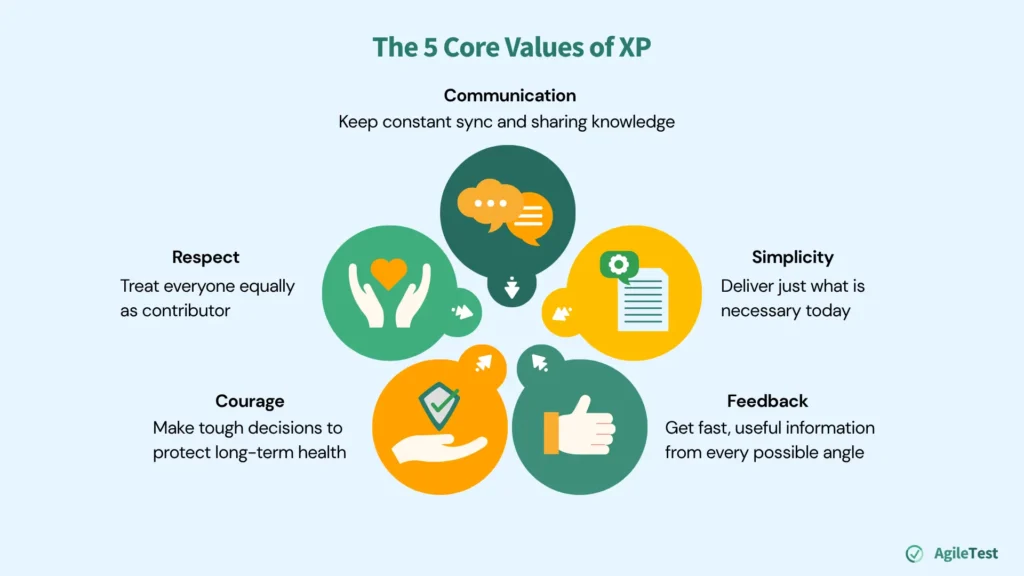
Communication
The value of Communication in XP means keeping the entire team in constant sync and sharing knowledge. It’s not just about talking; instead, it’s about actively making sure everyone has the same understanding at the same time. For example, before writing a feature like the login screen, developers and testers might discuss edge cases, such as what happens when a user enters an expired password or tries to log in from multiple devices. By having these direct conversations early, the team prevents bugs from ever appearing, rather than relying on testers to find them later. Extreme Programming favors direct, simple conversations over creating long, outdated documents, ensuring that all information is always fresh, accessible, and immediately actionable. This clear, continuous flow of information reduces misunderstandings, accelerates problem-solving, ensures quality, and prevents wasted effort fixing issues later.
Simplicity
The value of Simplicity means delivering just what is necessary today and actively avoiding overcomplicating the solution. The rule is: always implement the minimal solution that works. For the login feature example, you should start with only a basic, secure username and password form. Extra features like “remember me” or social logins are on a waiting list until there is a clear, proven need for them. This focused approach keeps the codebase clean, automatically reduces potential bugs, and makes future changes much easier. By focusing only on implementing what is needed, you could avoid wasting time on unnecessary work, speed up delivery, and maintain the flexibility to adapt to new customer ideas without introducing unnecessary complexity.
Feedback
The value of Feedback is all about getting fast, useful information from every possible angle, including the code, the tests, and the users. With the same login feature example, you run automated tests right after coding to catch technical errors immediately. At the same time, you can get early opinions from real users on things like usability and how the page flows. This constant loop of information helps quickly spot minor issues before they become major problems. It allows you to check your assumptions and adjust the feature to exactly meet user needs. By making feedback a critical part of the process, XP ensures that every change is smart and informed, which decreases risk and improves the overall quality of the product. Feedback loops also accelerate learning across the team, allowing adjustments to both code and process quickly.
Courage
The value of Courage is about making tough decisions today that protect the project’s long-term health. In XP, this means being brave enough to solve problems directly. This includes refactoring (cleaning up and simplifying existing code), fixing complex logic, or removing features that don’t add real value, even if that work feels risky or uncomfortable in the short term. For example, a team might spend time cleaning up the old login module, knowing this work could temporarily break existing tests. This takes courage, but the reward is a cleaner, more stable codebase that allows the team to make future changes safely and quickly. Courage ensures the team always prioritizes long-term quality over just finding a short-term, easy solution. It also prevents technical debt accumulation by forcing the team to confront messy code early.
Respect
The value of Respect means treating every team member, stakeholder, and customer as a capable and valuable contributor. In practice, this ensures that developers take feedback seriously and adjust features promptly based on those insights. Respect builds trust, which is essential for open communication. It creates a safe environment where team members feel comfortable sharing new ideas, admitting mistakes, and giving honest input without fear. This collaborative culture isn’t just nice to have; it actively improves quality and speeds up problem-solving and new ideas across the entire project. Respect ensures that all feedback, from testers to users, is acted upon quickly, improving product quality.
3. How XP Improves Testing
XP directly boosts the quality of testing and the final product by making testing a continuous, integrated part of development, not a separate final stage. This is done through three core areas:
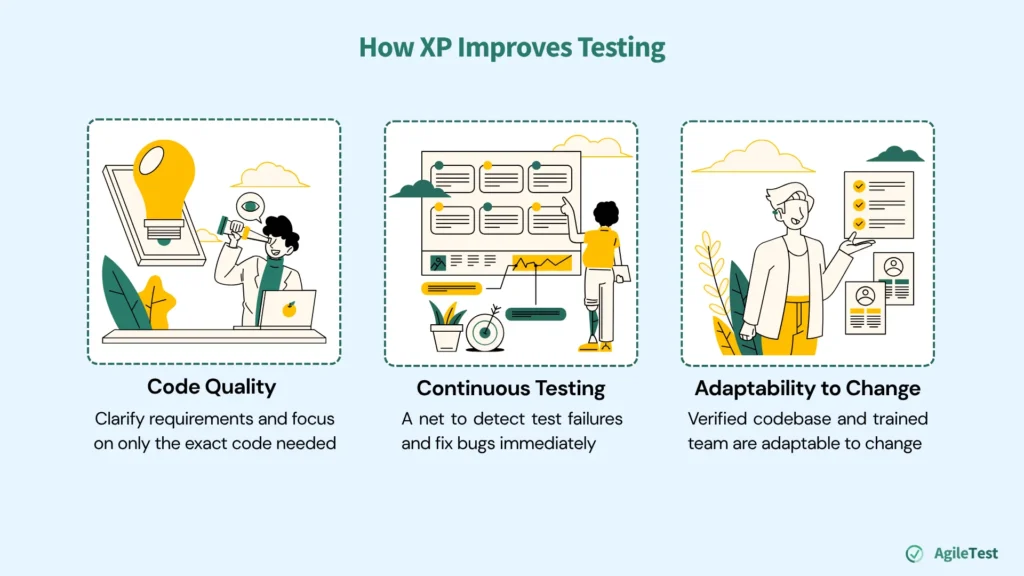
Code Quality
XP makes the code better by encouraging Test-Driven Development (TDD). This is like drawing the map before you start building the road. You need to clearly define what the feature must do before you write any lines of code. For example, before building a login feature, the team first writes the test that says, “If the password is wrong, show an error.” The act of writing the test first makes the requirements clear and forces the developer to write only the exact code needed. This ensures the feature is correct, clean, and simple from the start.
Have a look at our article about Test-Driven Development here: Test-First Development vs. Test-Driven Development
Continuous Testing
Testing in XP is an ongoing activity that acts as an instant safety net. Teams use Continuous Integration (CI), meaning developers frequently combine their new code with the main project. Every single time code is merged, a set of automated tests runs instantly. This way, any small error or defect is caught immediately while it’s still small and easy to fix. It would be like a net to detect test failures immediately, allowing the team to fix them before the bug causes problems elsewhere in the system.
Adaptability to Change
XP helps teams stay flexible and adapt quickly to new ideas or issues. The codebase stays easy to change because of two main reasons: all changes are small and are immediately verified by automated tests. If users request a totally new login method, the team can add it safely because their old tests guarantee the existing features still work. Additionally, Pair Programming spreads knowledge across team members, so anyone can make changes safely without introducing errors, keeping the system adaptable.
By combining these practices—writing tests first, testing constantly, and sharing knowledge—XP guarantees high code quality, verifies the product continuously, and keeps the team quick enough to respond to any new requirement, reducing the costly need to go back and fix old mistakes.
4. Clearing Up the Confusion: What XP Is Not
The name “Extreme Programming” sometimes gives people some misunderstanding about what it is.
Extreme Programming Is Chaotic
The biggest mistake people make is thinking that XP is disorganized or chaotic. In reality, XP requires a high degree of structure and discipline. In fact, the structure is the discipline; it sets clear workflows, defined roles, and consistent practices that guide how the team collaborates and delivers software. Without this foundation, even simple projects can become messy and error-prone.
Once you have established the structure, XP applies disciplined practices like Test-Driven Development (writing tests before code) and Continuous Integration (merging code multiple times a day). These practices thrive because the team already has a clear process to follow. Together, structure and discipline prevent chaos, maintain code quality, and ensure smooth, predictable development.
Extreme Programming Is Only for Small Teams
Another common misconception is that XP only works for small teams and can’t scale to larger projects. While XP is recommended for small groups under 10 members, its practices are scalable. In small contexts, the discipline of Pair Programming (two people working at one computer) is a powerful way for large teams to share knowledge quickly and train new members.
Even in large projects, you can apply XP as part of a hybrid model with Scrum or modular sub-teams for coordination. When multiple teams work on different parts of a system, regular stand-ups and shared test suites ensure everyone stays on the same page. Automated tests, small releases, and continuous integration help catch issues early, preventing them from multiplying across teams. By scaling XP practices thoughtfully, large organizations can maintain quality, speed, and collaboration just like small teams do.
Final Thoughts
Extreme Programming is a powerful framework because it teaches that discipline leads to freedom. By strictly following simple practices like Test-Driven Development (TDD) and Continuous Integration (CI), XP teams lower the risk and cost of change. This stability allows them to be truly flexible and responsive to customer needs. It’s a complete quality system that starts with the code and ends with the customer, ensuring the software isn’t just fast, but fundamentally excellent. By integrating XP values into daily work, teams reduce errors, adapt quickly to feedback, and continuously deliver value with confidence.