

Why do so many software projects run late, cost too much, or deliver a product that customers barely use? The answer often lies in wasted effort, endless waiting, and unclear goals. To solve these common problems, many successful organizations apply Lean Software Development principles (LSD) during their testing process. It acts as an approach to strengthen and offer a strategic mindset for building software with incredible speed, high quality, and minimal waste.
This blog is a straightforward guide to Lean Software Development (LSD), clearing out the misconceptions and fully explaining its core principles to enhance your testing activity.
1. What is Lean Software Development (LSD)?
Lean approach
Lean Software Development (LSD) is an approach that focuses on eliminating waste and maximizing efficiency. It emphasizes delivering maximum value to the customer while minimizing unnecessary work. It shifts the focus from simply being busy to being truly effective.
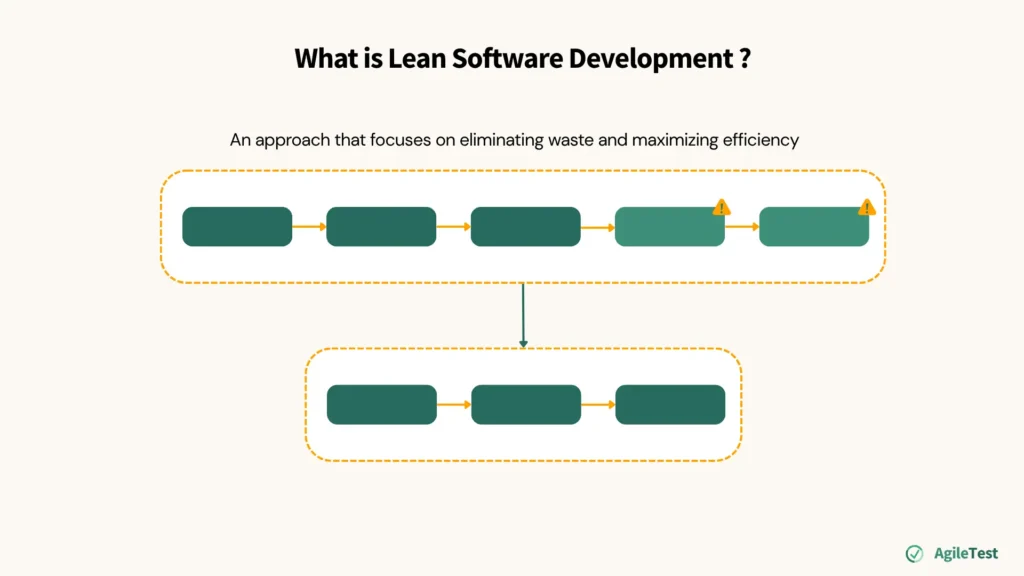
“ Lean methodology facilitates an ongoing process of incremental adjustment, significantly accelerating product delivery by optimizing resources and effort and allowing teams to work efficiently and effectively. “
Atlassian, 2025
How Lean actually works
The Lean approach emphasizes a continuous and rapid flow of value to the customer. Rather than planning a year-long project, Lean encourages breaking down the big work into small, complete units that can move quickly through stages. This approach enables fast feedback from customers and stakeholders, helping the team identify problems, validate assumptions, and adjust priorities in real-time. The team is encouraged to constantly assess their processes and ask one fundamental question: “Does this activity add value for the customer?” If the answer is no, it is considered wasted effort, and the team should eliminate it.
2. The Seven Principles of LSD
The entire Lean philosophy is summarized by seven core principles that guide every decision a software team makes.
Principle 1: Eliminating the Waste
This is the most important principle. In software, waste is defined as anything that consumes time, effort, or resources but does not deliver value to customers. Sometimes this waste can come from separate sources, but it can also be a combination of them both.
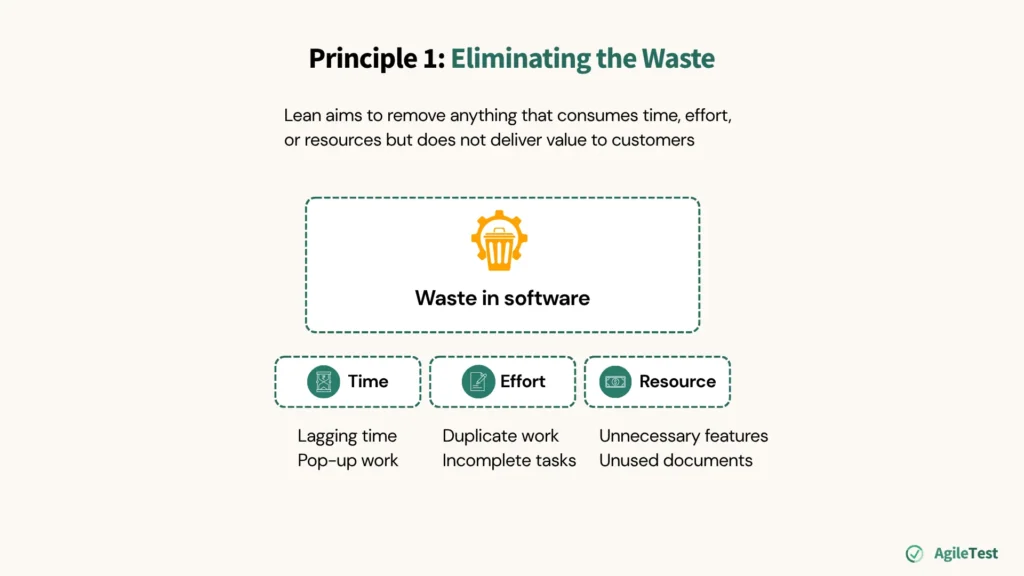
Time
Time waste occurs when finished work sits around, such as when a new feature waits days for review (lagging time). It also happens when your main work gets prolonged by sudden, pop-up tasks. Lean solves this by eliminating steps that don’t add value and establishing fast feedback loops. By continuously reviewing priorities and tracking how much work is in progress at each stage, teams can move important tasks forward without waiting. This approach keeps work efficient, prevents interruptions and delays.
Effort
Effort waste occurs when work needs to be redone or duplicated. This often happens when initial tasks are incomplete, instructions are unclear, or multiple team members tackle the same problem in different ways. Lean addresses effort waste by breaking a big requirement into smaller tasks, thus ensuring members can understand what to do with more detailed instructions. Practices like limiting the number of work in progress (WIP) at a time can further reduce rework and keep effort targeted.
Resource
Resource Waste arises from building unnecessary features that customers don’t need or producing documents nobody reads. Lean encourages delivering only what adds real value, preventing wasted effort on unnecessary functionality. With careful planning, aligning all work with verified customer needs, and continuously reviewing priorities, you can ensure resources are invested wisely
By finding and removing these wastes, you make sure that everything your team does leads to real results and gives the customer the most value.
Principle 2: Fast Delivery
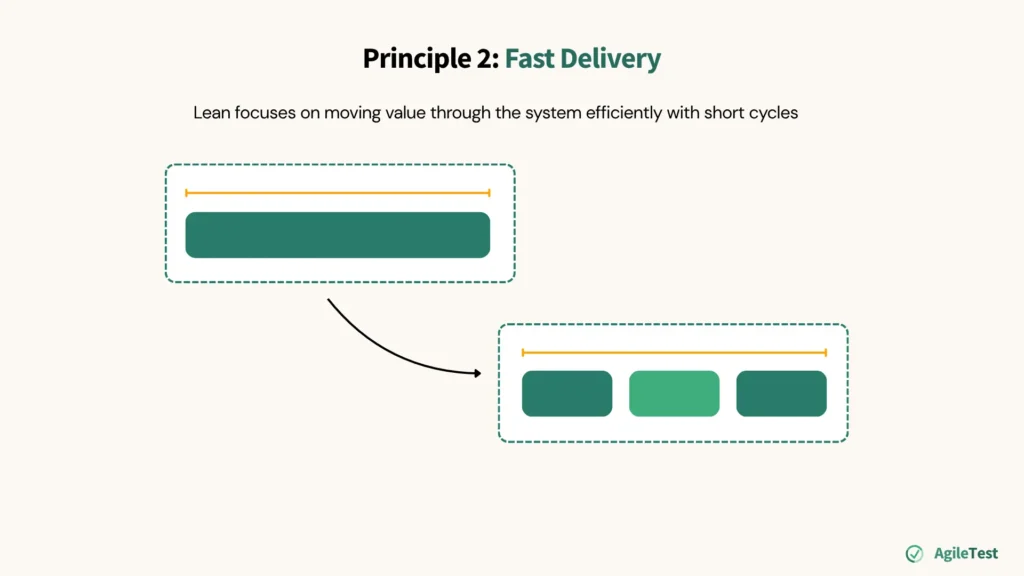
Fast delivery isn’t just about working faster; it’s about moving value through the system efficiently. Lean emphasizes maintaining a smooth flow of value through the process. Teams focus on delivering small, complete pieces of work that can be finished and receive feedback quickly. For example, when working on the login page, you can deliver a functional login form early, even if it doesn’t have the “remember me” feature yet. This provides value to the customer right away, as they can start using the login feature while the remaining functionality is completed.
Short delivery cycles enable rapid feedback from users and stakeholders, helping the team identify problems, improve the product, reduce risk, and keep the development process aligned with customer value. With those continuous short cycles, teams ensure that every piece of work, little by little, contributes real value to the customer. That’s how you can move value faster through the process.
To maintain fast delivery, teams leverage tools such as continuous integration, which merges code frequently to detect issues early, and automated testing, which constantly verifies code quality. By integrating these practices, teams catch defects sooner, reduce the risk of breaking existing functionality, and maintain a stable codebase. This allows teams to respond quickly to changes and improve the product continuously.
Refer to our related article about Automated testing here: Automated Testing vs. Manual Testing: The Ultimate Showdown (Or Why They’re Actually BFFs)
Principle 3: Amplify Learning
Amplify Learning recognizes that software development is a continuous journey of discovery; rarely do you know everything at the start. Customer needs, market conditions, and technical realities evolve constantly, so Lean sets up processes to maximize learning from every step. For instance, when testing the login method, user feedback reveals that the login button placement is causing confusion and is hard to locate, so the team can know what to focus on to improve the user’s real experience journey.
Fast delivery (Principle 2) gets the product value into users’ hands quickly; Amplify Learning focuses on what happens afterward. If a feature doesn’t work as expected, Lean treats it not as a failure, but as a valuable lesson. Teams learn quickly and inexpensively, adjusting assumptions and improving the next iteration. Short feedback loops enable rapid validation, reduce risk, and ensure each new piece of work builds on lessons learned, making the process smarter and more informed over time.
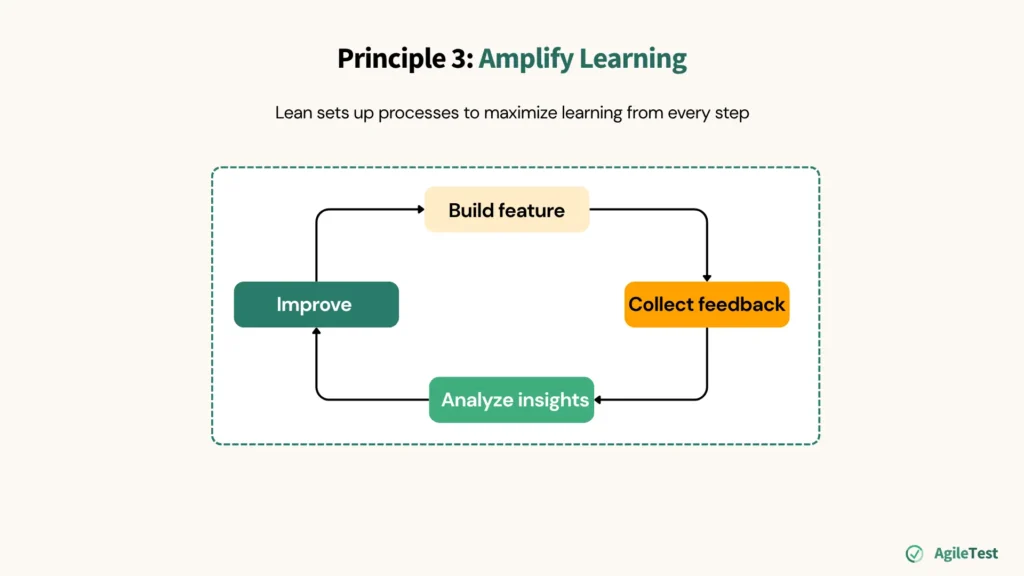
To put continuous learning into practice, teams can gather feedback through user behavior tracking, analytics dashboards, or direct feedback channels. These data help you identify what worked, what didn’t, and why. Over time, this continuous learning loop ensures that every decision is guided by real-world evidence, reducing risk and accelerating the team’s understanding of user needs.
Principle 4: Built-in Quality
Built-in Quality can be simplified: you can’t check quality at the end; you have to build it in from the start. This principle means that teams must create a quality process that detects and fixes errors when found, rather than relying on a big testing phase at the end to solve them all. The goal is to detect and fix errors at the source, when they are still small and inexpensive to correct. This prevents costly rework later, which is one of the most significant forms of waste in software development.
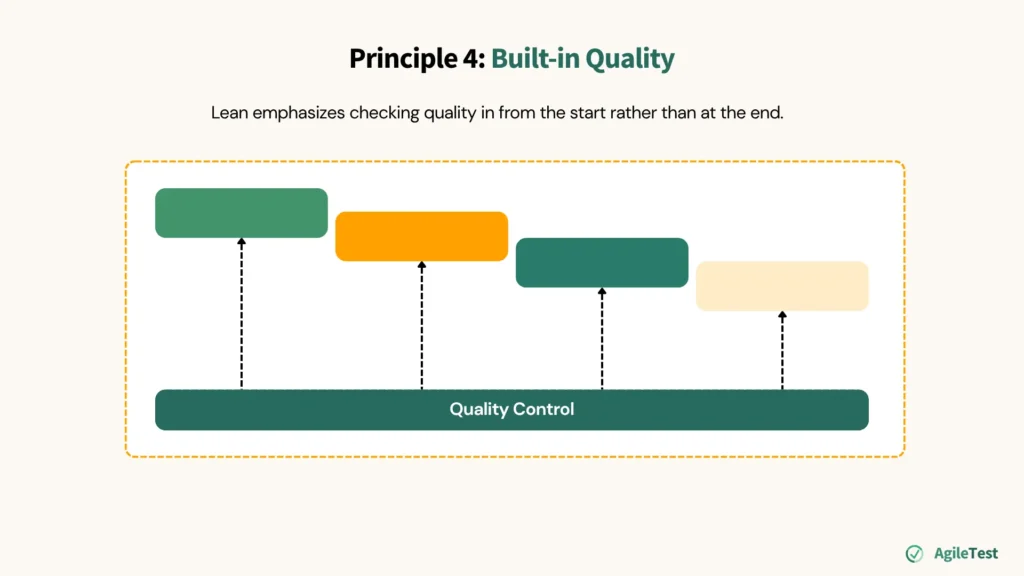
Teams achieve this principle by embedding quality checks throughout the process, using practices like automated testing, continuous integration, and reviews to verify if any issues arise. When every team member takes responsibility for the quality of their own work, the software becomes more stable, reliable, and easier to maintain. This approach transforms quality from a final inspection step into a continuous, shared responsibility, creating a feedback loop that allows the team to learn from mistakes, improve processes, and consistently deliver higher-quality software.
Principle 5: Respect Teamwork
Respect Teamwork defines that people are the most valuable asset in the development process. Lean emphasizes respect for every team member. It shifts away from top-down management and instead empowers the team to identify problems, make decisions, and continuously improve their work. Team members are treated as knowledgeable experts, not just parts in a machine. When people feel respected and valued, they are motivated to contribute their best ideas, driving innovation and helping the team uncover and eliminate hidden waste more effectively.
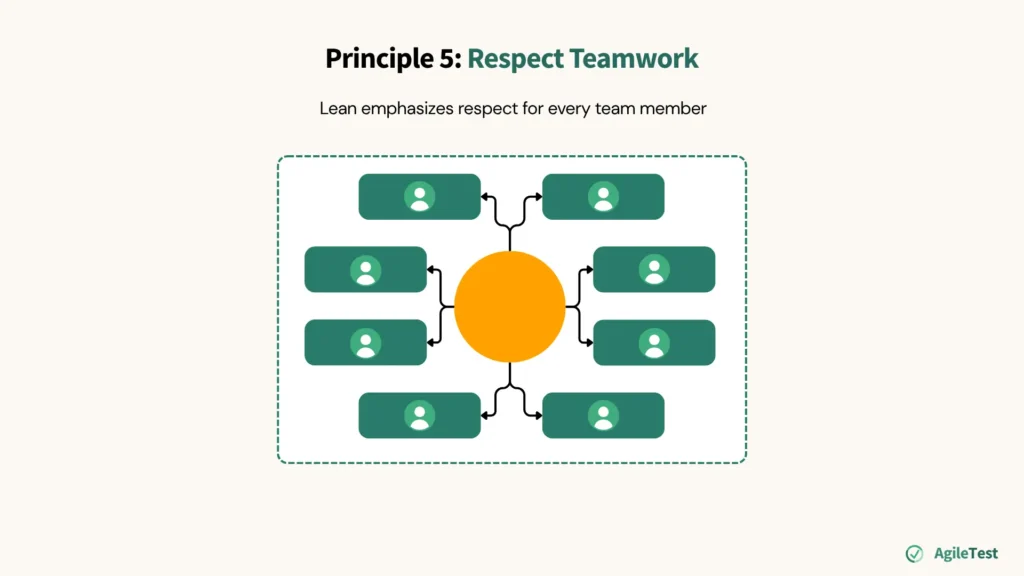
To achieve the Respect Teamwork principle, teams must create a culture of trust, autonomy, and collaboration. Encouraging cross-functional collaboration between stakeholders (developers, testers, and product owners) ensures that business needs are aligned early on. Providing the right tools and resources helps team members work efficiently while allowing flexibility for innovation. Regular retrospectives and recognizing individual contributions help maintain motivation and continuous improvement. When teams feel respected and valued, they are more driven to contribute their best ideas and eliminate hidden waste.
Principle 6: Delay the Commitment
Delay the Commitment is about making decisions at the right time, when enough information is available, to avoid unnecessary risks and waste. Lean encourages teams to avoid rushing into decisions too early, especially when there are uncertainties. By waiting until the “last responsible moment“, teams can gather more data, test assumptions, and ensure they make the best possible decision.
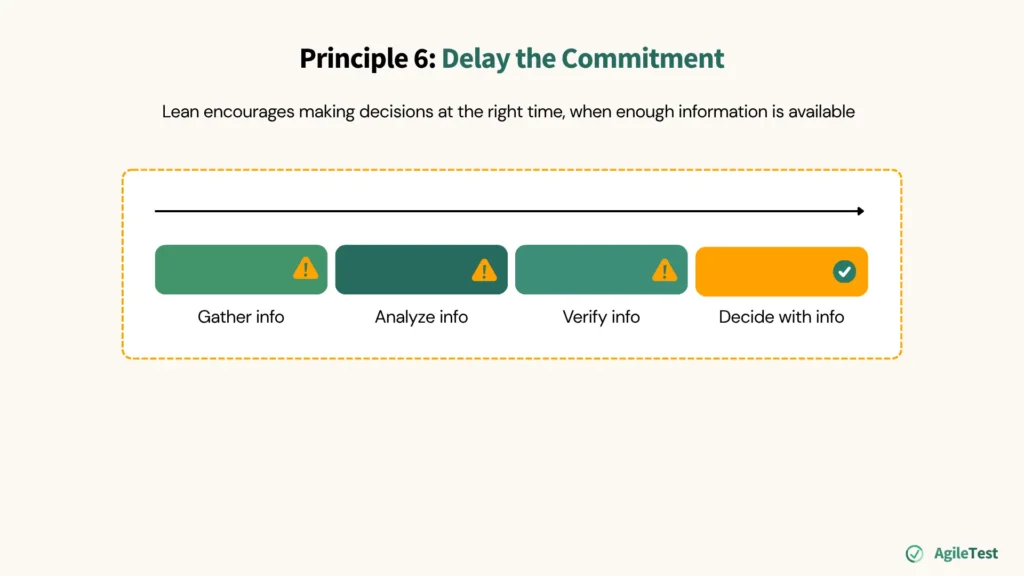
To apply Delay the Commitment principle, teams should embrace flexibility and remain open to new information throughout the development process. Rather than locking in a solution upfront, you could apply iterative planning and continuous discovery. By delaying major commitments until the team has enough clarity, you can avoid unnecessary rework and ensure the final solution aligns with actual user needs. This principle helps teams manage uncertainty, minimize waste, and maximize value.
Principle 7: Optimizing the Whole System
The principle of Optimizing the Whole System focuses on improving the entire value stream rather than just individual parts of the process. In Lean, success isn’t measured by the performance of a single team or department, but by the efficiency and effectiveness of the whole system. This principle encourages teams to break down silos, collaborate across functions, and look at the big picture.
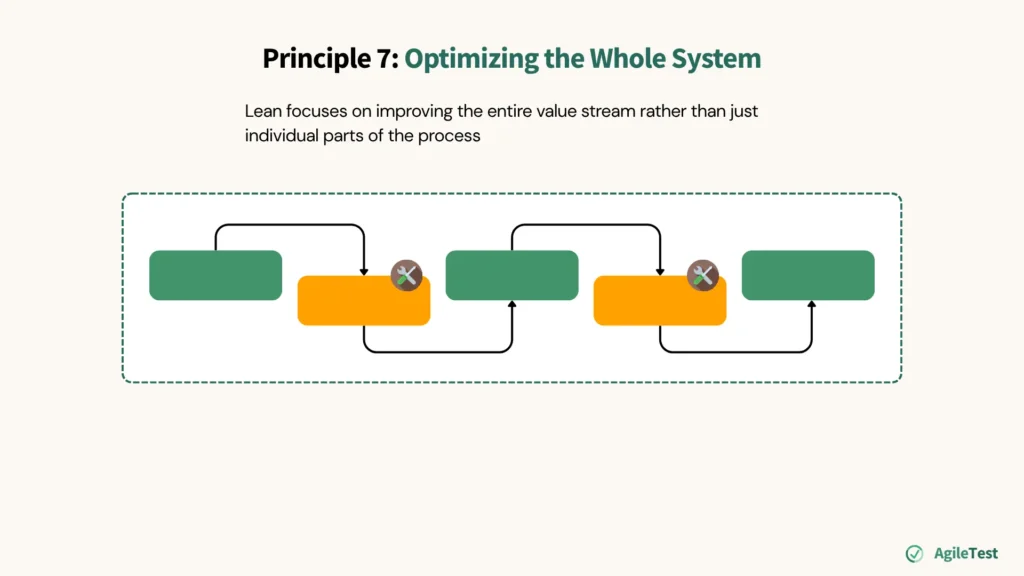
To apply this principle, teams should collaborate regularly, share knowledge across departments, and focus on the end-to-end process rather than just their individual tasks. By doing so, they can streamline operations, eliminate unnecessary steps, and ensure the system works as efficiently as possible. Ultimately, optimizing the whole system leads to faster delivery, higher-quality products, and better value for the customer.
3. What may be misleading about the Lean approach
After diving into the principles, it’s important to clear up a few common misunderstandings about what the Lean approach actually is.
Lean Focuses on Value, Not Just Speed
Many people think the Lean approach is just about rushing the team to work faster, but that’s not the case. If you deliver bad work quickly, you just create more problems later. The real goal of Lean is to make things move faster and get feedback sooner. It’s about reducing the time a feature spends waiting, whether it’s for approval, testing, or deployment. The speed comes from cutting out delays and unnecessary steps, not from pushing people to work faster.
Lean Requires Structure and Discipline
Since the Lean approach focuses on flexibility and change, some people believe it means there’s less planning or structure. In reality, it’s quite the opposite. Teams need to set up clear and actionable goals to follow and maintain the working discipline during the process. You need to define the number of tasks that need to be focused on at a time. If there is too much work to do, everyone will be overscoped. If there are too few, you expand the project timeline. Thus, you should keep track of their tasks clearly, and only focus on a limited number of tasks at a time. This prevents the team from chasing quantities rather than qualities.
Lean is Not Just About Cost-Cutting
While Lean helps reduce costs by cutting unnecessary work, its main goal isn’t just saving money. The focus is on delivering maximum value to the customer. By concentrating only on the features that customers truly need, you avoid wasting time and resources on things that aren’t valuable. This focus on value leads to long-term cost savings, rather than just cutting current budgets.
Final thoughts
Lean Software Development is ultimately a mindset for continuous improvement. It asks teams to be disciplined in their pursuit of simplicity and ruthless in their elimination of waste. By applying the seven principles—from cutting out non-essential documentation to delaying big decisions—teams can create a culture focused on flow, quality, and genuine customer value. Embracing Lean doesn’t just make your process better; it fundamentally changes the way you build software for the better.