
You’ve done it. You’ve assembled a software testing team. You have a mix of experienced veterans and eager newcomers, and you’re ready to tackle your next big project. But as you dig in, you start to notice a few things. Perhaps your team is fantastic at exploratory testing but struggles with building a robust automation framework. Or maybe they are technical wizards but have a hard time communicating the business impact of a defect to stakeholders.
If this sounds familiar, don’t worry. It’s completely normal. The reality is that you will almost never start a project with a team where every single person has the exact skills required. The goal isn’t to find a group of mythical, “perfect” individuals. The goal is to build a strong, balanced team where strengths and weaknesses are complemented, and more importantly, where everyone has the opportunity to grow.
But how do you turn those skill gaps into strengths? It all comes down to a deliberate, thoughtful approach to competence development. This guide will walk you through how to first identify your team’s needs and then explore five powerful, proven strategies to foster continuous growth and build a truly world-class QA team. 🌟
The First Step: Charting Your Course with a Skills Matrix
Before you can plan a journey, you need a map. In the world of team development, your map is a skills matrix. This simple but incredibly effective tool helps you get a clear, objective snapshot of the skills your team currently possesses versus the skills your project actually needs.
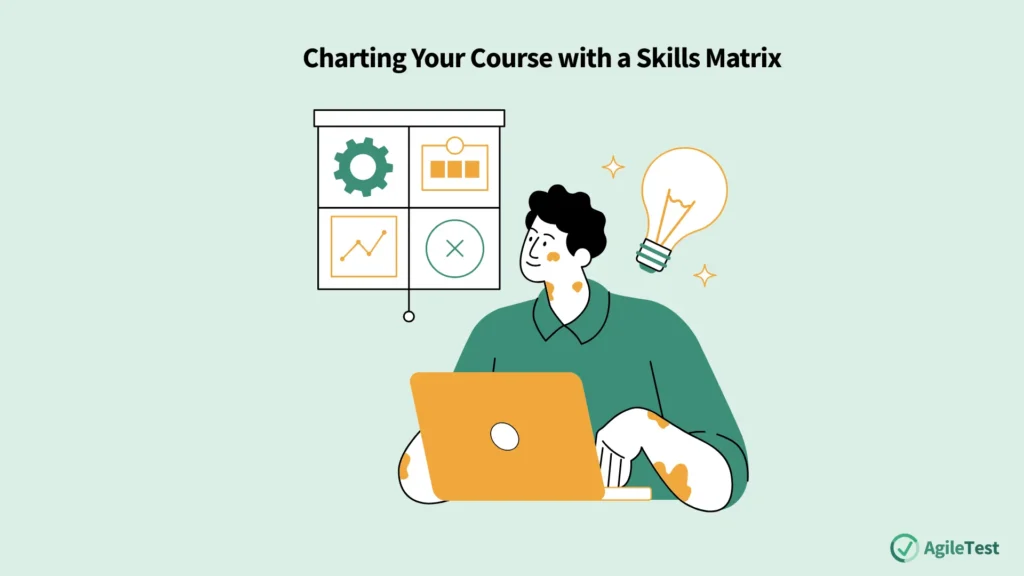
Think of it as a grid. Along one axis, you list your team members. Along the other, you list the critical skills required for success. These skills should cover all three pillars of a great tester:
- Professional/Methodological Competence: This includes hard skills like test automation (e.g., Selenium, Cypress), performance testing (e.g., JMeter), API testing, SQL, and knowledge of specific test techniques.
- Social Competence: This covers soft skills like communication, defect reporting, collaboration with developers, giving and receiving feedback, and conflict resolution.
- Personal Competence: This includes attributes like curiosity, problem-solving, self-management, resilience, and a willingness to learn.
Refer to our related guide about test team skill here: Building a Dream Team: The Ultimate Guide to Essential Test Team Member Skills
Once you have your grid, you can work with your team to rate each person’s proficiency in each area, using a simple scale (e.g., 0 = No Knowledge, 1 = Beginner, 2 = Competent, 3 = Expert).
The result is a powerful visual a “heat map” of your team’s collective abilities. You can immediately see where your strengths lie and, more importantly, where the development needs are. This data-driven approach removes guesswork and allows you to choose the most effective and efficient development strategies.
5 Powerful Approaches to Competence Development
With your skills matrix as your guide, you can now implement a targeted development plan. Here are five powerful approaches you can mix and match to build a well-rounded and highly skilled team.
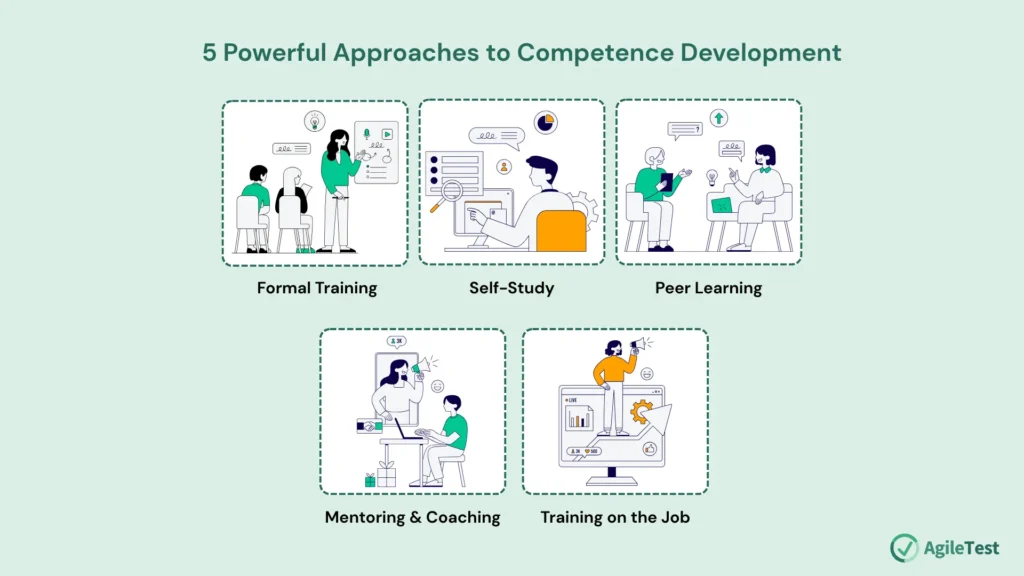
1. Formal Training and Education: Building a Strong Foundation
This is the most traditional approach, involving structured learning delivered by experts, usually in a virtual or physical classroom setting. It’s an excellent way to introduce foundational knowledge or complex new topics in a systematic way.
What it looks like:
- Sending team members to public training courses or industry conferences.
- Hiring an expert to conduct in-house training sessions tailored to your team.
- Utilizing live e-learning courses and workshops.
Best for developing: Professional and Methodological Competence. Formal training is fantastic for getting everyone on the same page. For example, having your team participate in ISTQB® (International Software Testing Qualifications Board) training is a brilliant way to establish a common vocabulary and understanding of testing principles and practices. This ensures that when one tester talks about “boundary value analysis,” everyone else knows exactly what they mean.
The trade-off: While highly effective for theoretical knowledge, formal training can be expensive and may not always be directly applicable to the unique challenges of your specific project.
2. Self-Study: Empowering Individual Growth and Proactivity
Self-study is all about empowering individuals to take control of their own learning journey. In our fast-paced industry, the ability to learn independently is a superpower. This approach fosters a culture of curiosity and personal responsibility.
What it looks like:
- Reading books and industry blogs.
- Watching recorded conference talks, webinars, and YouTube tutorials.
- Working through online courses on platforms like Udemy, Coursera, or Pluralsight.
- Diving deep into the official documentation for a new tool or technology.
Best for developing: Professional and Methodological Competence. Self-study is incredibly efficient for targeted skill acquisition. If your project requires the team to learn a new automation framework like Playwright, self-study allows motivated individuals to get up to speed quickly and at a low cost. Providing a budget for books or a subscription to an online learning platform can yield a massive return on investment.
The trade-off: Self-study requires a high degree of discipline and self-motivation. It also lacks the immediate feedback and social interaction that can be crucial for reinforcing learning and developing softer skills.
Discover how you can gain insight from data and improve your testing process here: From “I Think” to “I Know”: A QA Manager’s Guide to Analytical Test Process Improvement
3. Peer Learning: The Power of the Collective 🤝
Never underestimate the wealth of knowledge that already exists within your team. Peer learning is the process of creating channels for that knowledge to be shared freely, where colleagues learn with and from each other. It’s one of the most organic and effective ways to elevate the entire team’s skill level.
What it looks like:
- Lunch & Learns / Brown Bag Sessions: Informal weekly or bi-weekly meetings where one team member presents on a topic they’ve been exploring, from a new testing tool to a book they’ve read.
- Pair Testing: Two testers working together at one computer to test a piece of functionality. This is a fantastic way to share domain knowledge, testing techniques, and different perspectives in real-time.
- Code Reviews: For automation testers, having peers review test scripts is an essential practice for ensuring quality, sharing best practices, and learning new coding techniques.
- Internal Chat Channels: A dedicated Slack or Teams channel where people can ask questions, share interesting articles, and help each other solve problems.
Best for developing: A healthy mix of Professional and Social Competence. Team members can share technical tips and tricks while simultaneously practicing their communication, collaboration, and feedback skills.
The trade-off: Peer learning needs to be fostered deliberately. It requires creating a psychologically safe environment where people feel comfortable asking “dumb questions” and admitting what they don’t know.
Have a look at the Stakeholder matrix with our article: Who’s in Your Corner? A Developer’s Guide to the Stakeholder Matrix
4. Mentoring and Coaching: Guided Expertise
This approach provides individualized guidance to help team members grow. While often used interchangeably, mentoring and coaching are slightly different but equally valuable.
- A mentor is typically a more experienced person who shares their knowledge, skills, and experience to help a mentee navigate their career path.
- A coach focuses more on helping an individual unlock their own potential, asking powerful questions and providing feedback to improve their performance in specific areas.
What it looks like:
- Mentoring: A senior test architect mentors a mid-level tester who wants to improve their test strategy and design skills, meeting regularly to review plans and offer advice.
- Coaching: A test lead coaches a junior team member on how to deliver more effective and diplomatic defect reports, perhaps by role-playing conversations with developers.
Best for developing: All three skill pillars, but it is especially powerful for Social and Personal Competence. As the provided content notes, skills like communication, leadership, and conflict resolution are best developed through social exchange, feedback, and reflection. Self-study can teach you the theory of empathy, but a great coach or mentor can provide the feedback you need to actually practice it.
The trade-off: This approach requires a significant time commitment from your senior team members, so it’s important to recognize and reward that investment.
5. Training on the Job: Learning by Doing
Training on the job is perhaps the most practical and holistic approach of all. It’s not a single method but rather a blend of the others, applied directly within the context of daily work. It’s where theory meets practice.
What it looks like:
- A tester is tasked with a new challenge, like setting up security scanning tools for the first time. They will engage in self-study to learn the basics, get help from a peer who has some security experience, and receive ongoing guidance from their mentor or lead. They are learning and delivering value simultaneously.
Best for developing: A comprehensive skill set. It grounds theoretical knowledge in real-world application, which is one of the most effective ways to make learning stick. It’s the ultimate “learn-by-doing” environment.
The trade-off: To be effective, on-the-job training must be intentional. Simply throwing someone into the deep end without support is not training; it’s a recipe for burnout. It must be a structured experience with clear goals and access to resources like peers and mentors.
Choosing the Right Tool for the Job
As we’ve seen, not all development approaches are equally effective for all types of skills. The key to success is creating a blended learning program that uses the right tool for the job.
- To build Professional and Methodological Competence (the “what you know”), a combination of Formal Training (for fundamentals like ISTQB®), Self-Study (for specific tools), and Peer Learning (for practical tips) is a winning formula.
- To cultivate Social and Personal Competence (the “how you act” and “who you are”), self-study is far less effective. Here, you should lean heavily on interactive approaches like Mentoring, Coaching, and collaborative workshops that emphasize social exchange, feedback, and reflection.
Try out AgileTest, a unified tool that helps you keep track and manage your test cases effectively.
Conclusion: An Investment in Quality
Building a dream test team is not a one-time hiring activity; it’s a continuous journey of growth and development. It begins with understanding where you are by using a skills matrix and then thoughtfully applying a mix of strategies—from formal training to peer mentoring—to close the gaps.
By investing in your team’s development, you’re doing more than just improving individual skills. You’re building a resilient, adaptable, and highly motivated team. You’re fostering a culture of quality and continuous improvement that will pay dividends in the long run, leading to better processes, better products, and a better work environment for everyone.
Frequently Asked Questions (FAQ)
Q1: What is a skills matrix and why is it important for a QA team?
A skills matrix is a tool used to map the skills of team members against the skills required for a project. It’s crucial because it provides a clear, data-driven view of your team’s strengths and weaknesses, allowing you to create targeted and efficient training plans instead of guessing what your team needs.
Q2: What is the most cost-effective way to develop my test team’s skills?
Self-study and peer learning are typically the most cost-effective methods. Encouraging your team to share knowledge through lunch & learns and providing access to online resources can deliver huge value with minimal financial investment.
Q3: How can I improve my team’s “soft skills” like communication?
Soft skills are best improved through interactive methods. Mentoring, coaching, and workshops that involve role-playing and direct feedback are far more effective than just reading a book. Pairing a junior tester with a senior tester who excels at communication is also a great on-the-job approach.
Q4: Is getting my team ISTQB® certified really worth it?
For many teams, yes. The primary value of ISTQB® certification is that it provides a standardized, industry-recognized foundation of testing terminology and principles. This creates a common language within your team and across the organization, reducing misunderstandings and improving the efficiency of your testing processes.