
Test automation has become essential in the Agile universe to quickly reduce repetitive and manual test workload. While there are countless tools available for automating tests, simply picking a tool isn’t enough. The framework you choose to build your automation on is what truly determines the long-term success of your efforts.
This blog will explore what a test automation framework is, dive into the most common types, and provide a clear guide on how to choose the right one for your project.
1. What Is a Test Automation Framework?
A test automation framework is a set of rules, guidelines, and tools that provides a structured approach to organizing and managing your automated tests. It is not a testing tool itself, but rather a system that makes the use of those tools more efficient. Without a framework, automated tests would be a disorganized collection of scripts, making them difficult to maintain, trace back, reuse, and manage. The framework provides the structure for test scripts, stores test data separately, and handles reporting, creating a consistent and repeatable process that saves time and effort.
Have an overview of test automation with our article: What is Test Automation? and Its Practice with AgileTest.
“ Test automation frameworks are crucial for organization, maintenance, reusability, and scalability. They centralize test assets, simplify updates when software changes, promote the reuse of scripts across different functions, and allow efficient scaling of tests for various scenarios, improving overall test accuracy. “
Katalon Team, 2025.
2. Types of Test Automation Frameworks
There are several types of frameworks, each with its own strengths and weaknesses.
Linear framework
The Linear framework, often called record-and-playback, is the simplest. In this approach, testers manually conduct the testing activities on the first test. During this run, a testing tool records every single one of their actions (including clicking, typing, etc). For the following re-run sessions, the recorded sequence of actions is played back automatically by the tool based on what testers have conducted from the first run.
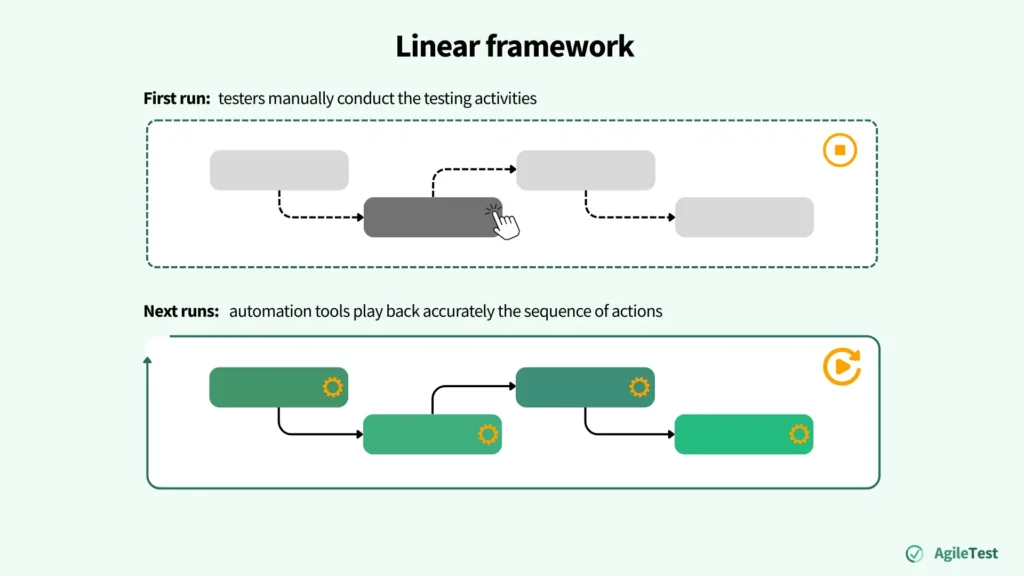
This approach is best for small projects or simple tests where ease of use is more important than flexibility. It helps you automate repetitive tasks with minimal coding knowledge requirements. However, because the tool records steps only from the first run, it cannot provide sufficient test coverage in the long run. Testers usually use it to reduce manual workload during early test runs and shift their focus to other important tasks, such as preparing detailed new test steps.
Keyword-Driven framework
In a Keyword-Driven framework, you create your test cases with keywords. First, you need a set of simple keywords that represent actions, like “click” or “enter.” This list should be usable for multiple tests. Then, you have to set up a keyword spreadsheet. You pick up the keywords from your sets and follow a sequence of test actions. After that, you add a Function column to describe the exact action to be performed. For example: “clickbutton[login]”, clickbutton[sign_up]”. Optionally, you can have another Description column in your spreadsheet to clarify the action (“User hit the login button”). Now, you have finished the manual setup stage. You can use automatic test tools to read the spreadsheet data and run the test cases.
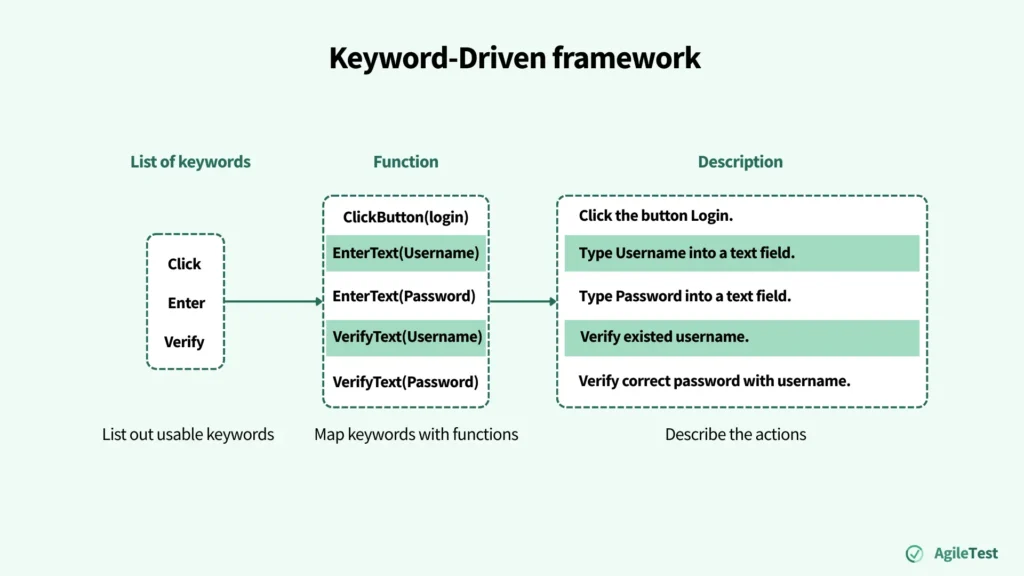
This approach is suitable for a scalable and maintainable process in a medium to large-sized project. Because the test cases are built from keywords, adding more cases is much easier compared to the coding method. Also, since you have a clear test logic, when a test fails or needs updates, you can save more time on debugging by simply locating your logic in the spreadsheet instead of code lines. In addition, the use of easy-to-understand keywords enables effective collaboration between technical and non-technical team members. Unfortunately, it requires you to spend time on the manual setup stage before automatically executing the tests. Therefore, you can consider this framework when the team includes fewer technical members or wants to reduce coding effort.
Data-Driven framework
A Data-Driven framework focuses on externalizing the test data and running the same tests with different sets of data. You will conduct the same manual setup as the keyword-driven approach. Then, you need to prepare different sets of test data. That data needs to be stored externally, like another sheet, database, etc, to separate from your test logic. Now, you make use of automatic test tools to run your test with each set of test data, one by one.
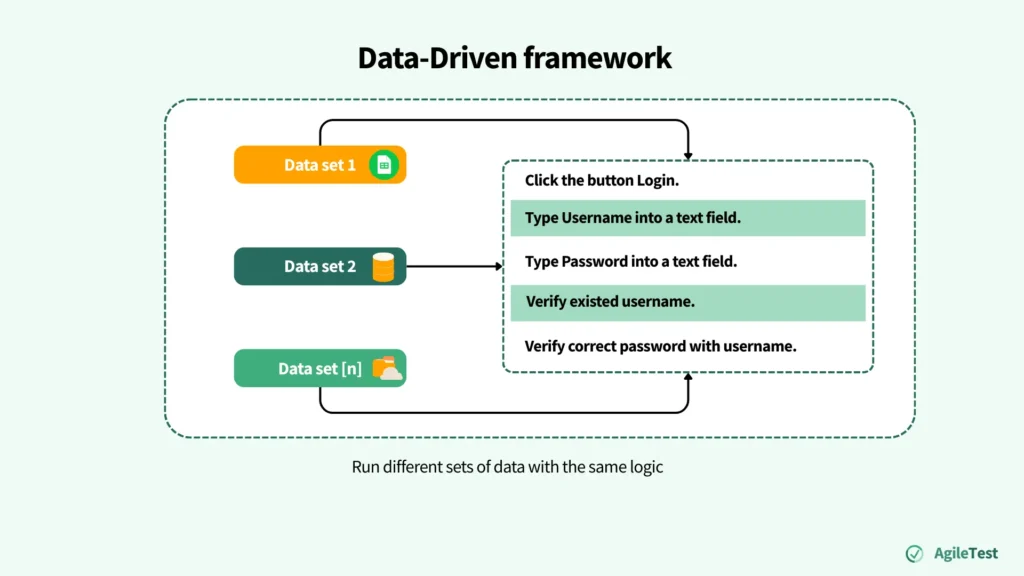
This is ideal for when you need to run the same tests for many different data sets, such as testing a login page with 100 different usernames and passwords. Instead of writing a new test script for every scenario, you write a single, reusable test script for the core process. However, when your data gets larger and larger, it would be hard to keep track of and maintain. This framework is more suitable for medium-sized projects where multiple data sets need testing and the data size is under your control, helping to ensure comprehensive coverage across different input combinations.
Modular framework
The Modular framework breaks down tests into smaller, independent, and reusable modules. A module refers to a self-contained, reusable unit that performs a specific task or group of related tasks within a test. These modules are typically created to handle common, repetitive actions that appear across multiple test cases. For example, a “login” module might include steps like entering a username and password, clicking the login button, and verifying the login was successful. When you have a test case about checkout that needs users to log in, you don’t have to write these login steps again, but would rather make use of the login module and continue with other test steps.
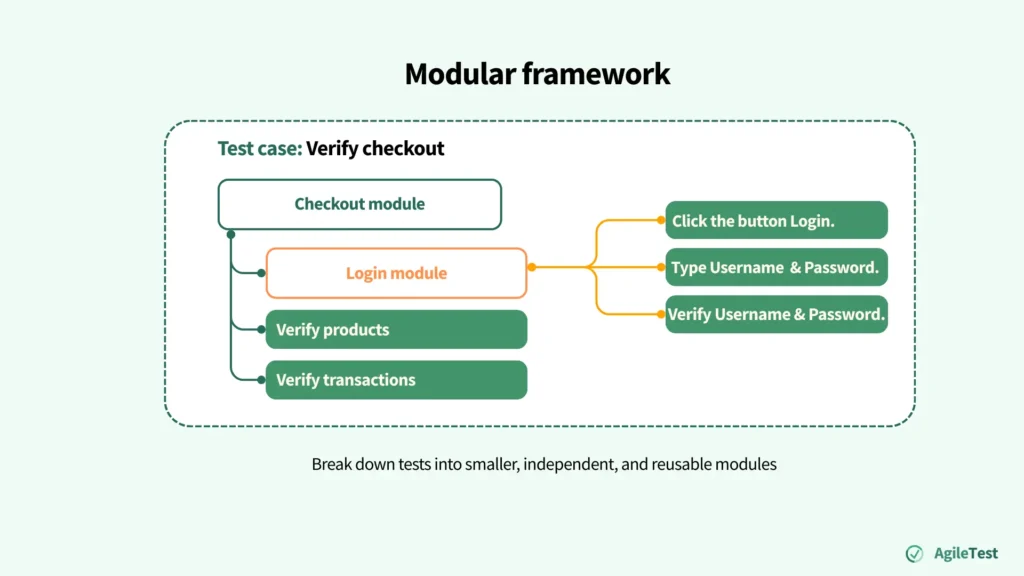
This approach is best for large projects because it requires your time and investment before actually harvesting. Initially, you need to establish your simple modules from scratch. Little by little, these modules enrich your test case pool, and then you can reuse them to save lots of preparation time. In addition, since every module performs a different task or a group of tasks, you can easily trace back to debug. This is a good option to apply through the long test process, since you can have enough time to accumulate and refine your modules. For smaller and shorter-term projects, you may not need to build up a large quantity of modules; you can just choose another simple approach.
Hybrid framework
A Hybrid framework combines two or more frameworks into a single one. The goal is to leverage the strengths of each approach while minimizing its weaknesses. For instance, you might use keyword-driven methods for non-tech readable and maintainable test steps, and a data-driven approach to run the same scripts with multiple data sets.
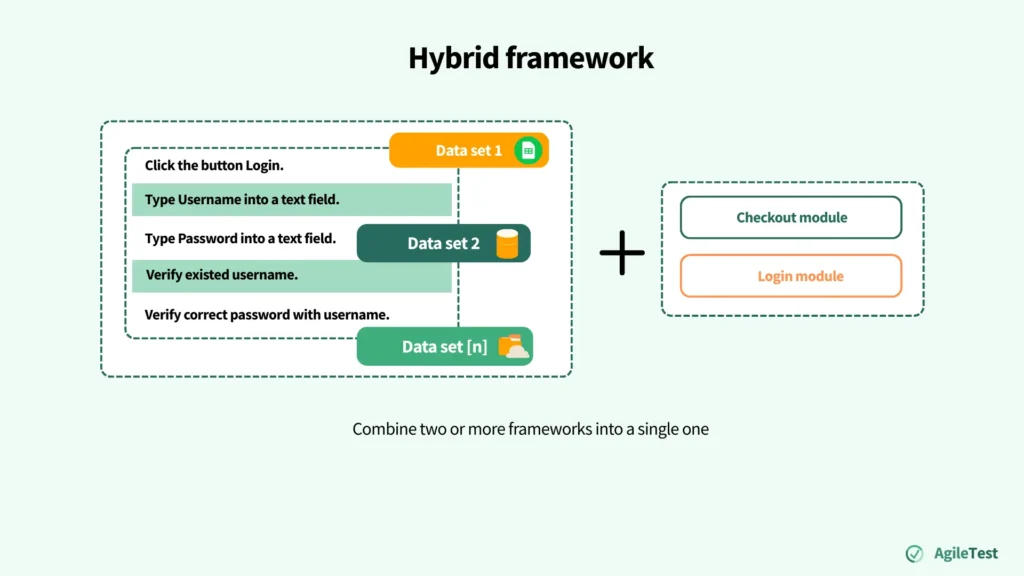
The Hybrid framework is the most popular choice for medium to large projects. By combining frameworks, teams can achieve reusable, maintainable test scripts while handling multiple data sets efficiently. Yet, managing a Hybrid framework requires careful planning and coordination to avoid complexity. It can be applied in those projects when you need flexibility, scalability, and comprehensive coverage across different test types.
Behavior-Driven Development framework
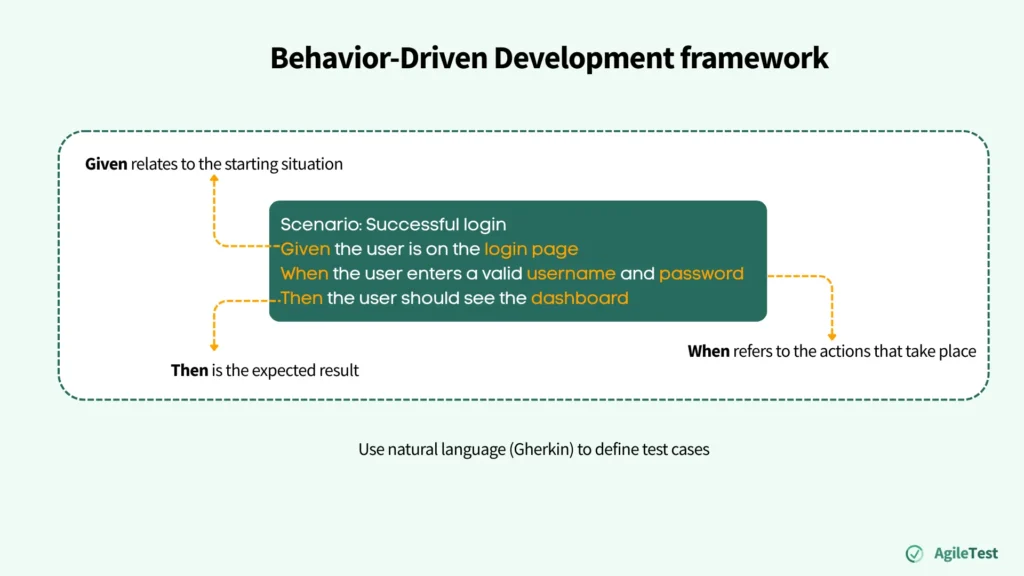
Finally, the Behavior-Driven Development (BDD) framework uses natural language to define test cases instead of technical scripts. The first step is the collaboration session, often called a “Three Amigos” meeting, where the product owner, a developer, and a tester work together to define the feature’s behavior in plain language (Gherkin). Each scenario describes the expected behavior of the system in terms of “Given-When-Then” steps. Under Gherkin format, the “Given” relates to the starting situation, the “When” refers to the actions that take place, and the “Then” is the expected result. But the automation tool cannot understand plain language, so you need to write step definitions – some pieces of code that instruct the tool to perform each step.
Scenario: Successful login
Given the user is on the login page
When the user enters a valid username and password
Then the user should see the dashboard
In some way, you can see that the BDD is quite opposite in the setup from the Keyword-driven approach. The BDD makes your test cases into written stories, so that even non-tech members can easily understand them from the very beginning. But you will have to write code to instruct automation tools on how to execute each step. On the other hand, for the keyword-driven method, you have to establish a basic understanding of the feature you want to test before writing a logical series of test actions. In exchange, you can put the rest of the execution for automation tools.
BDD works best for medium to large projects when you need clear communication between technical and non-technical stakeholders. It is ideal for agile environments where changes take place frequently and close collaboration between testers, developers, and product owners is key.
3. Criteria to Choose the Right Test Automation Framework
Choosing the right framework requires a careful look at your project and team, as the best choice is a direct reflection of your specific needs.
First, consider the project’s size and complexity. A smaller project with a simple, contained scope might work well with a straightforward approach like a Linear framework, where the ease of initial setup outweighs the need for long-term scalability. In contrast, a large-scale enterprise application with many features and constant updates demands a more complex solution. For these projects, a Modular or Hybrid framework is a more logical choice because they are built to handle complexity and are easier to maintain over time.
Next, you must evaluate your team’s skillset and dynamics. You should select a framework that empowers your team, whether you have experienced developers, a mix of testers and developers, or non-technical members who need to contribute. For instance, a Keyword-Driven framework is perfect for empowering testers with minimal coding experience, while a BDD framework is ideal if your goal is to foster clear, collaborative communication between technical and non-technical team members from the very beginning.
Finally, you need to think about long-term maintainability and scalability. The best framework isn’t just one that works today, but one that can grow with your project. As your application evolves, your automated tests will need to be updated. A framework that makes it easy to update and add new tests will save your team from significant future headaches and ensure your automation remains a valuable asset, not a burden.
4. Common Mistakes When Implementing Test Automation Frameworks
Even with the right framework, there are common mistakes you should be aware of.
One of the most frequent is over-automating. Teams often try to automate every single test without first thinking about whether it’s worth the time and effort. For example, an ad-hoc test can be completed in 15 minutes manually, but it takes you hours to set up for automation. Is it really worth it? The main idea is that not every test is equally important. It’s much smarter to focus your automation on tests that are done over and over again and are very important for the product. Automating everything can quickly lead to a big mess of tests that are hard to manage and cost more time than they save.
Another mistake is neglecting test maintenance. A test framework is not a “set it and forget it” solution. As your application changes, your automated tests will need to be updated. When you don’t keep your tests up to date, they will start to fail for no real reason. For instance, if you change the text on a login button, an existing automated test might fail just because it’s looking for the old text. This creates more delays in your testing process to fix and re-do later, which can be seen as automation debt rather than being helpful.
Finally, many teams underestimate the learning curve. It takes time for team members to learn and master a new framework. Failing to plan for this learning period in your plan and framework selection process can lead to unrealistic expectations and frustration within the team.
Final thoughts
Choosing the right test automation framework is one of the most critical decisions you will make for your project. It’s the difference between a disorganized pile of scripts and a robust, scalable system. By carefully considering your project’s needs, your team’s skills, and the long-term maintainability of your tests, you can select the right framework to ensure your automation efforts are a success.