
Software testing is changing as AI adoption grows, development cycles accelerate, and teams take on more complex testing challenges. These developments are reshaping how QA teams design tests, evaluate software, and manage quality throughout the development lifecycle.
But what do these changes mean for test management? Looking back at 2026, this article explores the major trends shaping software testing, the challenges QA teams still face, and the priorities they should focus on to prepare for 2027.
1. Test Management in 2026: The Industry at a Glance
In 2026, software testing has become more closely connected to development, automation, and continuous delivery. QA teams are adopting new tools and practices to handle growing testing demands and maintain quality throughout the software development lifecycle.
According to Applause’s 2026 State of Digital Quality report, more than 92% of respondents use AI in their testing processes. In SmartBear’s 2026 State of Software Quality and Testing report, 73% expressed at least some concern that application quality is suffering.
For QA teams, the challenge is no longer limited to organizing test cases and tracking execution status. Test management increasingly needs to connect testing activities across the development lifecycle, maintain traceability, and provide reliable evidence that helps teams assess software quality and make informed release decisions.
2. Three Major Changes That Shaped Test Management in 2026
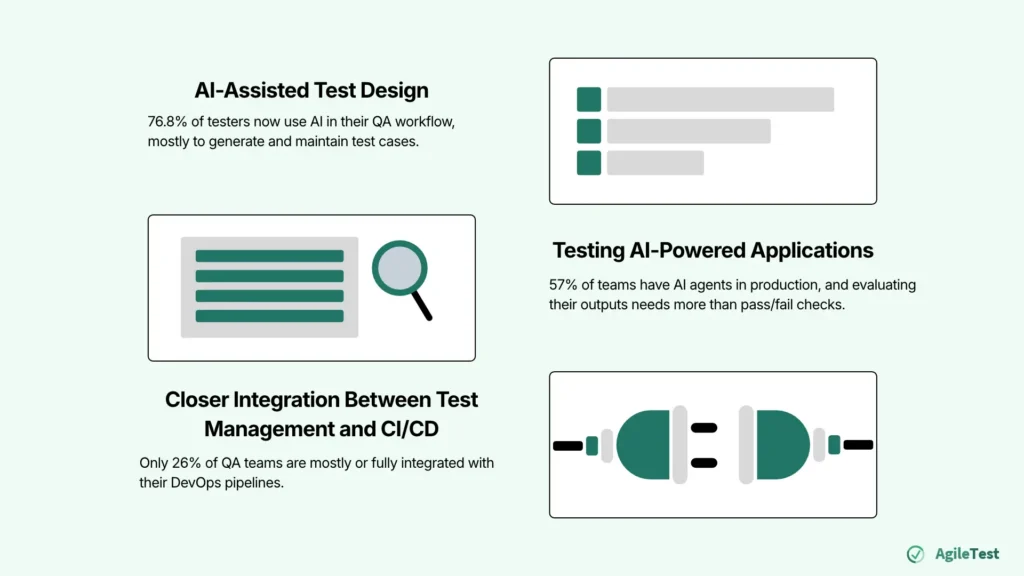
Three developments stand out in 2026: AI is changing how testers design and analyze tests, AI-powered applications are introducing new testing challenges, and CI/CD integration is bringing testing closer to software delivery.
AI-Assisted Test Design
AI has become a practical tool in everyday testing workflows. QA teams use it to generate test cases from requirements, create automation scripts, identify coverage gaps, and analyze execution failures.
PractiTest’s 2026 State of Testing report found that 76.8% of respondents use AI in their QA workflow. TestRail’s Fourth Edition Software Testing & Quality Report found that 54% of QA professionals use ChatGPT, while 23% use GitHub Copilot for tasks such as generating test cases, debugging, and writing automation code.
The shift is less about speed than about where effort goes. AI can generate an initial set of test cases in minutes, but those tests still reflect the quality of the requirements they’re based on. As a result, the bottleneck in test design is moving from writing tests to checking whether they test the right things.
Read more: AgileTest Generator: Preparing Test Cases Through AI-Guided Conversations
Testing AI-Powered Applications
As more organizations introduce AI-powered features, testing AI itself has become an important part of quality assurance.
LangChain’s 2026 State of Agent Engineering report found that 57% of respondents had AI agents in production. This introduces a different testing challenge. AI-powered applications can produce different outputs depending on prompts, context, and user interactions. Conventional pass/fail checks alone may not be sufficient to evaluate their behavior.
TestMu AI’s 2026 State of AI in Quality Engineering report highlights how teams are approaching this type of testing. Among teams building AI agents:
- 63% use human review to evaluate agent outputs.
- 41% use LLM-as-a-judge, where one AI model evaluates another’s responses.
- 35% test long, multi-turn conversations.
These practices reflect the growing scope of AI testing, covering conversational AI, autonomous agents, and applications that interact with users through text and voice.
Read more: The Two Sides of AI Quality: Testing AI Agents and Using AI to Improve Testing
Closer Integration Between Test Management and CI/CD
CI/CD has become a standard part of modern software delivery. JetBrains’ 2026 Developer Ecosystem Survey found that 83.4% of developers run CI/CD pipelines. As automated builds and deployments become more common, testing needs to be integrated into these workflows to provide faster feedback on code changes.
Test management systems also play a role in connecting automated test results with test cases, executions, and defects. This gives teams a broader view of test coverage, execution history, and release readiness.
In practice, this means a failed pipeline run should point to a specific test case, the requirement it covers, and any linked defect. Then, team can see what broke and what it affects without searching across tools.
3. What Is Holding QA Teams Back?
Despite advances in AI and automation, many QA teams still struggle to keep pace with software development. Growing testing demands, disconnected tools, and limited quality visibility make it harder to maintain consistent testing processes and assess release readiness.
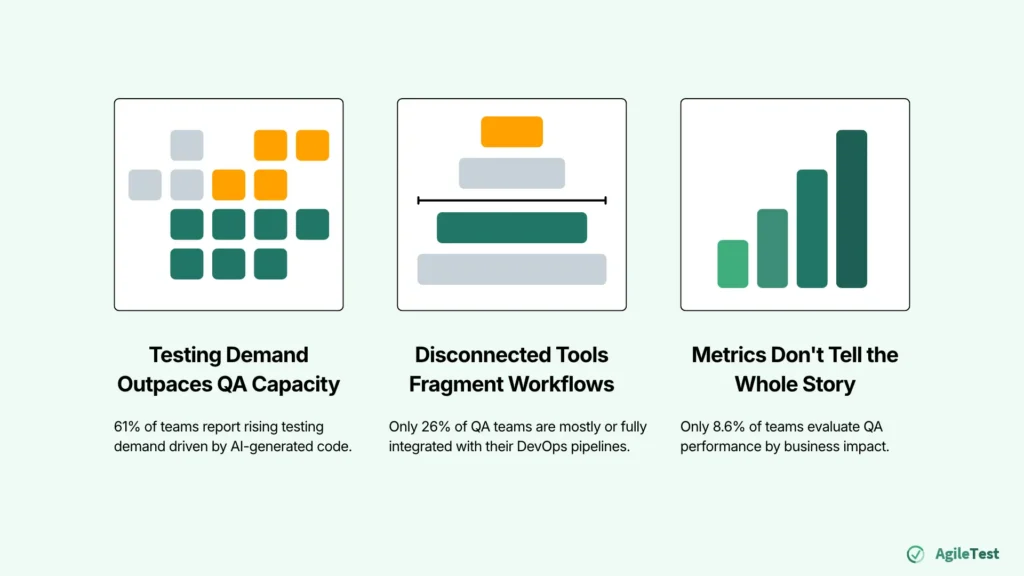
Testing Demand Is Growing Faster Than QA Capacity
AI-assisted development allows teams to produce code faster, but testing capacity does not always grow at the same pace. More code means more scenarios to validate, more regression tests to maintain, and more potential defects to investigate.
The 2026 Sembi Software Quality Pulse Report found that 61% of respondents reported moderate to dramatic increases in QA testing demand due to AI-generated code.
Similarly, SmartBear’s 2026 State of Software Quality and Testing report found that 55% of respondents experienced application quality issues in the past year because development was moving faster than testing could keep up.
This creates pressure on QA teams to expand test coverage and shorten feedback cycles while maintaining testing quality.
Related reading: AI for Regression Testing: Challenges, Benefits, and What’s Next
Disconnected Tools Make Testing Workflows Harder to Manage
Modern testing involves multiple activities, from managing requirements and test cases to executing automated tests and tracking defects. When these activities happen across disconnected tools, teams can struggle to maintain traceability and get a complete picture of testing progress.
The 2026 Sembi Software Quality Pulse Report found that only 26% of QA teams reported being mostly or fully integrated with their DevOps pipelines.
Limited integration can lead to duplicated work, delayed feedback, and gaps in visibility between development and testing. As teams adopt more automation and AI-assisted testing, connecting these workflows becomes increasingly important.
QA Metrics Don’t Always Reflect Actual Software Quality
Many QA teams collect large amounts of testing data, but the metrics they track don’t always explain the overall quality of a product or its readiness for release.
PractiTest’s 2026 State of Testing report found that 56.4% of teams use test coverage as a performance metric, while 40.1% track automation coverage. In comparison, only 8.6% evaluate their teams based on business impact.
Coverage and pass rates show how much testing was done. Pair them with indicators of what’s still at risk, such as open critical defects, untested high-risk requirements, and failures in core user workflows.
4. Priorities QA Teams Should Prepare for In 2027
The developments and challenges discussed above point to three priorities for QA teams in 2027: establishing governance for AI-generated tests, improving quality reporting, and developing stronger evaluation and test strategy skills.
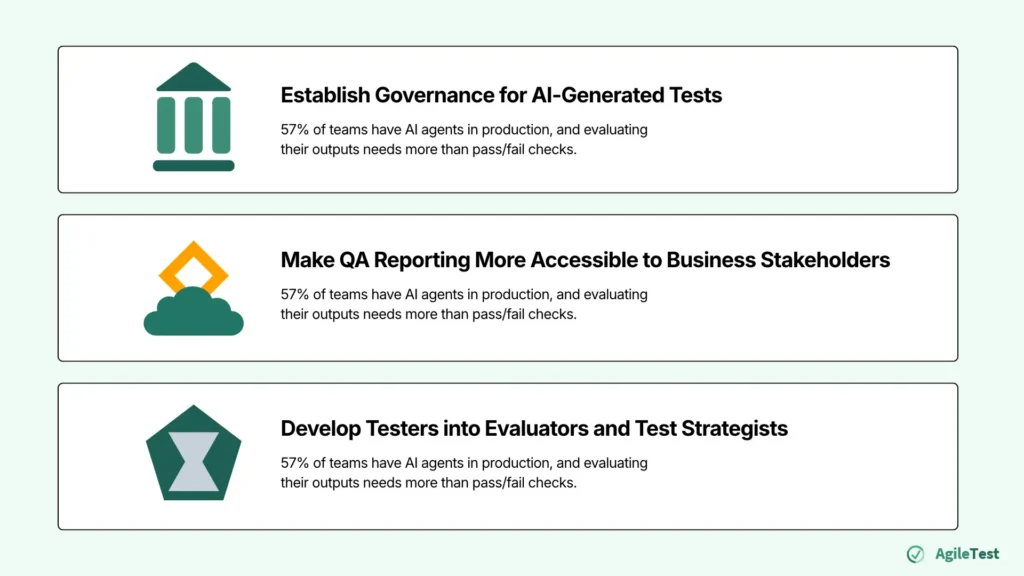
Establish Governance for AI-Generated Tests
As AI becomes more involved in test creation, teams need clear processes to manage generated test cases.
QA teams can start by:
- Defining review responsibilities: Assign owners to review and approve AI-generated test cases before adding them to the test repository.
- Establishing validation criteria: Check whether generated scenarios reflect requirements, cover relevant edge cases, and include accurate expected results.
- Maintaining traceability: Link generated test cases to their source requirements, owners, and execution results.
- Reviewing test repositories regularly: Identify outdated, duplicated, or irrelevant test cases and keep the repository up to date.
These practices help teams maintain test quality and accountability as AI-generated content becomes more common.
Make QA Reporting More Accessible to Business Stakeholders
QA reports should communicate more than execution progress and pass rates. They should help stakeholders understand product quality, unresolved risks, and release readiness.
Teams can improve their reporting by:
- Selecting meaningful metrics: Track test coverage, pass rates, critical defects, unresolved issues, and testing progress.
- Connecting metrics to business impact: Explain how failed tests or unresolved defects affect critical features and user workflows.
- Creating audience-specific reports: Provide detailed execution results for QA engineers and high-level quality summaries for managers and stakeholders.
- Highlighting release risks: Clearly identify outstanding issues that could affect release decisions.
The goal is to turn testing data into information that supports better decisions across the organization.
Develop Testers into Evaluators and Test Strategists
As AI and automation take on more routine testing activities, testers need to develop skills beyond manual test execution.
QA teams can prepare by focusing on three areas:
- AI evaluation: Train testers to assess AI-generated outputs, validate generated test scenarios, and evaluate AI-powered application behavior.
- Risk-based testing: Develop the ability to identify high-risk areas, prioritize test coverage, and select appropriate testing methods based on potential impact.
- Strategic thinking and communication: Help testers interpret testing results, communicate quality risks, and contribute to testing and release decisions.
Investing in these skills will help QA professionals take greater responsibility for evaluating software quality and guiding testing strategies.
FAQs
1. Will AI Replace Manual Software Testing?
AI is expected to automate more repetitive testing activities, such as test case generation, script creation, and test execution. However, manual testing remains important for exploratory testing, usability evaluation, and scenarios that require human judgment. Rather than replacing testers, AI is changing how they spend their time.
2. How Will AI Agents Change Software Testing?
AI agents introduce testing scenarios that go beyond checking individual responses. QA teams need to evaluate how agents interpret instructions, select tools, perform actions, handle unexpected situations, and complete multi-step tasks. This requires testing both individual interactions and the overall task execution process.
3. Will Shift-Left Testing Remain Important in 2027?
Yes. Identifying defects earlier in development helps reduce the cost and effort of fixing them later. However, shift-left testing alone is not enough. Teams also need continuous testing throughout the delivery pipeline and monitoring after release to understand how software behaves in production.
4. Why Is Production Monitoring Becoming Part of Software Quality Assurance?
Testing before release cannot cover every real-world condition. Production monitoring helps teams identify unexpected behavior, performance issues, and defects that emerge after deployment. Combining production insights with testing results helps QA teams improve future test coverage and identify recurring problems.
5. How Is the Role of Quality Engineering Different from Traditional QA?
Traditional QA often focuses on verifying whether software meets predefined requirements. Quality engineering takes a broader approach by integrating quality practices throughout the development lifecycle. It involves test automation, risk management, continuous testing, performance, and collaboration between development and QA teams.
Final Thoughts
Test management is entering a new phase. AI is changing how tests are created and analyzed, AI-powered applications are expanding what QA teams need to evaluate, and CI/CD is bringing testing closer to software delivery.
As 2027 approaches, the focus should be on building a more connected and strategic approach to quality assurance. The goal is not simply to run more tests or automate more activities, but to help teams deliver reliable software with greater confidence.
AgileTest helps QA teams manage their testing activities directly in Jira, from test case management and execution to test planning, reporting, and CI/CD integration. Try it now !
References
Applause. (2026). The State of Digital Quality in Functional Testing 2026. The State of Digital Quality in Functional Testing 2026 Report
JetBrains. (2026). The State of CI/CD in 2026. The State of CI/CD in 2026: Key Findings, Trends, and What They Mean for Your Team – The JetBrains Blog
LangChain. (2026). State of Agent Engineering. State of AI Agents
PractiTest. (2026). The 2026 State of Testing Report. The 2026 State of Testing Report
Sembi. (2026). First Edition Sembi Software Quality Pulse Report. First Edition Sembi Software Quality Pulse Report – Sembi
SmartBear. (2026). The State of Software Quality and Testing 2026.The State of Software Quality and Testing 2026 | SmartBear
TestMu AI. (2026). State of AI in Quality Engineering 2026. State of AI in Quality Engineering 2026 Report | TestMu AI
TestRail. Fourth Edition Software Testing & Quality Report. AI in QA: Insights from the Fourth Edition Software Testing & Quality Report – TestRail