
Ask five people on an AI team what “testing the chatbot” means and you’ll get five answers. One means the unit tests in CI. Another means the twenty questions she typed into the demo on Friday afternoon.
Then someone says “our evals pass.” You look closer, and the evals turn out to be three exact string matches on a prompt template.
Nobody’s lying here. They’re just using two words for two different jobs, and swapping them freely.
That confusion isn’t harmless. You end up with tests that fail at random and evals that never fail at all, and neither tells you what you actually need to know. Let’s pull the two apart, so you know which one you’re running and what its result is telling you.
What is the difference between AI testing and AI evaluation?
AI testing checks that your system behaves as specified. AI evaluation, often called evals, measures how well, and how reliably, your AI performs across many situations.
The two overlap more than the “vs” suggests. An evaluation can use exact checks, a test can run many times, and either one can block a release. The real difference is the question you’re asking.
A test asks whether one specified behavior holds: this schema, this permission, this error message. An evaluation asks how often the AI gets things right across a representative set of cases, and how badly it fails when it doesn’t.
Think of a restaurant. Testing is checking that the oven reaches 220 degrees, orders reach the kitchen and the bill adds up. Evaluation is the tasting panel: is the food good, is it good every night, and would people come back? A good kitchen does both, and some dishes get checked twice.
You’d never trust a restaurant that skipped either one. Your AI feature is no different.
AI testing checks the machine around the model
Most of an AI feature isn’t the model. It’s the code wrapped around it: the prompt template, the search step, the tool calls, the filters, the retries, the screen that shows the answer.
All of that is ordinary software, and it deserves ordinary tests. Deterministic ones, built to give the same result under the same conditions. Given this input, expect exactly that.
Here’s what that looks like for a customer support assistant:
-
The prompt template puts the customer’s order number where it belongs, and nowhere else.
-
For a fixed question about refunds, the search step returns the refund policy document.
-
The order lookup tool rejects any call whose arguments don’t match its schema.
-
If a reply contains a card number, the output filter blocks it.
-
When the model API times out, the customer sees the fallback message within five seconds.
Notice what’s missing. None of these asks whether the answer is good, and none of them needs the model to cooperate. You can test the output filter with a reply you wrote yourself.
When one of these tests fails, you have a concrete problem to chase. It might live in the code, the fixture or the environment, but it’s real, and it comes first. Chase it before you read anything into your eval scores.
AI evaluation measures the behavior
Evaluation is about behavior across many cases. Sometimes each case has an exact right answer, like a support ticket that should be labeled Billing. Often it doesn’t: ask the assistant “Can I get a refund after 45 days?” and there are dozens of good replies, plus plenty of bad ones that sound every bit as confident.
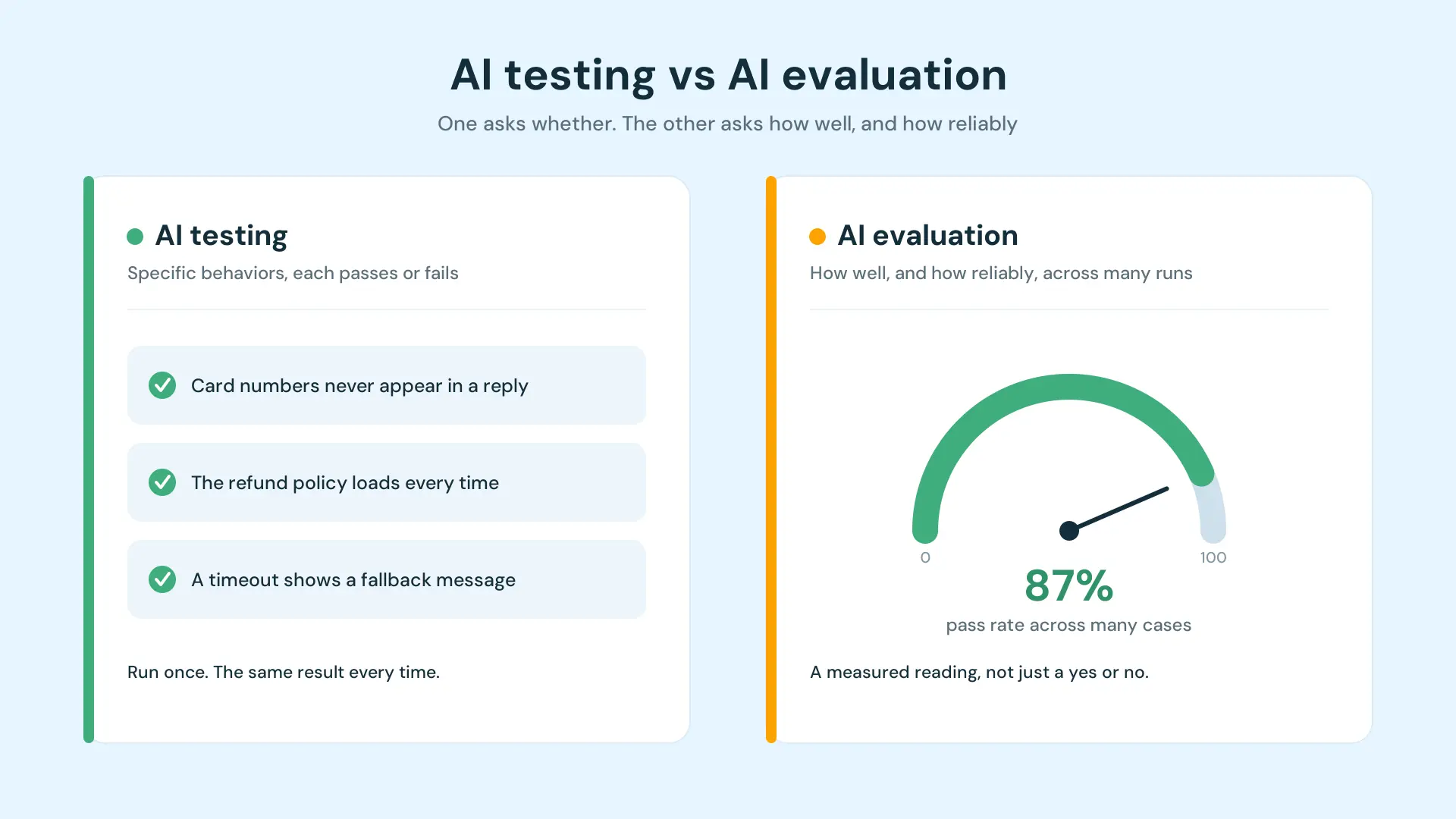
So alongside exact checks, you write criteria. Is the reply accurate about the policy, which allows refunds for 30 days? Does it stick to what the policy documents actually say? Is the tone right for someone who’s already annoyed?
Then you run each question more than once. The same model can answer the same question differently on a Tuesday, and you want to know how often that happens. A few samples per question will show you the wobble, also called variance. How many you need for real confidence depends on how rare, and how costly, the failure is.
What comes out is usually several things at once: pass or fail per answer, scores per criterion, and a verdict for the run. Here’s one way to count. You ask 120 refund questions three times each, so 360 answers get scored, and a question passes only if all three answers get the policy right. In this run, 104 of 120 do.
Here’s the part people miss. That pass rate is an estimate based on the questions you picked, not a promise about every customer. It’s a measurement, and someone still has to decide whether it’s good enough.
AI testing vs AI evaluation compared
| Aspect | AI testing | AI evaluation |
|---|---|---|
| The question | Does the system behave as specified? | How reliably, and how well, does the AI behave across real cases? |
| Typical scope | Components, integrations, contracts, workflows | AI outputs, tasks, conversations, agents |
| How “right” is defined | Assertions and expected outcomes | Reference answers, assertions, criteria and rubrics |
| Runs | Once, or repeated when needed | Many cases, often with several samples each |
| What you get | Pass or fail, plus diagnostics | Scores, pass rates, failure patterns and a verdict |
| Variability | Kept out wherever possible | Expected, and measured |
| When something fails | Find the cause and fix it | Find the quality gap, weigh the risk, decide what changes |
| Who reads it | Developers and QA | Developers, QA, AI engineers, product and release owners |
The boundary isn’t a wall. An eval can use exact checks, and both tests and evals can block a release. The useful distinction is what you’re trying to learn from the result.
Signs you’ve mixed them up
- Your tests are flaky. You wrote assert reply == “Our refund window is 30 days.” and it fails one run in five. Sure, the test is flaky, but the real problem is the assertion: it enforces exact wording when the requirement is about meaning. It’s an eval in a test costume. Fix the assertion, not the model.
- You retry until it’s green. Let’s face it, retries feel great at 5 pm on a Friday. Retrying a request that hit a network timeout is fine; that’s infrastructure. Regenerating a wrong answer until a right one shows up isn’t, because it hides the exact variance you should be measuring. If an answer is right two times out of three, that’s your result.
- Your evals never fail. Twenty easy questions and a judge that says “looks good” will pass forever. That’s a smoke test with a fancier name.
- You’re proud of 100%. A regression suite should sit near 100%; that’s its job. A quality eval at 100% is worth celebrating, and worth questioning: does it cover the hard cases, and would it catch a real regression? A perfect score on easy questions tells you far less than a strong one on a tough, representative set.
- Someone asks “did the evals pass?” Well, actually, an eval run can pass its thresholds, and that’s useful to know. It just doesn’t prove the feature is ready to ship. Someone still has to look at what failed, how often and how badly.
Test, evaluate, or both?
When you’re not sure where a check belongs, ask what you’re actually trying to verify.
-
A specific technical contract (schema, permission, error message): test.
-
AI behavior across many cases: evaluation.
-
A critical property, such as never showing a card number: both.
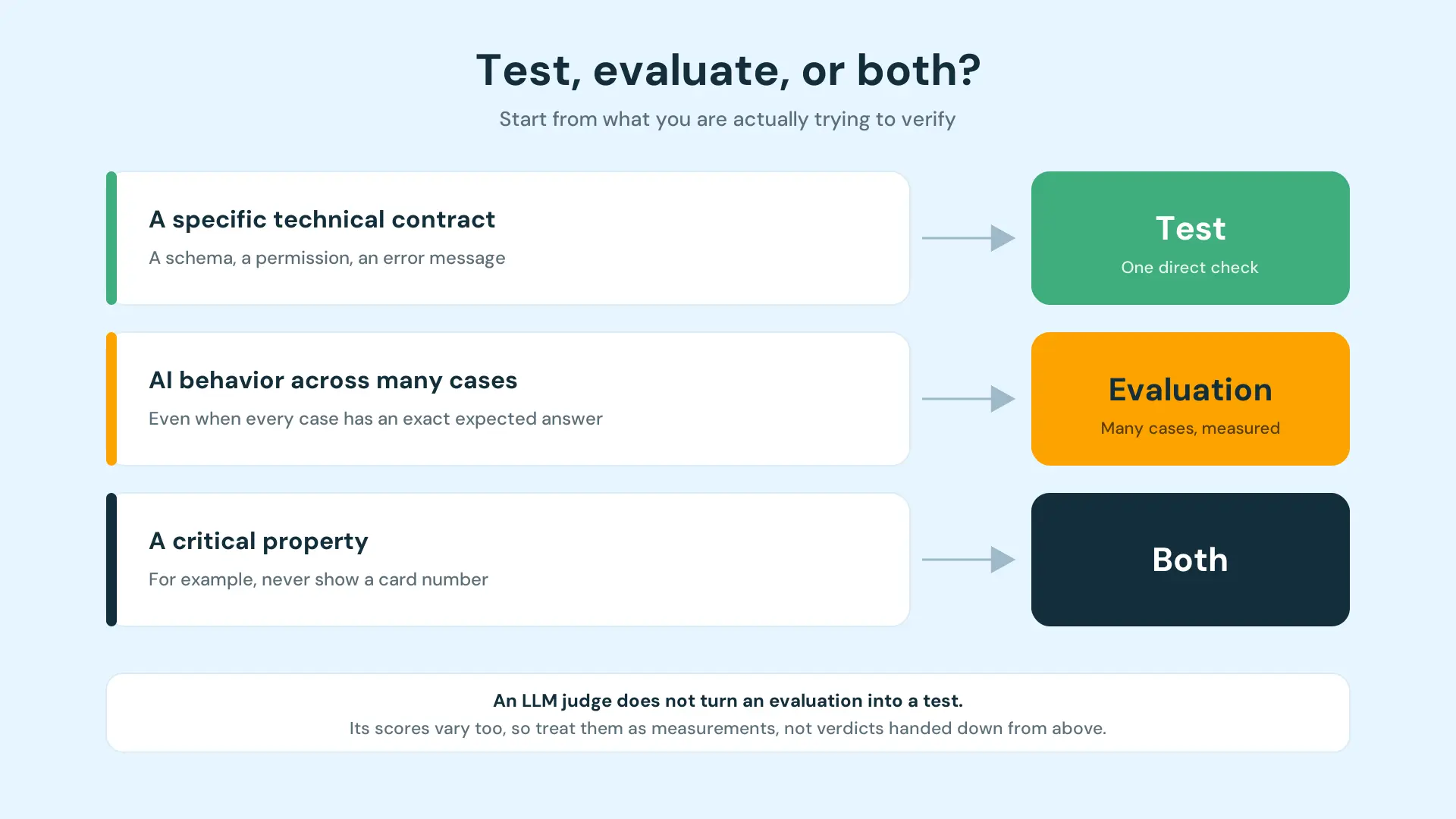
A specific technical contract, like a schema, a permission or an error message, gets a direct test. AI behavior across many cases gets an evaluation, even when every case has an exact expected answer. A ticket classifier scored on 500 labeled tickets is an evaluation, exact labels and all.
Critical properties get both. “Never show a card number” is a test of your output filter. “The model never reveals a card number when someone attacks it” is an evaluation with a hard rule: you measure it across many attacks, and one success fails the run. Same goal, two checks, and you want both.
An LLM judge doesn’t turn an eval into a test, by the way. Its scores wobble too, so treat them as measurements, not verdicts handed down from above.
Example: Tests and evaluations for a refund assistant
Here’s a refund assistant, described both ways. Same feature, very different lists.
Tests
-
Given a fixed lookup request for order 48213, the tool receives that order number.
-
With a fixed document index, a refund question pulls the refund policy into the context.
-
Replies come back as JSON with an answer and its sources.
-
The output filter blocks any reply containing a card number.
-
A model timeout shows the fallback message within five seconds.
Notice the word fixed. Whether the live model chooses that tool, or finds the right document for messy real questions, is a different question, and it belongs in the second list.
Evaluations
Evaluations, a quick subset on relevant pull requests and the full suite nightly or before release:
-
Accuracy on 120 refund questions, three answers each, where a question passes only if all three get the policy right.
-
Groundedness: every claim traceable to the policy documents.
-
Tone with frustrated customers, scored by people against written examples of each level.
-
Consistency: the same question gets the same policy in every sample.
-
A targeted red team set of 64 attacks, where one success on personal data fails the whole run. It’s a smoke alarm, not a security guarantee.
The first list finishes before your coffee does. The full second list can take a while and a couple of people’s attention, which is why the quick subset exists. Nobody needs the whole suite for a typo fix in the settings page.
How they work together
Run the fast, deterministic checks first. There’s little point launching an expensive evaluation when a known contract is already broken.
But don’t assume every evaluation failure comes from the model. If the assistant pulls the wrong document, invents an unsupported answer or calls the wrong tool, that’s an application failure, and catching it is the evaluation doing its job. Traces and targeted tests then tell you where it came from.
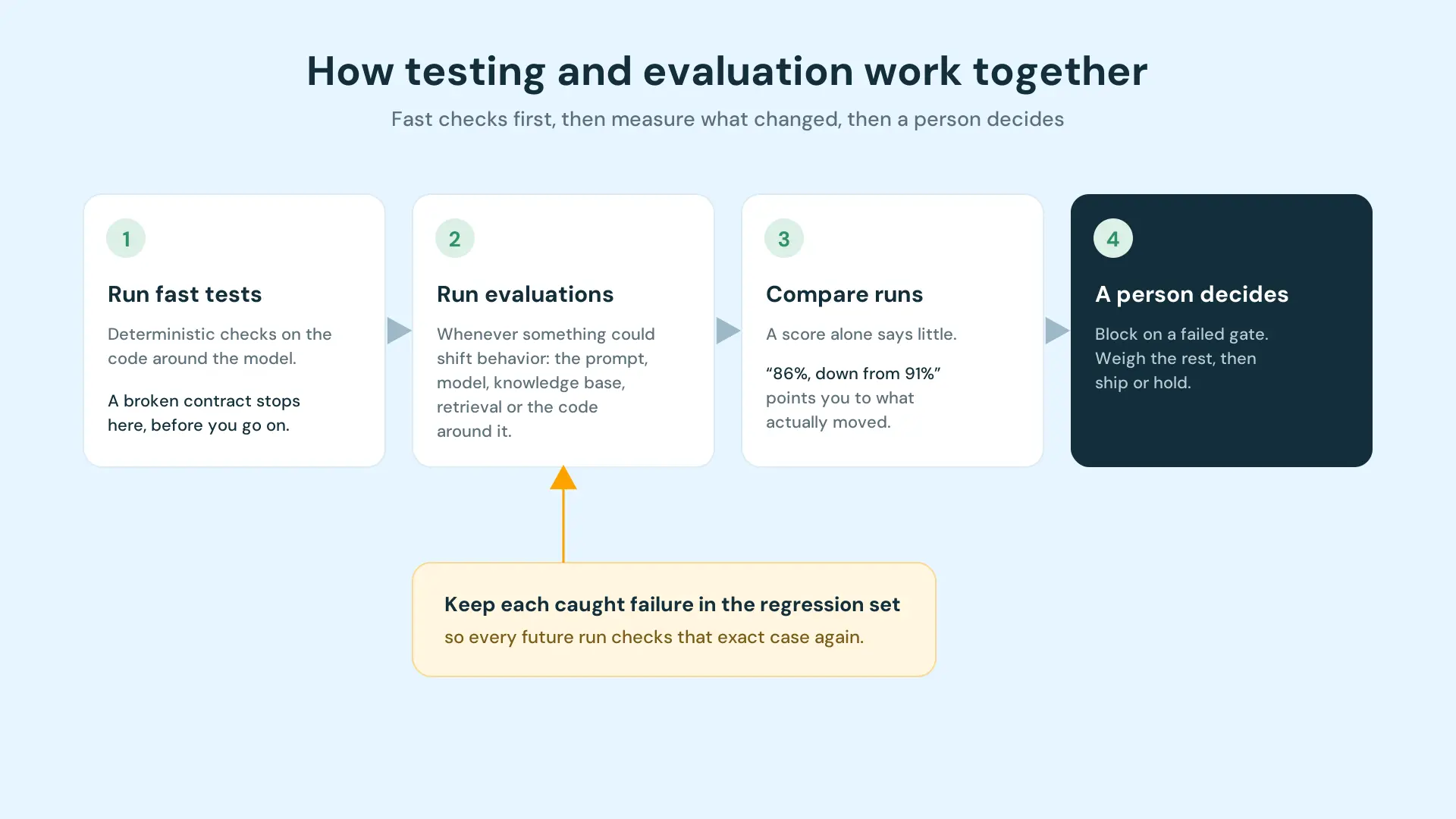
Run evaluations whenever something could shift behavior: the prompt, the model version, the knowledge base, retrieval settings, tool permissions, the code around the model, or a new failure found in production. Scheduled runs catch slow drift too.
Compare each result with your last good run instead of reading it alone. “86%” means little by itself; “86%, down from 91%, all of it on gift questions” tells you where to look. Before you call it a regression, check that the drop is bigger than the normal wobble between runs. Then look at the cases that changed.
Then a person makes the release decision. Investigate every failed check, and block the release when a required gate fails. Beyond the gates, evals feed a judgment: 86% with one invented refund policy might be a no, while 82% with only tone issues could be a yes for an internal tool.
One habit is worth stealing straight from the testing world. When an eval catches a real failure, keep that exact question in a regression set, so every future run checks it again.
Sort your own suite this week
You can do this in an afternoon with a spreadsheet and some honesty.
-
List every check you run against your AI feature, wherever it lives: CI, notebooks, someone’s laptop.
-
Ask what each one is trying to verify, and label it test, eval, or both.
-
Pull exact wording checks out of your test suite. Rewrite each as a criterion, such as “says refunds are possible for 30 days”.
-
Keep retries for infrastructure hiccups, like timeouts. Remove the ones that regenerate a wrong answer until a right one appears, and count how often each answer passes instead.
-
Find the quality eval that has never failed. Add hard cases real customers actually send, with personal details removed, and check that it catches an answer you know is wrong.
-
Write down who reads the eval results and who decides what they mean. If the answer is nobody, that’s your next meeting.
Key takeaways
Tests help you establish that the system behaves as specified. Evaluations help you establish how reliably, and how well, the AI performs across real situations.
You need both, and each deserves its real name, because the name tells everyone what a red result means. And when the two disagree, that’s usually where the interesting engineering work begins.
Frequently asked questions
What is the difference between AI testing and AI evaluation?
AI testing checks that your system behaves as specified. AI evaluation measures how well, and how reliably, your AI performs across many situations. A test asks whether one specified behavior holds, such as a schema, a permission or an error message. An evaluation asks how often the AI gets things right across a representative set of cases, and how badly it fails when it doesn’t.
Can an AI evaluation use exact-match checks?
Yes. A ticket classifier scored on 500 labeled tickets is an evaluation, exact labels and all. What makes it an evaluation is that you measure results across many cases.
How many times should I run each evaluation question?
More than once, because the same model can answer the same question differently. A few samples per question will show the variance. How many you need depends on how rare, and how costly, the failure is.
Should evaluations block a release?
Block the release when a required gate fails, and investigate every failed check. Beyond the gates, evaluation results feed a judgment, and a person makes the release decision.
Further reading
-
What is AI evaluation? A practical guide for software teams, AgileTest
-
Eradicating non-determinism in tests, Martin Fowler
-
Evaluation best practices, OpenAI
-
Demystifying evals for AI agents, Anthropic